answer.
Ask question
Login Signup
Ask question
All categories
  • English
  • Mathematics
  • Social Studies
  • Business
  • History
  • Health
  • Geography
  • Biology
  • Physics
  • Chemistry
  • Computers and Technology
  • Arts
  • World Languages
  • Spanish
  • French
  • German
  • Advanced Placement (AP)
  • SAT
  • Medicine
  • Law
  • Engineering
Ronch
16 days ago
14

Enter the net ionic equation representing solid chromium (iii) hydroxide reacting with nitrous acid. express your answer as a ba

lanced net ionic equation. identify all of the phases in your answer.

Chemistry
2 answers:
Anarel [852]16 days ago
5 0

The net ionic equation for the reaction between chromium (III) hydroxide and nitrous acid is:

Cr(OH)₃ (s) + 3H⁺ (aq) ⇒ Cr³⁺ (aq) + 3H₂O (l)

Additional Details

An electrolyte dissociates into ions in solution.

Chemical equations can also be represented with ionic species.

Strong electrolytes (fully ionized) are written as separate ions, whereas weak electrolytes (partially ionized) remain as intact molecules.

In ionic equations, spectator ions are those unchanged by the chemical process—they are present both before and after the reaction.

Removing these spectators results in the net ionic equation.

Gases, solids, and water (H₂O) are written as molecules, without ionization.

Therefore, only dissolved compounds are represented by their ions (aq).

The problem involves chromium (III) hydroxide reacting with nitrous acid.

The reaction occurring is:

Cr(OH)₃ (s) + 3HNO₂ (aq) ⇒ Cr(NO₂)₃ (aq) + 3H₂O (l)

Chromium (III) hydroxide is a solid and remains un-ionized, as does water.

Thus, the ionic equation is:

Cr(OH)₃ (s) + 3H⁺ (aq) + 3NO₂⁻ (aq) ⇒ Cr³⁺ (aq) + 3NO₂⁻ (aq) + 3H₂O (l)

The ion 3NO₂⁻ is a spectator ion; removing it yields the net ionic equation:

Cr(OH)₃ (s) + 3H⁺ (aq) ⇒ Cr³⁺ (aq) + 3H₂O (l)

alisha [964]16 days ago
3 0

The net ionic equation is \boxed{{\text{Cr}}{{\left( {{\text{OH}}} \right)}_3}\left( s \right)+3{{\text{H}}^+}\left( {aq} \right)\to{\text{C}}{{\text{r}}^{3+}}\left( {aq}\right)+3{{\text{H}}_{\text{2}}}{\text{O}}\left(l\right)}.

Among the substances, {\mathbf{Cr}}{\left( {{\mathbf{OH}}} \right)_{\mathbf{3}}} is in the solid state, {{\mathbf{H}}_{\mathbf{2}}}{\mathbf{O}} is liquid, while {{\mathbf{H}}^{\mathbf{ + }}} and {\mathbf{C}}{{\mathbf{r}}^{{\mathbf{3 + }}}} exist in an aqueous solution.

Explanation:

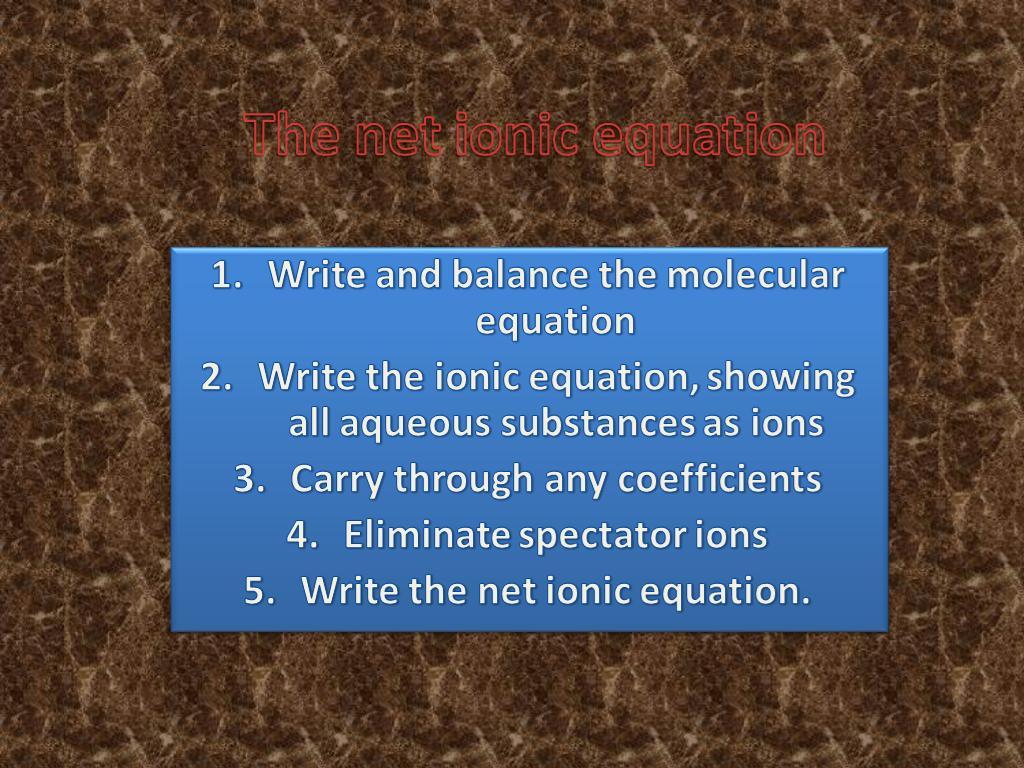
Chemical reactions can be portrayed by three equations:

1. Molecular equation

2. Total ionic equation

3. Net ionic equation

The molecular equation shows reactants and products as unchanged compounds. The total ionic equation displays all dissociated ions present in the reaction mixture. The net ionic equation includes only the ions actively involved in the reaction.

Steps to derive the net ionic equation:

Step 1: Write the balanced molecular equation, indicating phases.

Here, {\text{Cr}}{\left( {{\text{OH}}} \right)_3} reacts with {\text{HN}}{{\text{O}}_2} producing {\text{Cr}}{\left( {{\text{N}}{{\text{O}}_{\text{2}}}} \right)_3} and {{\text{H}}_2}{\text{O}}. The balanced molecular equation is:

{\text{Cr}}{\left( {{\text{OH}}} \right)_3}\left( s \right) + {\text{3HN}}{{\text{O}}_2}\left( {aq} \right) \to {\text{Cr}}{\left( {{\text{N}}{{\text{O}}_2}} \right)_3}\left( {aq} \right) + {\text{3}}{{\text{H}}_2}{\text{O}}\left( l \right)

Step 2: Break apart all aqueous compounds into ions to form the total ionic equation. Compounds in liquids or solids remain unchanged. Example total ionic equation:

{\text{Cr}}{\left( {{\text{OH}}} \right)_3}\left( s \right) + {\text{3}}{{\text{H}}^ + }\left( {aq} \right) + {\text{3NO}}_2^ - \left( {aq} \right) \to 3{\text{C}}{{\text{r}}^{3 + }}\left( {aq} \right) + {\text{3NO}}_2^ - \left( {aq} \right) + {\text{3}}{{\text{H}}_2}{\text{O}}\left( l \right)

Step 3: Cancel out ions that appear unchanged on both sides to obtain the net ionic equation:

{\text{Cr}}{\left( {{\text{OH}}} \right)_3}\left( s \right) + {\text{3}}{{\text{H}}^ + }\left( {aq} \right) + \boxed{{\text{3NO}}_2^ - \left( {aq} \right)} \to 3{\text{C}}{{\text{r}}^{3 + }}\left( {aq} \right) + \boxed{{\text{3NO}}_2^ - \left( {aq} \right)} + {\text{3}}{{\text{H}}_2}{\text{O}}\left( l \right)

Thus, the net ionic equation is:

{\text{Cr}}{\left( {{\text{OH}}} \right)_3}\left( s \right) + {\text{3}}{{\text{H}}^ + }\left( {aq} \right) \to 3{\text{C}}{{\text{r}}^{3 + }}\left( {aq} \right) + {\text{3}}{{\text{H}}_2}{\text{O}}\left( l \right)

Note: {\mathbf{Cr}}{\left( {{\mathbf{OH}}} \right)_{\mathbf{3}}} is solid, {{\mathbf{H}}_{\mathbf{2}}}{\mathbf{O}} is liquid, and {{\mathbf{H}}^{\mathbf{ + }}} and {\mathbf{C}}{{\mathbf{r}}^{{\mathbf{3 + }}}} are aqueous.

You might be interested in
Now that Snape and Dumbledore has taught you the finer points of hydration calculations they have a slightly more challenging pr
eduard [944]

Answer:

The integer value of x in the hydrate is 10.

Explanation:

Molarity=\frac{Moles}{Volume(L)}

Molar concentration of the solution = 0.0366 M

Volume of the solution = 5.00 L

Moles of hydrated sodium carbonate = n

0.0366 M=\frac{n}{5.00 L}

n=0.0366 M\times 5 mol=0.183 mol

Weight of hydrated sodium carbonate = n = 52.2 g

Molar mass of hydrated sodium carbonate = 106 g/mol + x * 18 g/mol

n=\frac{\text{mass of Compound}}{\text{molar mass of compound}}

0.183 mol=\frac{52.2 g}{106 g/mol+x\times 18 g/mol}

106 g/mol+x\times 18 g/mol=\frac{52.2 g}{0.183 mol}

By solving for x, we arrive at:

x = 9.95, approximating to 10

The integer x in the hydrate equals 10.

6 0
16 hours ago
1. Bailey wants to find out which frozen solid melts the fastest: soda, gatorade, or orange juice. She pours each of the three l
VMariaS [1037]

First scenario:

IV: soda, gatorade, orange juice, and water

DV: state of the liquids listed above

Control: freezer and ice tray

Second scenario:

IV: laundry detergent, water

DV: cleanliness of the squares post-wash

Control: chocolate, cloth type, cloth squares

Third scenario:

IV: type of water used, pea plant

DV: growth of the pea plant

Control: pots and daily water amount for the plant

4 0
10 days ago
Read 2 more answers
A chamber with a fixed volume is shown above. The temperature of the gas inside the chamber before heating is 25.2 C and it’s pr
KiRa [976]

Answer:

Explanation:

Given data:

Initial temperature T₁ = 25.2°C = 298.2K

Initial pressure P₁ = 0.6atm

Final temperature = 72.4°C = 345.4K

What we need to find:

Final pressure = ?

To determine this, we apply a modified version of the combined gas law with constant volume. This simplifies our calculations to:

\frac{P_{1} }{T_{1} }   = \frac{P_{2} }{T_{2} }

Here, P and T signify pressure and temperatures, 1 refers to initial and 2 to final temperatures.

Now we can substitute the known variables:

\frac{0.6}{298.2}   = \frac{P_{2} }{345.4}

P₂ = 0.7atm

3 0
14 days ago
Select all the element(s) from the periodic table shown that will form an ionic compound with a metal M and a nonmetal X and a f
VMariaS [1037]

Response:

Sulfate- SO4^2-

Sulfite- SO3^2-

Permanganate- MnO4

Carbonate- CO3^2

Clarification:

KEEP GOING WITH YOUR STUDIES!

4 0
3 days ago
A 0.0200 M NaCl solution was formed when 38.0 grams of NaCl was dissolved in enough water. What was the total volume of the solu
Tems11 [854]

Start by determining the number of moles, which is obtained by dividing 38 grams by the molar mass of 58.43 g/mol. This calculation yields 0.65 moles. The concentration is calculated by dividing the number of moles by the volume in liters. Using this formula, we can derive the total volume by dividing the number of moles by the concentration. Thus, 0.65 moles divided by 0.02M (mol/L) results in a total volume of 32.5 L.

4 0
3 days ago
Read 2 more answers
Other questions:
  • Hydrogen has three isotopes with mass numbers of 1, 2, and 3 and has an average atomic mass of 1.00794 amu. This information ind
    10·2 answers
  • At what temperature would the volume of a gas be 0.550 L if it had a volume of 0.432 L at –20.0 o C?
    8·2 answers
  • Infrared spectroscopy is a useful tool for scientists who want to investigate the structure of certain molecules. Which of the f
    12·1 answer
  • Why do you think sodium bicarbonate is included to neutralize an acidic spill rather than sodium hydroxide?
    12·1 answer
  • Butane (c4h10) undergoes combustion in excess oxygen to generate gaseous carbon dioxide and water. given δh°f[c4h10(g)] = –124.7
    11·1 answer
  • In the mass spectrum of the molecule phenol, C6H5OH, the approximate intensity of the peak at m/z 95, relative to the molecular
    9·1 answer
  • The next 3 questions will walk you through using the Henderson-Hasselbalch equation for the following question. For each step pr
    11·1 answer
  • What is the molarity of a solution of 14.0 g NH4Br in enough H2O to make 150 mL of solution?
    5·2 answers
  • Question 1: Which of the following statement is false about conjugated systems?
    7·1 answer
  • When drawing the Lewis structure for a molecule, after drawing the skeletal structure and distributing all of the electrons arou
    14·1 answer
Add answer
Login
Not registered? Fast signup
Signup
Login Signup
Ask question!