answer.
Ask question
Login Signup
Ask question
All categories
  • English
  • Mathematics
  • Social Studies
  • Business
  • History
  • Health
  • Geography
  • Biology
  • Physics
  • Chemistry
  • Computers and Technology
  • Arts
  • World Languages
  • Spanish
  • French
  • German
  • Advanced Placement (AP)
  • SAT
  • Medicine
  • Law
  • Engineering
blondinia
2 months ago
15

A resultant vector is 8.00 units long and makes an angle of 43.0 degrees measured ������� – ��������� with respect to the positi

ve � − ����. What are the magnitude and angle (measured ������� – ��������� with respect to the positive � − ����) of the equilibrant vector? Please show all steps in your calculations

Physics
1 answer:
Maru [3.3K]2 months ago
4 0

Answer:

223 degrees

Explanation:

We have the following information:

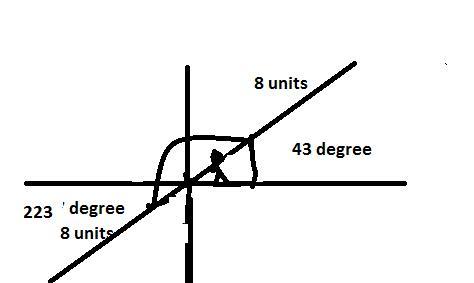
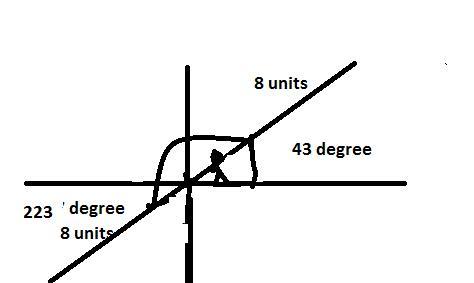
Magnitude of the resultant vector = 8 units

The resultant vector makes a counterclockwise angle with the positive x-axis

\theta=43^{\circ}

Our goal is to determine the magnitude and angle of the equilibriant vector.

We understand that the equilibrium vector has the same magnitude but is oriented in the opposite direction of the given vector.

Thus, the equilibrium vector's magnitude = 8 units

x-component of a vector=v_x=vcos\theta

Where v = Magnitude of vector

Using the formula:

x-component of the resultant vector=v_x=8cos43=5.85

y-component of the resultant vector=v_y=vsin\theta=8sin43=5.46

x-component of the equilibrium vector=v_x=-5.85

y-component of the equilibrium vector=-v_y=-5.46

Because the equilibrium vector lies in the third quadrant

\theta=tan^{-1}(\frac{v_x}{v_y})=tan^{-1}(\frac{-5.46}{-5.85})=43^{\circ}

The angle \theta' is in the third quadrant

In the third quadrant, the angle =\theta'+180^{\circ}

The angle of the equilibrium vector measured from the positive x-axis in a counterclockwise direction is 180+43=223 degrees

You might be interested in
A student wants to determine the coefficient of static friction μ between a block of wood and an adjustable inclined plane. Of t
serg [3582]

Response:

A protractor to gauge the angle between the inclined plane and the horizontal

Explanation:

The student must elevate the free end of the adjustable inclined plane until the object just begins to slide and record the angle at that precise moment. At this juncture, the frictional force is balanced by the weight component aligned with the incline. That is:

f=\mu\,* N = \mu * m g\, cos(\theta)

and  w_{//}= m\,g\,sin(\theta)

Consequently, the coefficient of static friction can be entirely established by calculating the tangent of the angle formed by the incline with the horizontal.

f = w_{//}\\\mu *\,m \,g\,cos(\theta) = m\,g\,sin(\theta)\\\mu = tan(\theta)

For this, the sole additional tool needed is a protractor for angle measurement.

7 0
1 month ago
Question 1
Keith_Richards [3271]

Answer:

1)  g = 4π² / m, 3) on the x-axis we have the pendulum lengths, while the y-axis shows the squared periods.

Explanation:

a) learners can model this system as a simple pendulum, where the angular velocity is given by

         w = √ g / l

Here, angular velocity, frequency, and period are interconnected:

         w = 2π f = 2π / T

Substituting yields:

         T = 2π√ l / g

Using this formula, students can calculate the gravitational acceleration by measuring the period for several pendulum lengths and plotting:

        T² = 4π²  l / g

We plot T² against l.

This represents a linear equation where T² is on the y-axis and l is on the x-axis:

        y = (4π² / g) l

The slope is given by:

         m = 4π² / g

Solving for g gives:

         g = 4π² / m

The slope is determined from the line's values rather than experimental data.

2) To perform the experiment, the string is secured to the sphere, then the pendulum length from the pivot to the sphere's center is measured using a tape measure. A slight angle (less than 10 degrees) is released, allowing the first swing to occur. Generally, the time for several oscillations, usually 10 or 20, is tracked to find the period:

    T = t / n

Next, a table is created comparing T² to the length, plotted with length on the x-axis to find the slope, from which the gravitational acceleration is derived.

3) The independent variable, which is the length of the pendulums, is plotted on the x-axis, while the dependent variable, the squared period, is on the y-axis.

4) Referring to the line equation:

            m = 4π² / g

             resulting in:

            g = 4π² / m

5) Once the spring is cut, the sphere continues to be influenced by gravitational acceleration. The harmonic motion ceases, and the sphere moves vertically.
5 0
2 months ago
Suppose you are designing an amplifier and loudspeaker system to use at a rock concert. You want to make it as loud as possible.
Softa [3030]
The response is outlined below. Audio power amplifiers are present in various sound systems, including those for sound reinforcement, public addresses, home audio, and musical instrument amplifiers like those for guitars. This component is the final electronic element in the audio playback chain before signals reach the loudspeaker. To achieve the loudest possible sound, it is essential to maximize output while maintaining high input and low output impedance.
4 0
1 month ago
A metal object with a mass of 19g is heated to 96c, then transferred to a calorimeter containg 75g of water at 18c. the water an
Yuliya22 [3333]

Let Cp represent the specific heat of the metal object. To find this, we can set up a heat balance equation (heat lost by metal = heat gained by water):

- 19g * Cp * (22degC – 96degC) = 75g * 4.184J/g degC * (22degC - 18degC)

<span>Cp = 0.893 J/g degC</span>

6 0
2 months ago
Read 2 more answers
Help asap please!! An aluminum block of mass 12.00 kg is heated from 20 C to 118 C. If the specific heat of aluminum is 913 J-1
Sav [3153]
Q = mCΔT, in which Q = energy required, m = mass of the block, C = specific heat, ΔT = temperature change.

Utilizing the values provided;

Q = 12*913*(118-20) = 1073688 J = 1073.688 kJ.

The correct option is B.
7 0
2 months ago
Other questions:
  • The figure above represents a stick of uniform density that is attached to a pivot at the right end and has equally spaced marks
    13·1 answer
  • Three equal negative point charges are placed at three of the corners of a square of side d. What is the magnitude of the net el
    9·2 answers
  • The model of the atom has changed as scientists have gathered new evidence. Four models of the atom are shown below, but one imp
    11·2 answers
  • You should have observed that there are some frequencies where the output is stronger than the input. Discuss how that is even p
    15·1 answer
  • Heat is allowed to flow from the heat source of a heat engine at 425 K to a cold sink at 313 K. What is the efficiency of the he
    11·2 answers
  • A sinusoidal electromagnetic wave of frequency 6.10×10¹⁴hz travels in vacuum in the +x direction. the magnetic field is parallel
    7·1 answer
  • A company designed and sells an ultrasonic​ receiver, which detects sounds unable to be heard by the human ear. The receiver can
    11·1 answer
  • A car traveling at 91.0 km/h approaches the turn off for a restaurant 30.0 m ahead. If the driver slams on the brakes with the a
    15·1 answer
  • What is the energy equivalent of an object with a mass of 2.5 kg? 5.5 × 10⁸ J 7.5 × 10⁸ J 3.6 × 10¹⁶ J 2.25 × 10¹⁷ J
    9·2 answers
  • The hot glowing surfaces of stars emit energy in the form of electromagnetic radiation. It is a good approximation to assume tha
    8·1 answer
Add answer
Login
Not registered? Fast signup
Signup
Login Signup
Ask question!
