answer.
Ask question
Login Signup
Ask question
All categories
  • English
  • Mathematics
  • Social Studies
  • Business
  • History
  • Health
  • Geography
  • Biology
  • Physics
  • Chemistry
  • Computers and Technology
  • Arts
  • World Languages
  • Spanish
  • French
  • German
  • Advanced Placement (AP)
  • SAT
  • Medicine
  • Law
  • Engineering
iren2701
2 months ago
12

A jogger accelerates from rest to 3.0 m/s in 2.0 s. A car accelerates from 38.0 to 41.0 m/s also in 2.0 s. (a) Find the accelera

tion (magnitude only) of the jogger, (b) Determine the acceleration (magnitude only) of the car. (c) Does the car travel farther than the jogger during the 2.0 s? If so, how much farther?
Physics
1 answer:
Sav [3.1K]2 months ago
4 0

Answer:

a) The jogger's acceleration is 1.5 m/s²

b) The car's acceleration is also 1.5 m/s²

c) Yes, the car covers a distance 76 m greater than the jogger.

Explanation:

a) Acceleration is the change in velocity over a given time interval:

a = (final velocity - initial velocity) / time

For the jogger:

a = (3.0 m/s - 0 m/s) / 2.0 s = 1.5 m/s²

b) For the car:

a = (41.0 m/s - 38.0 m/s) / 2.0 s = 1.5 m/s²

c) To find how far the car has traveled after 2 seconds, use the formula for position under acceleration along a straight path:

x = x₀ + v₀ t + ½ a t²

where

x = position at time t

x₀ = initial position

v₀ = initial velocity

t = elapsed time

a = acceleration

Assuming x₀ = 0 (origin at car's starting point):

x = 38.0 m/s × 2 s + ½ × 1.5 m/s² × (2.0 s)²

x = 79 m

Similarly, position of the jogger after 2 seconds is:

x = 0 m/s × 2 s + ½ × 1.5 m/s² × (2.0 s)² = 3 m

The difference traveled by the car compared to the jogger is 79 m - 3 m = 76 m

You might be interested in
How many electrons must be removed from a neutral, isolated conducting sphere to give it a positive charge of 8.0 x 10 8 C? [Q=n
inna [3103]

The new charge of the ball will amount to 8x10^8C after removing 5x10^27 electrons.

Explanation:

Initially, if the sphere is electrically neutral, its charge stands at 0C.

When an electron with a charge of (-1.6*10^-19 C) is taken away, we effectively add a positive charge, leading to:

1.6*10^-19 C as the sphere's new charge.

For a total of N electrons removed, the sphere's overall charge now becomes:

N*1.6*10^-19 C.

To calculate N when:

N*1.6*10^-19 C = 8.0x 10^8 C.

We find that N is: (8.0/1.6)x10^(8 + 19) = 5x10^27 electrons.

7 0
1 month ago
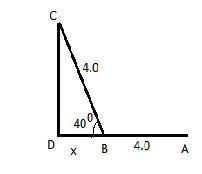
A wildlife researcher is tracking a flock of geese. The geese fly 4.0 km due west, then turn toward the north by 40° and fly ano
serg [3582]

Answer:

(a). The distance traveled is 7.06 km towards the west.

(b). Their displacement magnitude is 7.51 km.

Explanation:

The information given states that,

The geese initially move 4.0 km directly west, then alter course to the north at a 40° angle, covering an additional 4.0 km.

Based on the diagram,

(a). To determine the distance

We will apply the distance formula

AD=AB+BD

Insert the values into the equation

D= 4+4.0\cos40^{\circ}

D=7.06\ km

The resultant distance is 7.06 km westward.

(b). We will find the total displacement's magnitude

Using the displacement formula

AC=\sqrt{(CD)^2+(AD)^2}

Insert the values into the equation

AC=\sqrt{(4.0\sin40)^2+(7.06)^2}

AC=7.51

The total displacement magnitude is 7.51 km.

In conclusion, (a). The traveled distance is 7.06 km towards the west.

(b). The magnitude of their total displacement is 7.51 km.

7 0
1 month ago
A 5.8 × 10⁴-watt elevator motor can lift a total weight of 2.1 × 10⁴ newtons with a maximum constant speed of
Keith_Richards [3271]
Power is defined as the speed at which work is performed on an object. Like all rates, power is measured in relation to time. It reflects how quickly a task is completed. Two identical tasks can be executed at varying speeds - one slower and the other faster. The equation P = Fv can be used, where P symbolizes power, F denotes force, and V represents average velocity. Calculating the average velocity gives us V = P/F, or V = (5.8 x 10^4 W) / (2.1 x 10^4 N), resulting in V = 2.8 m/s.
8 0
1 month ago
A rocket takes off vertically from the launch pad with no initial velocity but a constant upward acceleration of 2.25 m/s^2. At
kicyunya [3294]

Answer:

A) 328 m

B) 80.22 m/s

C) 8.18 sec

Explanation:

A)

The rocket's initial acceleration is 2.25 m/s²

Time until engine failure is 15.4 s

Initial velocity u during takeoff = 0 m/s

Distance covered while the engine is functional =?

We apply Newton's laws for this calculation

S = ut + \frac{1}{2}at^{2}

Here, S represents the distance traveled under the rocket's thrust

S = (0 x 15.4) + \frac{1}{2}(2.25 x 15.4^{2})

S = 0 + 266.81 m = 266.81 m

Before the engine fails, the final velocity can be found using:

v = u + at

v = 0 + (2.25 x 15.4) = 34.65 m/s

Once the engine fails, the rocket decelerates under gravitational pull at g = -9.81 m/s²  (acting downwards)

The upward initial velocity when freefall begins is v = 34.65 m/s

The final velocity is reached at peak height, where the rocket halts, therefore:

u = 0 m/s

The distance covered during this freefall will be s =?

Utilizing the equation

v^{2} = u^{2} + 2gs

0^{2} = 34.65^{2} + 2(-9.81 x s)

0 = 1200.6 - 19.62s

-1200.6 = -19.62s

s = -1200.6/-19.62 = 61.19 m

Thus,

Maximum Height = 266.81 m  + 61.19 m =  328 m

B)

At maximum height, the rocket’s initial upward velocity drops to 0 m/s (the rocket completely stops)

The descent occurs freely under g = 9.81 m/s² (acting downwards)

The distance covered during the fall will be 328 m

Final velocity v just prior to impact =?

Applying v^{2} = u^{2} + 2gs

v^{2} = 0^{2} + 2(9.81 x 328)

v^{2} = 0 + 6435.36

v = \sqrt{6435.36} = 80.22 m/s

The time taken before reaching the pad is found as follows

v = u + gt

80.22 = 0 + 9.81t

t = 80.22/9.81 = 8.18 sec

7 0
1 month ago
A metal object with a mass of 19g is heated to 96c, then transferred to a calorimeter containg 75g of water at 18c. the water an
Yuliya22 [3333]

Let Cp represent the specific heat of the metal object. To find this, we can set up a heat balance equation (heat lost by metal = heat gained by water):

- 19g * Cp * (22degC – 96degC) = 75g * 4.184J/g degC * (22degC - 18degC)

<span>Cp = 0.893 J/g degC</span>

6 0
1 month ago
Read 2 more answers
Other questions:
  • A large crate with mass m rests on a horizontal floor. The static and kinetic coefficients of friction between the crate and the
    5·2 answers
  • A shell is launched with a velocity of 100 m/s at an angle of 30.0° above horizontal from a point on a cliff 50.0 m above a leve
    13·1 answer
  • 4. A cylindrical tube has a length of 14.4cm and a radius of 1.5cm and is filled with a colorless gas. If the density of the gas
    12·1 answer
  • An ant travels 2.78 cm [W] and then turns and travels 6.25 cm [S 40 degrees E]. What is the ant's total displacement?
    14·1 answer
  • What is the total energy released when 9.11 x10^-31 ki?
    7·1 answer
  • An organ pipe open at both ends has a radius of 4.0 cm and a length of 6.0 m. what is the frequency (in hz) of the third harmoni
    14·1 answer
  • A 3.50-meter length of wire with a cross-sectional area of 3.14 × 10⁻⁶ meter2 is at 20° Celsius. If the wire has a resistance of
    11·1 answer
  • A glass beaker of unknown mass contains of water. The system absorbs of heat and the temperature rises as a result. What is the
    9·1 answer
  • A plane has an average air speed (this is the speed the plane moves through air) of 750 mph. The plane flies a route of 5000 mil
    14·1 answer
  • Many kinds of analysis in the physical sciences are helped by identifying quantities that are constant. It is usual to begin by
    5·1 answer
Add answer
Login
Not registered? Fast signup
Signup
Login Signup
Ask question!