answer.
Ask question
Login Signup
Ask question
All categories
  • English
  • Mathematics
  • Social Studies
  • Business
  • History
  • Health
  • Geography
  • Biology
  • Physics
  • Chemistry
  • Computers and Technology
  • Arts
  • World Languages
  • Spanish
  • French
  • German
  • Advanced Placement (AP)
  • SAT
  • Medicine
  • Law
  • Engineering
lys-0071
2 months ago
13

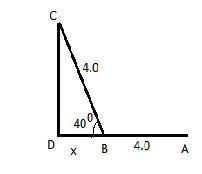
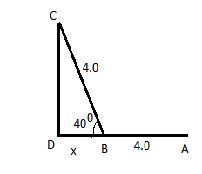
A wildlife researcher is tracking a flock of geese. The geese fly 4.0 km due west, then turn toward the north by 40° and fly ano

ther 4.0 km. How far west are they of their initial position? What is the magnitude of their displacement? Knight, Randall D., (Professor Emeritus). College Physics (p. 100). Pearson Education. Kindle Edition.

Physics
1 answer:
serg [3.5K]2 months ago
7 0

Answer:

(a). The distance traveled is 7.06 km towards the west.

(b). Their displacement magnitude is 7.51 km.

Explanation:

The information given states that,

The geese initially move 4.0 km directly west, then alter course to the north at a 40° angle, covering an additional 4.0 km.

Based on the diagram,

(a). To determine the distance

We will apply the distance formula

AD=AB+BD

Insert the values into the equation

D= 4+4.0\cos40^{\circ}

D=7.06\ km

The resultant distance is 7.06 km westward.

(b). We will find the total displacement's magnitude

Using the displacement formula

AC=\sqrt{(CD)^2+(AD)^2}

Insert the values into the equation

AC=\sqrt{(4.0\sin40)^2+(7.06)^2}

AC=7.51

The total displacement magnitude is 7.51 km.

In conclusion, (a). The traveled distance is 7.06 km towards the west.

(b). The magnitude of their total displacement is 7.51 km.
You might be interested in
It's a snowy day and you're pulling a friend along a level road on a sled. You've both been taking physics, so she asks what you
Maru [3345]

Answer:

0.0984

Explanation:

The first diagram below illustrates a free body diagram that will aid in resolving this problem.

According to the diagram, the force's horizontal component can be expressed as:

F_X = F_{cos \ \theta}

Substituting 42° for θ and 87.0° for F

F_X =87.0 \ N \ *cos \ 42 ^\circ

F_X =64.65 \ N

Meanwhile, the vertical component is:

F_Y = Fsin \ \theta

Again substituting 42° for θ and 87.0° for F

F_Y =87.0 \ N \ *sin \ 42 ^\circ

F_Y =58.21 \ N

In resolving the vector, let A denote the components in mutually perpendicular directions.

The magnitudes of both components are illustrated in the second diagram provided and can be represented as A cos θ and A sin θ

The frictional force can be expressed as:

f = \mu \ N

Where;

\mu is the coefficient of friction

N = the normal force

Also, the normal reaction (N) is calculated as mg - F sin θ

Substituting F_Y \ for \ F_{sin \ \theta}. Normal reaction becomes:

N = mg \ - \ F_Y

By balancing the forces, the horizontal component of the force equals the frictional force.

The horizontal component is described as follows:

F_X = \mu \ ( mg - \ F_Y)

Rearranging the equation above to isolate \mu leads to:

\mu \ = \ \frac{F_X}{mg - F_Y}

Substituting in the following values:

F_X \ = \ 64.65 \ N

m = 73 kg

g = 9.8 m/s²

F_Y = \ 58.21 N

Thus:

\mu \ = \ \frac{64.65 N}{(73.0 kg)(9.8m/s^2) - (58.21 \ N)}

\mu = 0.0984

Therefore, the coefficient of friction is = 0.0984

5 0
2 months ago
Large and small numbers are often best entered in exponential notation. For example, the mass of the earth is 5.98x1024 kg and t
Maru [3345]
We are required to find the charge-to-mass ratio.
4 0
1 month ago
Read 2 more answers
A kangaroo jumps to a vertical height of 2.8 m. How long was it in the air before returning to earth
serg [3582]
The kangaroo reaches a maximum vertical altitude of 2.8 m, which can be calculated using the formula 2.8 = 1/2 * 9.8 * t^2. Thus, applying the equation s = ut + 1/2at^2.
8 0
2 months ago
Considering the activity series given for nonmetals, what is the result of the below reaction? Use the activity series provided.
ValentinkaMS [3465]

Response: The result would be no reaction.

Clarification:

7 0
1 month ago
Read 2 more answers
A 25kg child sits on one end of a 2m see saw. How far from the pivot point should a rock of 50kg be placed on the other side of
Sav [3153]

Answer:

A rock weighing 50kg should be positioned at a distance of 0.5m from the pivot of the seesaw.

Explanation:

τchild=τrock  

We will utilize the formula for torque:

(F)child(d)child)=(F)rock(d)rock)

The gravitational force acts equally on both objects.

(m)childg(d)child)=(m)rockg(d)rock)

We can eliminate gravity from both sides of the equation for simplification.

 (m)child(d)child)=(m)rock(d)rock)  

Now employing the given masses for the rock and child. The seesaw's total length is 2 meters, with the child sitting at one end, placing them 1 meter from the center of the seesaw.

(25kg)(1m)=(50kg)drock

Solve for the distance where the rock should be positioned in relation to the seesaw's center.

drock=25kg⋅m50kg

drock=0.5m

6 0
2 months ago
Other questions:
  • An aluminum wire of length 1.0 meter has a resistance of 9.0x10^-3 ohm. If the wire were cut into two equal lengths, each length
    11·2 answers
  • How can philosophy help you become a productive citizen<br>​
    13·1 answer
  • Mrs. Gonzalez is about to give birth and Mr. Gonzalez is rushing her to the hospital at a speed of 30.0 m/s. Witnessing the spee
    8·1 answer
  • Calculate the change in the kinetic energy (KE) of the bottle when the mass is increased. Use the formula KE = mv2, where m is t
    9·3 answers
  • A vacuum tube diode consists of concentric cylindrical electrodes, the negative cathode and the positive anode. Because of the a
    11·1 answer
  • An electron moves in a region where the magnetic field is uniform and has a magnitude of 80 μT. The electron follows a helical p
    14·1 answer
  • A "biconvex" lens is one in which both surfaces of the lens bulge outwards. Suppose you had a biconvex lens with radii of curvat
    6·2 answers
  • A stable air mass is most likely to have which characteristic? 1. turbulent air 2. poor surface visibility 3. showery precipitat
    15·1 answer
  • Suppose students experiment with the tube and a variety of darts. Some darts have higher masses than others but are the same aer
    8·1 answer
  • Consider what happens when you jump up in the air. Which of the following is the most accurate statement? Consider what happens
    9·1 answer
Add answer
Login
Not registered? Fast signup
Signup
Login Signup
Ask question!