answer.
Ask question
Login Signup
Ask question
All categories
  • English
  • Mathematics
  • Social Studies
  • Business
  • History
  • Health
  • Geography
  • Biology
  • Physics
  • Chemistry
  • Computers and Technology
  • Arts
  • World Languages
  • Spanish
  • French
  • German
  • Advanced Placement (AP)
  • SAT
  • Medicine
  • Law
  • Engineering
poizon
1 month ago
9

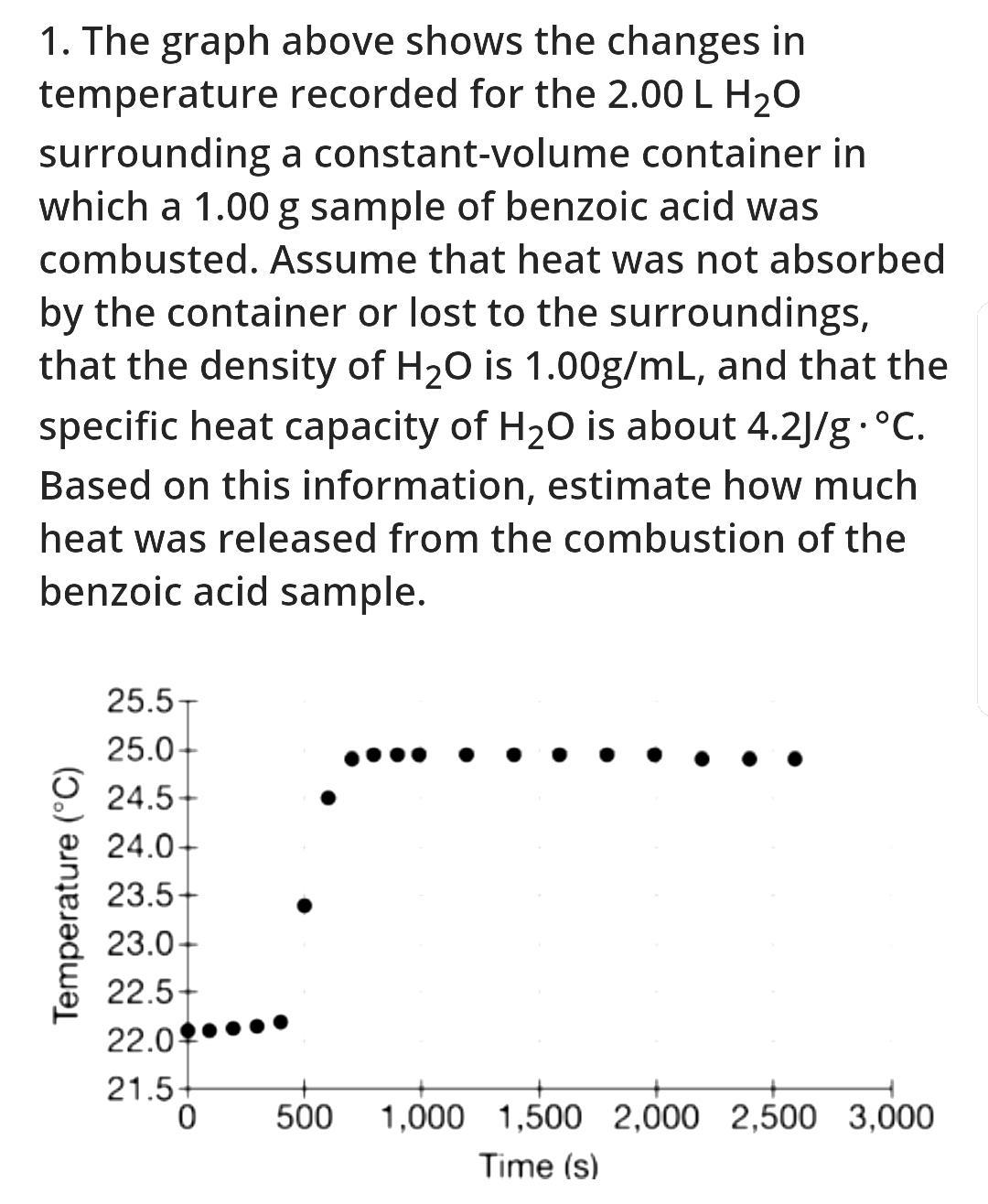
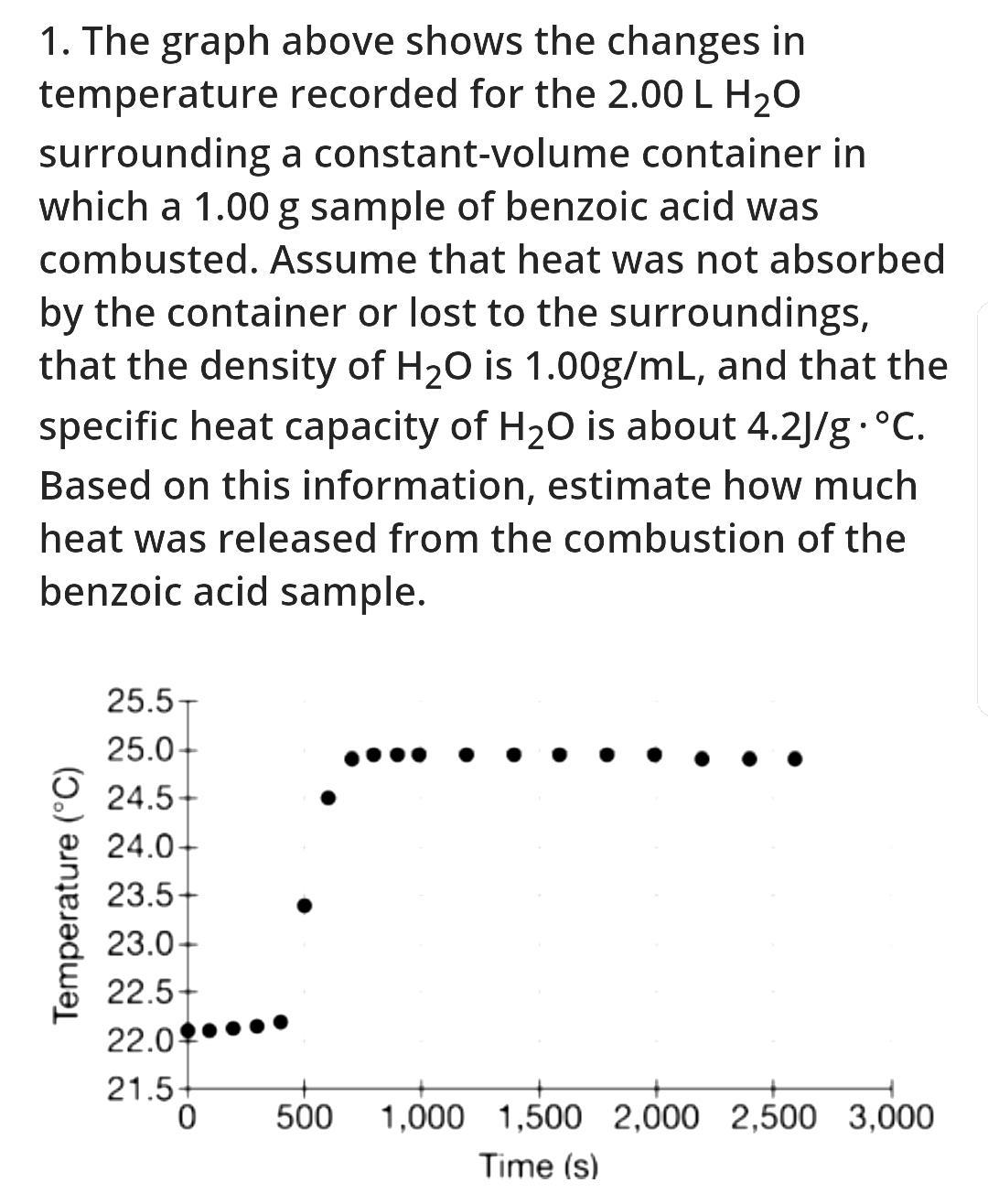
The graph above shows the changes in temperature recorded for the 2.00 l of h2o surrounding a constant-volume container in which

a 1.00 g sample of benzoic acid was combusted. Assume that heat was not absorbed by the container or lost to the surroundings

Chemistry
1 answer:
Alekssandra [3K]1 month ago
6 0

Answer:

25.2 kJ

Explanation:

The full question can be found in the image linked to this response.

It's important to highlight that the heat absorbed by the 2.00 L of water for increasing its temperature from the beginning to the end comes solely from the burning of benzoic acid, as there are no heat transfers to the container or the surroundings.

To find the heat released from benzoic acid combustion, we simply measure the heat needed to warm the water.

Q = mCΔT

To find the mass of the water,

Density = (mass)/(volume)

Mass = Density × volume

Density = 1 g/mL

Volume = 2.00 L = 2000 mL

Mass = 1 × 2000 = 2000 g

C = specific heat of water = 4.2 J/g.°C

ΔT = (final temperature) - (Initial temperature)

<pAccording to the graph,

Final water temperature = 25°C

Initial water temperature = 22°C

ΔT = 25 - 22 = 3°C

Q = (2000×4.2×3) = 25,200 J = 25.2 kJ

Hope this Helps!!!
You might be interested in
A 19.3-g mixture of oxygen and argon is found to occupy a volume of 16.2 l when measured at 675.9 mmhg and 43.4oc. what is the p
KiRa [2933]
<span>The partial pressure of oxygen is 438.0 mmHg. The ideal gas equation is expressed as PV = nRT where P represents pressure, V denotes volume, n is the number of moles, R is the ideal gas constant (8.3144598 (L*kPa)/(K*mol)), and T signifies absolute temperature. To convert from Celsius to Kelvin, we have 43.4 + 273.15 = 316.55 K. For the pressure conversion from mmHg to kPa: 675.9 mmHg * 0.133322387415 = 90.11260165 kPa. When solving for n using the ideal gas equation, we derive n = PV / (RT) which provides n = 90.11260165 kPa * 16.2 L / (8.3144598 (L*kPa)/(K*mol) * 316.55 K)= 1459.824147 L*kPa / 2631.94225 (L*kPa)/(mol), resulting in n = 0.554656603 mol. Thus, we have 0.554656603 moles of gas particles. Next, we determine the contribution from oxygen. The atomic weight of oxygen is 15.999 g/mol, while argon is 39.948 g/mol, and the molar mass of O2 is 31.998 g/mol. We establish the relationships where M is the number of moles of O2, and 0.554656603 - M gives the number of moles of Ar. Setting up the equation: M * 31.998 + (0.554656603 - M) * 39.948 = 19.3, we solve for M resulting in 0.359424148 moles of oxygen out of 0.554656603 total moles. This leads to oxygen providing 0.359424148 / 0.554656603 = 0.648012024 or 64.8012024% of the total pressure of 675.9 mmHg. The partial pressure therefore calculates to 675.9 * 0.648012024 = 437.9913271 mmHg, rounded to 438.0 mmHg</span>
7 0
1 month ago
Solving applied density problems Mr. Auric Goldfinger, criminal mastermind, intends to smuggle several tons of gold across Inter
KiRa [2933]

Answer:

thickness is 0.29 cm

Explanation:

To create a fake iron ball out of gold, we must ensure that its mass matches that of the iron ball. Therefore, we first find the volume of the iron ball using the provided diameter, applying the formula of 4/3 pi r^3.

Given the diameter d = 6 cm; thus, the radius r = 3 cm (d/2).

We calculate the volume of the iron ball: 4/3 * 3.14 * 3^3 = 113.04 cm^3.

The corresponding mass of the iron ball is the volume multiplied by its density: 113.04 * 5.15 g/cm^3 = 582.156 g.

This value represents the mass for the gold ball; now we determine the volume of the gold ball using its density.

Volume of gold ball = mass of gold ball/density of gold = 582.156 g/19.3 g/cm^3 = 30.1635 cm^3.

So this volume must correspond to a hollow sphere with an outer radius R = 3 cm and an unknown inner radius r.

Volume of the hollow ball can be represented as: 4/3 pi [R^3 - r^3].

Thus, 30.1635 cm^3 = 4/3 pi [3^3 - r^3].

30.1635 * 3/(4 * 3.14) = 27 - r^3.

Simplifying gives 7.2046 = 27 - r^3, resulting in r^3 = 19.7954.

Therefore, r = 2.7051 cm.

This indicates the thickness is the outer radius minus the inner radius: 3 - 2.7051 = 0.2949 cm.

Rounding to two significant figures yields

the thickness = 0.29 cm.

8 0
1 month ago
The average distance between nitrogen and oxygen atoms is 115 pm in a compound called nitric oxide. What is this distance in mil
lorasvet [2795]

Answer:

C) 1.15 × 10⁻⁷ mm

Explanation:

Step 1: Provided information

Average separation between oxygen and nitrogen atoms: 115 pm

Step 2: Change the distance to meters (SI standard unit)

Using the conversion 1 m = 10¹² pm.

115 pm × (1 m/10¹² pm) = 1.15 × 10⁻¹⁰ m

Step 3: Transform the distance to millimeters

Employing the conversion 1 m = 10³ mm.

1.15 × 10⁻¹⁰ m × (10³ mm/1 m) = 1.15 × 10⁻⁷ mm

5 0
10 days ago
Given two half reactions as follows: A2+ → 2 A2+ + 3 e− 4 e− + B → B4− What would you multiply each half-reaction by, to cancel
Tems11 [2777]
To achieve the cancellation of electrons, the oxidation half-reaction needs to be multiplied by 4 while the reduction half-reaction must be multiplied by 3. Explanation: The oxidation reaction accounts for the loss of electrons, increasing the oxidation state, while the reduction implies gaining electrons, leading to a decrease in oxidation state. The respective half-reactions illustrate this, confirming that multiplying the oxidation by 4 and the reduction by 3 achieves the desired effect.
5 0
28 days ago
The solubility of glucose at 30°C is 125 g/100 g water. Classify a solution made by adding 550 g of glucose to 400 mL of water a
VMariaS [2998]
At 30°C, glucose has a solubility of 1.25 g per gram of water. Given that the density of water at this temperature is 1 g/mL, the mass corresponding to 400 mL of water is also 400 g. Therefore, the concentration of the solution is calculated as 550 g divided by 400 g of water, which gives 1.375 g of glucose per gram of water. Since this concentration exceeds the solubility limit for glucose at this temperature, the solution can be classified as SATURATED.
4 0
27 days ago
Read 2 more answers
Other questions:
  • A decorative "ice" sculpture is carved from dry ice (solid CO2) and held at its sublimation point of –78.5°C. Consider the proce
    10·1 answer
  • How many grams of a solution that is 5.2% sucrose by mass are needed to obtain 18g of sucrose
    12·1 answer
  • Identify Earth’s neighbors in the solar system by choosing the correct answer. The are bodies of rock or gas that are named for
    15·2 answers
  • In this lab, you will do experiments to identify types of changes. Using the question format you learned (shown above), write an
    11·1 answer
  • What is the maximum number of hydrogen atoms that can be covalently bonded in a molecule containing two carbon atoms?a) 2b) 3c)
    6·1 answer
  • At a certain temperature, the reaction 2NO + Cl2 ⇌ 2NOCl has an equilibrium constant Kc of 45.0. A chemist creates a mixture wit
    5·1 answer
  • Aluminum has a specific heat of 0.902 j/gC. How much heat is lost when a piece of aluminum with a mass of 23.984 g cools from a
    6·1 answer
  • How many grams of Fe are produced from 65.9 g of FeO given the following reaction: 3FeO + 2Al -&gt; 3Fe +Al2O3
    6·2 answers
  • A sample of gasoline contains various hydrocarbons, which comprise atoms of carbon, hydrogen, and oxygen. The hydrocarbons mix t
    6·1 answer
  • for the final step of the copper cycle, zinc, Zn(s), is added to copper sulfate, CuSO4(aq). Elemental copper appears as a solid.
    12·1 answer
Add answer
Login
Not registered? Fast signup
Signup
Login Signup
Ask question!