answer.
Ask question
Login Signup
Ask question
All categories
  • English
  • Mathematics
  • Social Studies
  • Business
  • History
  • Health
  • Geography
  • Biology
  • Physics
  • Chemistry
  • Computers and Technology
  • Arts
  • World Languages
  • Spanish
  • French
  • German
  • Advanced Placement (AP)
  • SAT
  • Medicine
  • Law
  • Engineering
andriy
29 days ago
12

A 227 pound compressor is supported by four legs that contact the floor of a machine shop. At the bottom of each leg there is a

circular pad formed from a synthetic material to dampen vibration. The synthetic material will support up to a maximum pressure of 42 psi before deforming. What is the minimum diameter to avoid deforming the material?
Engineering
1 answer:
choli [191]29 days ago
6 0

Answer:

1.312 in

Explanation:

The details provided in the question are:

The weight of the compressor, W is 227 pounds.

It has 4 legs.

The maximum permissible pressure is 42 psi.

Let F represent the force exerted by each leg.

Thus,

W = 4F,

or

227 pounds = 4F,

implying that:

F = 56.75 pounds.

Furthermore,

Force = Pressure × Area,

therefore:

56.75 pounds = 42 psi × πr²  [ r signifies the radius of one leg]

Consequently, we find:

r² = 0.4301,

and thus:

r = 0.656;

resulting in a diameter equal to 2r = 2 × 0.656,

which equals 1.312 in.

You might be interested in
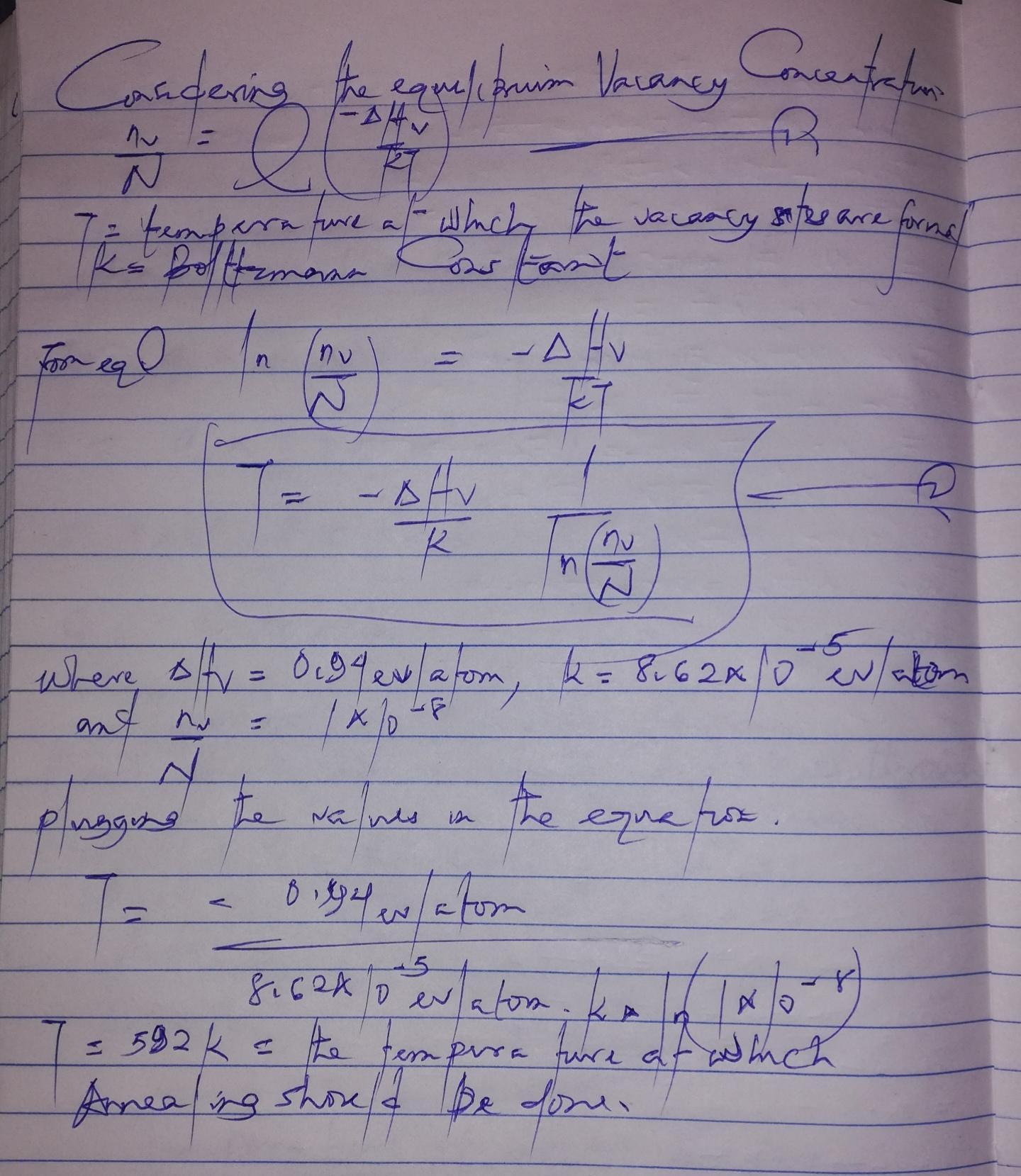
A thin-film gold conductor for an integrated circuit in a satellite application is deposited from a vapor, and the deposited gol
mote1985 [204]

Answer:

Explanation:

The equilibrium vacancy concentration can be described by:

nv/N = exp(-ΔHv/KT),

where T is the temperature at which vacancies form,

K = Boltzmann's constant,

and ΔHv = enthalpy of vacancy formation.

Rearranging this equation to express temperature allows you to calculate it using the provided values. A detailed breakdown of the process is included in the attached file.

5 0
19 days ago
The Machine Shop has received an order to turn three alloy steel cylinders. Starting diameter = 250 mm and length = 625 mm. Feed
alex41 [274]

Response:

The cutting speed is calculated at 365.71 m/min

Clarification:

Given parameters include

diameter D = 250 mm

length L = 625 mm

Feed f = 0.30 mm/rev

cut depth = 2.5 mm

n = 0.25

C = 700

To find

the cutting speed that ensures the tool life coincides with the cutting time for the three parts

The formula for cutting time is given as

Tc =

....................1

where D refers to diameter, L refers to length and f refers to feed while V represents speed \frac{\pi DL}{1000*f*V}

Thus, we derive

Tc = \frac{\pi (250)*625}{1000*0.3*V}

Tc = \frac{1636.25}{V}

Given the tool life is expressed as

T = 3 × Tc............................2

where T denotes tool life and Tc is the cutting duration

Calculating tool life by substituting values into equation 2 yields

T = 3 × \frac{1636.25}{V}

According to the Taylor tool formula, cutting speed is expressed as

VT^{0.25} = 700

 × V × 8.37 = 700

This yields V = 365.71

Thus, the cutting speed calculates to 365.71 m/min

5 0
9 days ago
A hydrogen-filled balloon to be used in high altitude atmosphere studies will eventually be 100 ft in diameter. At 150,000 ft, t
mote1985 [204]

Answer:

The calculated result is 11.7 ft

Explanation:

You can apply the combined gas law, which incorporates Boyle's law, Charles's law, and Gay-Lussac's Law, because hydrogen demonstrates ideal gas behavior under these specific conditions.

\frac{p_1 V_1}{T_1} = \frac{p_2 V_2}{T_2}

where the subscripts indicate "p" for pressure, "V" for volume, and "T" for temperature (in Kelvin) at varying moments. Let's denote t_1 as the balloon at 150,000 ft so

p_1 = 0.14 \ lb/in^2

V_1 = \frac{4}{3} \pi R_1^3 = 523598.77 \ ft^3

and T_1 = -67^\circ F = 218.15\ K.

Then t_2 represents the point at which the balloon is on the ground.

p_2 = 14.7 \ lb/in^2 and T_2 = 68^\circ F = 293.15\ K.

Based on the first equation

V_2 = \frac{p_1 V_1 T_2}{T_1 p_2}, we find

V_2 = 6701.07 ft^3 and consequently the radius turns out to be

R_2 = \sqrt[3]{\frac{3 V_2}{4 \pi}} = 11.7 \ ft.

5 0
5 days ago
A liquid food with 12% total solids is being heated by steam injection using steam at a pressure of 232.1 kPa (Fig. E3.3). The p
iogann1982 [279]

Answer:

m_{s}=20kg/min

H_{s}=1914kJ/kg

Explanation:

A liquid food containing 12% total solids is heated via steam injection at a pressure of 232.1 kPa (see Fig. E3.3). The product starts at a temperature of 50°C and has a flow rate of 100 kg/min, being elevated to a temperature of 120°C. The specific heat of the product varies with its composition as follows:

c_{p}=c_{pw}(mass fraction H_{2}0)+c_{ps}(mass fraction solid) and the

specific heat of the product at 12% total solids is 3.936 kJ/(kg°C). The goal is to calculate the quantity and minimum quality of steam required to ensure that the leaving product has 10% total solids.

Given

Product total solids in (X_{A}) = 0.12

Product mass flow rate (m_{A}) = 100 kg/min

Product total solids out (X_{B}) = 0.1

Product temperature in (T_{A}) = 50°C

Product temperature out (T_{B}) = 120°C

Steam pressure = 232.1 kPa at (T_{S}) = 125°C

Product specific heat in (C_{PA}) = 3.936 kJ/(kg°C)

The mass equation is:

m_{A}X_{A}=m_{B}X_{B}

100(0.12)=m_{B}(0.1)\\m_{B}=\frac{100(0.12)}{0.1} =120

Also m_{a}+m_{s}=m_{b}\\

Therefore: 100}+m_{s}=120\\\\m_{s}=120-100=20

The energy balance equation is:

m_{A}C_{PA}(T_{A}-0)+m_{s}H_{s}=m_{B}C_{PB}(T_{B}-0)

3.936 = (4.178)(0.88) +C_{PS}(0.12)\\C_{PS}=\frac{3.936-3.677}{0.12} =2.161

C_{PB}= 4.232*0.9+0.1C_{PS}= 4.232*0.9+0.1*2.161=4.025  kJ/(kg°C)

By substituting values into the energy equation:

100(3.936)(50-0)+20H_{s}=120(4.025)}(120-0)

19680+20H_{s}=57960\\20H_{s}=57960-19680 \\20H_{s}=38280\\H_{s}=\frac{38280}{20} =1914

H_{s}=1914kJ/kg

From the properties of saturated steam at 232.1 kPa,

H_{c} = 524.99 kJ/kg

H_{v} = 2713.5 kJ/kg

% quality = \frac{1914-524.99}{2713.5-524.99} =63.5%

Any steam quality above 63.5% will result in higher total solids in the heated product.

3 0
16 days ago
An insulated box containing helium gas falls from a balloon 4.5 km above the earth's surface. calculate the temperature rise in
iogann1982 [279]
The increase in temperature of the helium gas is calculated to be 14.25 K. The helium is located in an insulated box that falls from a height of 4.5 km. As it descends, the potential energy is transformed into internal energy of the helium gas. The equation for temperature change can be expressed as: 10 x 4.5 = 3.15 x ΔT, yielding a temperature increase of ΔT = 14.25 K.
6 0
2 days ago
Other questions:
  • Degreasers can be broken down into two main categories
    9·2 answers
  • Consider 1.0 kg of austenite containing 1.15 wt% C, cooled to below 727C (1341F). (a) What is the proeutectoid phase? (b) How
    5·1 answer
  • A fireboat is to fight fires at coastal areas by drawing seawater with a density of 1030 kg/m through a 20-cm-diameter pipe at a
    13·1 answer
  • A manometer measures a pressure difference as 40 inches of water. Take the density of water to be 62.4 lbm/ft3.What is this pres
    13·1 answer
  • Design a decimal arithmetic unit with two selection variables, V1, and Vo, and two BCD digits, A and B. The unit should have fou
    7·1 answer
  • A test machine that kicks soccer balls has a 5-lb simulated foot attached to the end of a 6-ft long pendulum arm of negligible m
    12·1 answer
  • A tank contains initially 2500 liters of 50% solution. Water enters the tank at the rate of 25 iters per minute and the solution
    13·1 answer
  • Soap is a very interesting chemical. We even discussed it on the discussion board. How does it work, exactly?
    7·1 answer
  • Consider film condensation on a vertical plate. Will the heat flux be higher at the top or at the bottom of the plate? Why?
    5·1 answer
  • PDAs with two stacks are strictly more powerful than PDAs with one stack. Prove that 2-stack PDAs are not a valid model for CFLs
    12·1 answer
Add answer
Login
Not registered? Fast signup
Signup
Login Signup
Ask question!