answer.
Ask question
Login Signup
Ask question
All categories
  • English
  • Mathematics
  • Social Studies
  • Business
  • History
  • Health
  • Geography
  • Biology
  • Physics
  • Chemistry
  • Computers and Technology
  • Arts
  • World Languages
  • Spanish
  • French
  • German
  • Advanced Placement (AP)
  • SAT
  • Medicine
  • Law
  • Engineering
Allisa
2 months ago
7

The 10-kg block slides down 2 m on the rough surface with kinetic friction coefficient μk = 0.2. What is the work done by the fr

iction force?

Engineering
1 answer:
iogann1982 [368]2 months ago
7 0

Answer:

153.2 J

Explanation:

Let’s first identify our known variables:

mass (m) of the block = 10 kg

distance slid down (i.e., displacement) = 2 m

coefficient of kinetic friction (μk) = 0.2

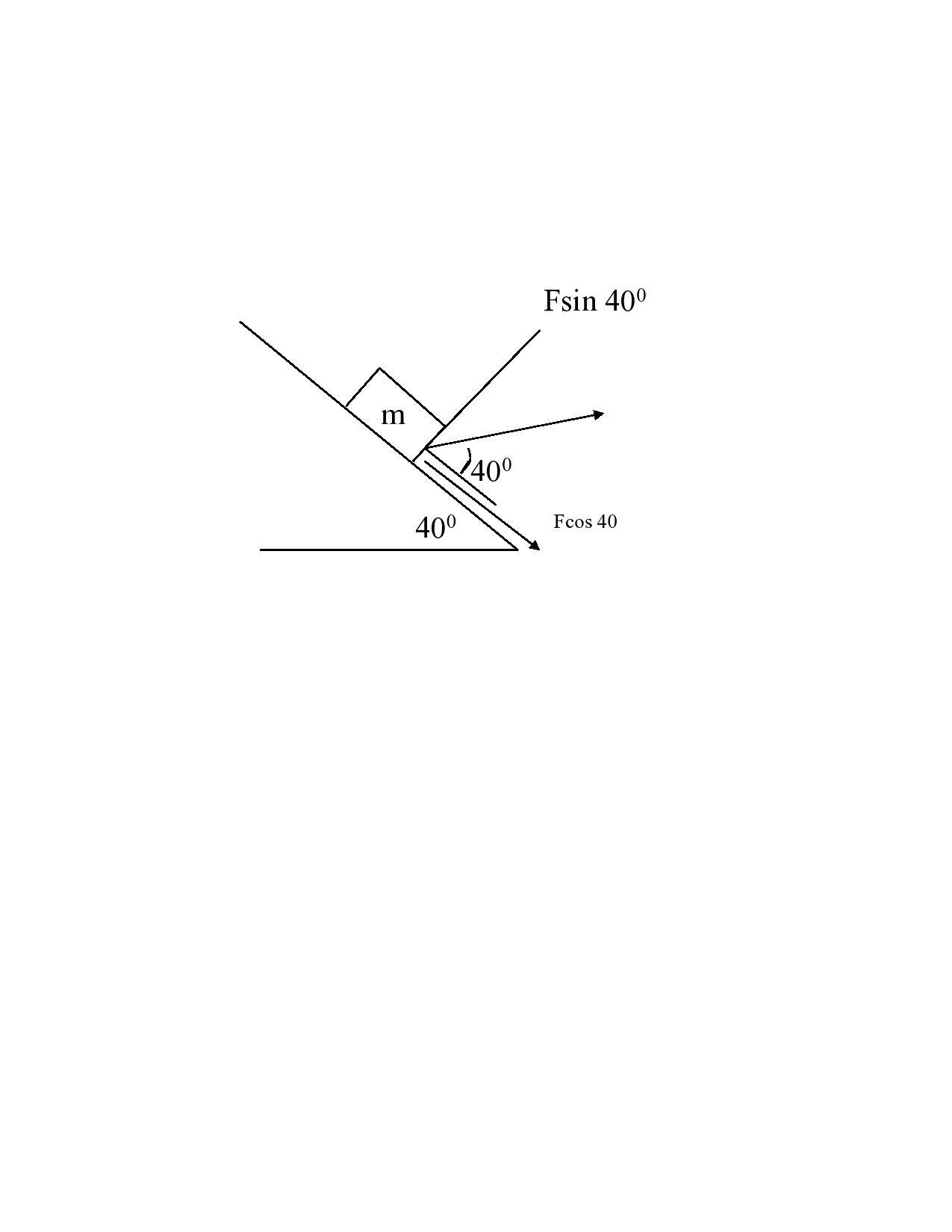
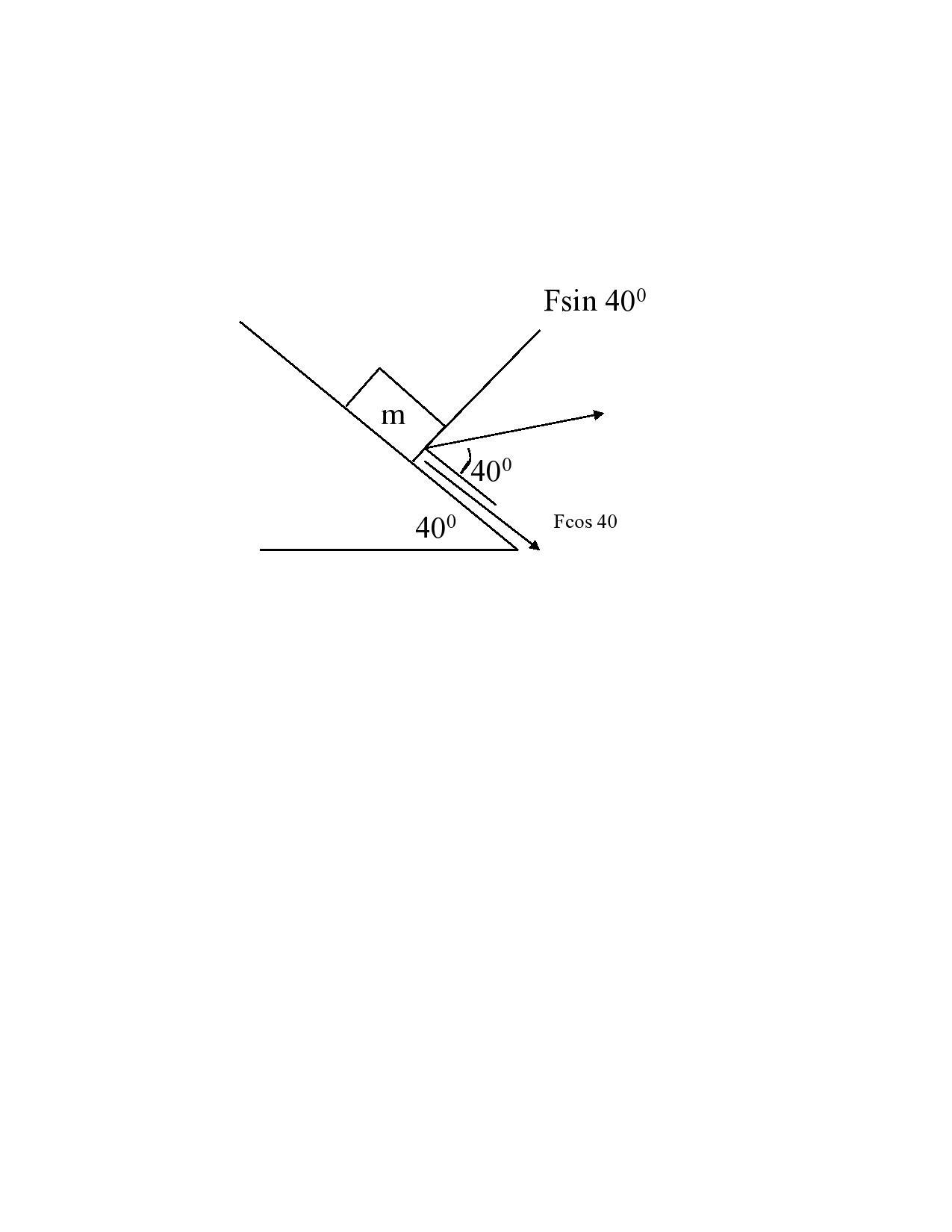
In the following diagram, if we analyze the force component directed along the displacement, we find

F_x= Fcos 40°

F_x= 100 (cos 40°)

F_x= 76.60 N

The work done by the frictional force is then calculated as:

W = F_x × displacement

W = 76.60 × 2

W = 153.2 J

Therefore, the work done by the frictional force equals 153.2 J

You might be interested in
Design a digital integrator using the impulse invariance method. Find and give a rough sketch of the amplitude response, and com
mote1985 [299]
50 μsec.
8 0
1 month ago
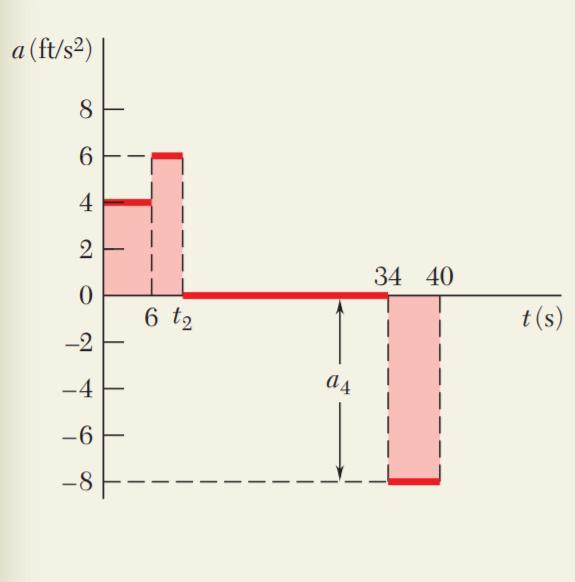
A subway car leaves station A; it gains speed at the rate of 4 ft/s^2 for of until it has reached and then at the rate 6 then th
Daniel [329]

Answer:

Refer to the attached document

1512 ft

Explanation:

Because the acceleration is constant or zero, the acceleration-time graph consists of horizontal segments. The values for t2 and a4 are derived as follows:

Acceleration - Time

0 < t < 6: Velocity change = area beneath the a–t graph

V_6 - 0 =  (6 s)(4 ft/s²) = 24 ft/s

6 < t < t2: The velocity rises from 24 to 48 ft/s,

Velocity change = area beneath the a–t graph

48 - 24 = (t2 - 6) * 6

t2 = 10 s

t2 < t < 34: The velocity remains constant, meaning acceleration is zero.

34 < t < 40: Velocity change = area beneath the a–t graph

0 - 42 = 6*a4

a4 = - 8 ft / s²

A negative acceleration shows the area lies below the t-axis, indicating a decrease in speed.

Velocity - Time

Since acceleration remains constant or zero, the v−t graph is made up of linear segments connecting the calculated points.

Position change = area beneath the v−t graph

0 < t < 6:  x6 - 0 = 0.5*6*24 = 72 ft

6 < t < 10:    x10 - x6 = 0.5*4*(24 + 48) = 144 ft

10 < t < 34: x34 - x10 = 48*24 = 1152 ft

34 < t < 40: x40 - x34 = 0.5*6*48 = 144 ft

Summing these position changes yields the distance from A to B:

d = x40 - 0 = 1512 ft
8 0
2 months ago
The Machine Shop has received an order to turn three alloy steel cylinders. Starting diameter = 250 mm and length = 625 mm. Feed
alex41 [359]

Response:

The cutting speed is calculated at 365.71 m/min

Clarification:

Given parameters include

diameter D = 250 mm

length L = 625 mm

Feed f = 0.30 mm/rev

cut depth = 2.5 mm

n = 0.25

C = 700

To find

the cutting speed that ensures the tool life coincides with the cutting time for the three parts

The formula for cutting time is given as

Tc =

....................1

where D refers to diameter, L refers to length and f refers to feed while V represents speed \frac{\pi DL}{1000*f*V}

Thus, we derive

Tc = \frac{\pi (250)*625}{1000*0.3*V}

Tc = \frac{1636.25}{V}

Given the tool life is expressed as

T = 3 × Tc............................2

where T denotes tool life and Tc is the cutting duration

Calculating tool life by substituting values into equation 2 yields

T = 3 × \frac{1636.25}{V}

According to the Taylor tool formula, cutting speed is expressed as

VT^{0.25} = 700

 × V × 8.37 = 700

This yields V = 365.71

Thus, the cutting speed calculates to 365.71 m/min

5 0
2 months ago
An insulated box containing helium gas falls from a balloon 4.5 km above the earth's surface. calculate the temperature rise in
iogann1982 [368]
The increase in temperature of the helium gas is calculated to be 14.25 K. The helium is located in an insulated box that falls from a height of 4.5 km. As it descends, the potential energy is transformed into internal energy of the helium gas. The equation for temperature change can be expressed as: 10 x 4.5 = 3.15 x ΔT, yielding a temperature increase of ΔT = 14.25 K.
6 0
2 months ago
The manufacturer of a 1.5 V D flashlight battery says that the battery will deliver 9 mA for 40 continuous hours. During that ti
pantera1 [306]

Response:

a) 144.000 seconds

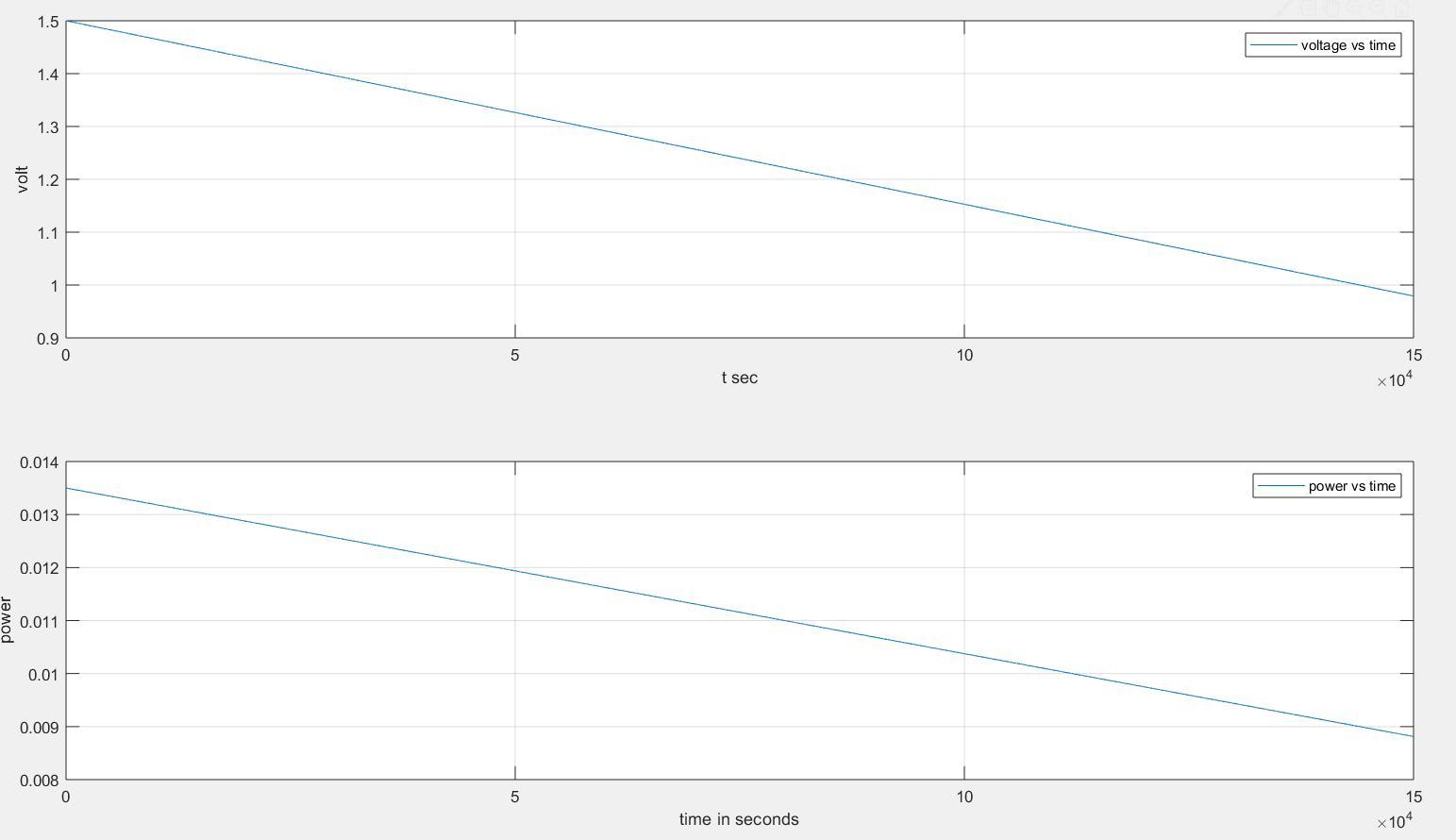
b) and c) Battery voltage and power graphs are in the attached image.

   V=-\frac{0.5}{144000} t + 1.5 V[tex] [tex]P(t)=-(31.25X10^{-9}) t+0.0135  where D:{0<t h="" />

d) 1620 J

Description:

a) The initial response is derived via a rule of three

s=\frac{3600s * 40h}{1h} = 144000s

b) Using the line equation from the starting point (0 seconds, 1.5 V)

m=\frac{1-1.5}{144000-0} = \frac{-0.5}{144000}

where m denotes the slope.

V-V_{1}=m(x-x_{1})

where V represents voltage in volts and t signifies time in seconds

V=m(t-t_{1}) + V_{1} along with P and m.

V=-\frac{0.5}{144000} t + 1.5 V[tex] c) Using the equation VPOWER IS DEFINED AS:[tex] P(t) = v(t) * i(t) [tex]so.[tex] P(t) = 9mA * (-\frac{0.5}{144000} t + 1.5) [tex][tex]P(t) = - (31.25X10^{-9}) t + 0.0135

d) By evaluating that count.

E = \int\limits^{144000}_{0} {P(t)} \, dt = \int\limits^{144000}_{0} {v(t)*i(t)} \, dt

E = \int\limits^{144000}_{0} {-\frac{0.5}{144000} t + 1.5*0.009} \, dt = 1620 J

4 0
2 months ago
Other questions:
  • Multiply each element in origList with the corresponding value in offsetAmount. Print each product followed by a space.Ex: If or
    13·1 answer
  • A technician has been dispatched to assist a sales person who cannot get his laptop to display through a projector. The technici
    13·1 answer
  • Number pattern Write a recursive method called print Pattern() to output the following number pattern. Given a positive integer
    8·2 answers
  • Can a 1½ " conduit, with a total area of 2.04 square inches, be filled with wires that total 0.93 square inches if the maximum f
    8·1 answer
  • PDAs with two stacks are strictly more powerful than PDAs with one stack. Prove that 2-stack PDAs are not a valid model for CFLs
    12·1 answer
  • 1. A four-lane freeway (two lanes in each direction) is located on rolling terrain and has 12-ft lanes, no lateral obstructions
    7·1 answer
  • A solid circular shaft has a uniform diameter of 5 cm and is 4 m long. At its midpoint 65 hp is delivered to the shaft by means
    12·1 answer
  • A piston–cylinder assembly contains propane, initially at 27°C, 1 bar, and a volume of 0.2 m3. The propane undergoes a process t
    6·1 answer
  • A pressurized 2-m-diameter tank of water has a 10-cm-diameter orifice at the bottom where water discharges to the atmosphere. Th
    12·1 answer
  • In this exercise, we will examine how replacement policies affect miss rate. Assume a two-way set associative cache with four on
    9·2 answers
Add answer
Login
Not registered? Fast signup
Signup
Login Signup
Ask question!