answer.
Ask question
Login Signup
Ask question
All categories
  • English
  • Mathematics
  • Social Studies
  • Business
  • History
  • Health
  • Geography
  • Biology
  • Physics
  • Chemistry
  • Computers and Technology
  • Arts
  • World Languages
  • Spanish
  • French
  • German
  • Advanced Placement (AP)
  • SAT
  • Medicine
  • Law
  • Engineering
Lelu
1 month ago
11

The filament of an electric bulb draws a current of 0.4 ampere. Calculate the amount of charge flowing through the filament if t

he bulb glows for 2 hours. Also calculate the number of electrons passed.
Physics
1 answer:
Ostrovityanka [3.2K]1 month ago
3 0
In this scenario, I equals 0.4 amperes and the time t is 2 hours, which converts to 2 × 60 × 60 seconds.
Using the formula I = nQ/t where Q represents charge and n signifies the number of charges,
we have n = It/Q
which gives 0.4 × (2 × 60 × 60) / 1.6 × 10^-19.
You might be interested in
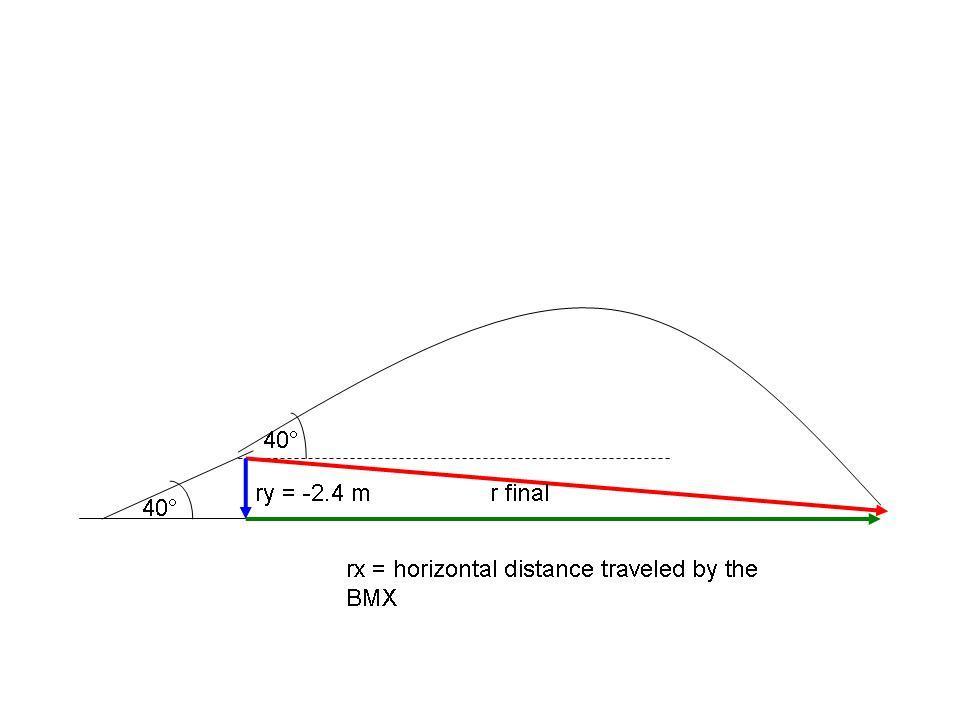
A BMX bicycle rider takes off from a ramp at a point 2.4 m above the ground. The ramp is angled at 40 degrees from the horizonta
Ostrovityanka [3204]

Answer:

The BMX rider lands 5.4 meters horizontally away from the ramp's end.

Explanation:

The BMX position vector is represented as:

r = (x0 + v0 × t × cos α, y0 + v0 × t × sin α + ½ × g × t²)

Where:

r = position at time t

x0 = initial horizontal position

v0 = initial speed

α = angle of jump

y0 = initial vertical height

g = gravitational acceleration (-9.8 m/s², upward positive)

Refer to the diagram for clarity. At the landing time, the vertical coordinate of the position vector is -2.4 m, measured from the ramp's edge as the origin. Using the vertical component equation for y, one can solve for t, then substitute t to find the horizontal distance.

The vertical position equation:

-2.4 m = 0 + 5.9 m/s × t × sin 40° - ½ × 9.8 m/s² × t²

Rearranged:

0 = -4.9 t² + 5.9 t × sin 40° + 2.4

Solving this quadratic yields:

t = 1.2 seconds

Then, calculate horizontal distance:

x = 0 + 5.9 m/s × 1.2 s × cos 40° = 5.4 m

This means the BMX lands 5.4 meters from the ramp's edge.

Have a great day!

8 0
2 months ago
tas watches as his uncle changes a flat tire on a car. his uncle raises the car using a machine called a jack. each time his unc
Softa [3030]

The answer is

-Small f and large D.

The explanation:

-A car jack acts as a machine, defined as an apparatus that aids individuals in exerting force more easily.

-Hence, by applying a small force to the jack, the height at which the car is elevated increases.

Machines are essential for people to amplify their strength; without them, lifting a car would be impossible.

Employing leverage or hydraulic principles, machines enhance your exerted force.

Utilizing a greater lever allows for extensive movement with minimal force, resulting in the opposite side moving shorter distances with an increased force.

7 0
1 month ago
Read 2 more answers
A scuba diver has his lungs filled to half capacity (3 liters) when 10 m below the surface. If the diver holds his breath while
Keith_Richards [3271]
To address this problem, Boyle's Law must be applied, which states that the initial and final pressures and volumes are related as follows: Where, P₀ and V₀ represent the initial pressure and volume, while P and V refer to the final pressure and volume. The endpoint pressure in this scenario is atmospheric pressure. Thus, using the given equation, we can find the volume the lungs would occupy at the surface.
4 0
13 days ago
A hot air balloon of total mass M (including passengers and luggage) is moving with a downward acceleration of magnitude a. As i
inna [3103]

Answer:

The ratio of mass that is discarded is determined by this equation:

M - m = (3a/2)/(g²- (a²/2) - (ag/2))

Explanation:

The force acting on an object in motion is defined by the equation:

F = ma

Additionally, there is a gravitational force consistently acting downwards on the object, defined as g = 9.8 ms⁻²

For convenience, we will utilize a positive notation for downward acceleration and a negative notation for upward acceleration.

Case 1:

The hot air balloon has mass = M

Acceleration = a

Upward thrust from hot air = F = constant

Gravitational force acting downward = Mg

The net force on the balloon can be expressed as:

Ma = Gravitational force - Upward Force                              

Ma = Mg - F                      (since the balloon moves downward, that means Mg > F)

F = Mg - Ma

F = M (g-a)

M = F/(g-a)

Case 2:

After releasing the ballast, the new mass becomes m. The new upward acceleration is -a/2:

The net force is expressed as:

-m(a/2) = mg - F        (The balloon is moving upwards, hence F > mg)

F = mg + m(a/2)

F = m(g + (a/2))

m = F/(g + (a/2))

Determining the fraction of the mass initially dropped:

M-m = \frac{F}{g-a} - \frac{F}{g+\frac{a}{2} }\\M-m = F*[\frac{1}{g-a} - \frac{1}{g+\frac{a}{2} }]\\M-m = F*[\frac{(g+(a/2)) - (g-a)}{(g-a)(g+(a/2))} ]\\M-m = F*[\frac{g+(a/2) - g + a)}{(g-a)(g+(a/2))} ]\\M-m = F*[\frac{(3a/2)}{g^{2}-\frac{a^{2}}{2}-\frac{ag}{2}} ]

5 0
1 month ago
If a person weighs 882 N on the surface of the earth, at what altitude above the earth’s surface must they be for their weight t
Sav [3153]

Para calcular el peso utilizamos la fórmula:
F=m*g=882N

Cuando tenemos dos cuerpos, empleamos la fórmula de la gravedad general:
F=G* \frac{ M_{p}*M_{E} }{ r^{2} }
Donde:
G = constante de gravedad = 6.67* 10^{-11} m^{3} kg^{-1} s^{-2}
Mp = masa de la persona = 882 / 9.81= 89.9kg
ME = masa de la Tierra = 5.97* 10^{24} kg
r = distancia entre la Tierra y la persona

A partir de estas dos fórmulas, deducimos que los lados izquierdos son equivalentes, por lo tanto, los lados derechos también deben serlo.
m*g=G* \frac{ M_{p}*M_{E} }{ r^{2} }

Resolviendo esta ecuación para r:
r= \sqrt{G* \frac{ M_{p}*M_{E}}{M_{p}*g}
r=6371116m = 6371.116km

Esta es la distancia desde el centro de la Tierra. El radio de la Tierra es 6370km y la altura sobre la superficie es 6371.116 - 6370 = 1.116km o 1116m.

3 0
1 month ago
Other questions:
  • The thrust of a certain boat’s engine generates a power of 10kW as the boat moves at constant speed 10ms through the water of a
    13·1 answer
  • Early investigators (including Thomas Young) measured the thickness of wool fibers using diffraction. One early instrument used
    15·1 answer
  • The weight of a bucket is 186 N. The bucket is being raised by two ropes. The free-body diagram shows the forces acting on the b
    15·1 answer
  • Whale sharks swim forward while ascending or descending. They swim along a straight-line path at a shallow angle as they move fr
    15·1 answer
  • All forces on the bullets cancel so that the net force on a bullet is zero, which means the bullet has zero acceleration and is
    5·2 answers
  • A titanium bicycle frame displaces 0.314 l of water and has a mass of 1.41 kg.part what is the density of the titanium in g/cm3
    7·1 answer
  • Two identical conducting spheres, A and B, sit atop insulating stands. When they are touched, 1.51 × 10¹³ electrons flow from sp
    8·1 answer
  • A mover hoists a 50 kg box from the ground to a height of 2 m. What was the change in the box's energy
    11·1 answer
  • Deena made a chart to summarize features of a velocity vs. time graph for objects with constant acceleration and objects with co
    13·2 answers
  • A block of foam has a mass of 10 g, a volume of 60 cm3, and a length of 30 cm. What is the density of the foam? (If necessary, r
    5·2 answers
Add answer
Login
Not registered? Fast signup
Signup
Login Signup
Ask question!