answer.
Ask question
Login Signup
Ask question
All categories
  • English
  • Mathematics
  • Social Studies
  • Business
  • History
  • Health
  • Geography
  • Biology
  • Physics
  • Chemistry
  • Computers and Technology
  • Arts
  • World Languages
  • Spanish
  • French
  • German
  • Advanced Placement (AP)
  • SAT
  • Medicine
  • Law
  • Engineering
jeka94
1 month ago
8

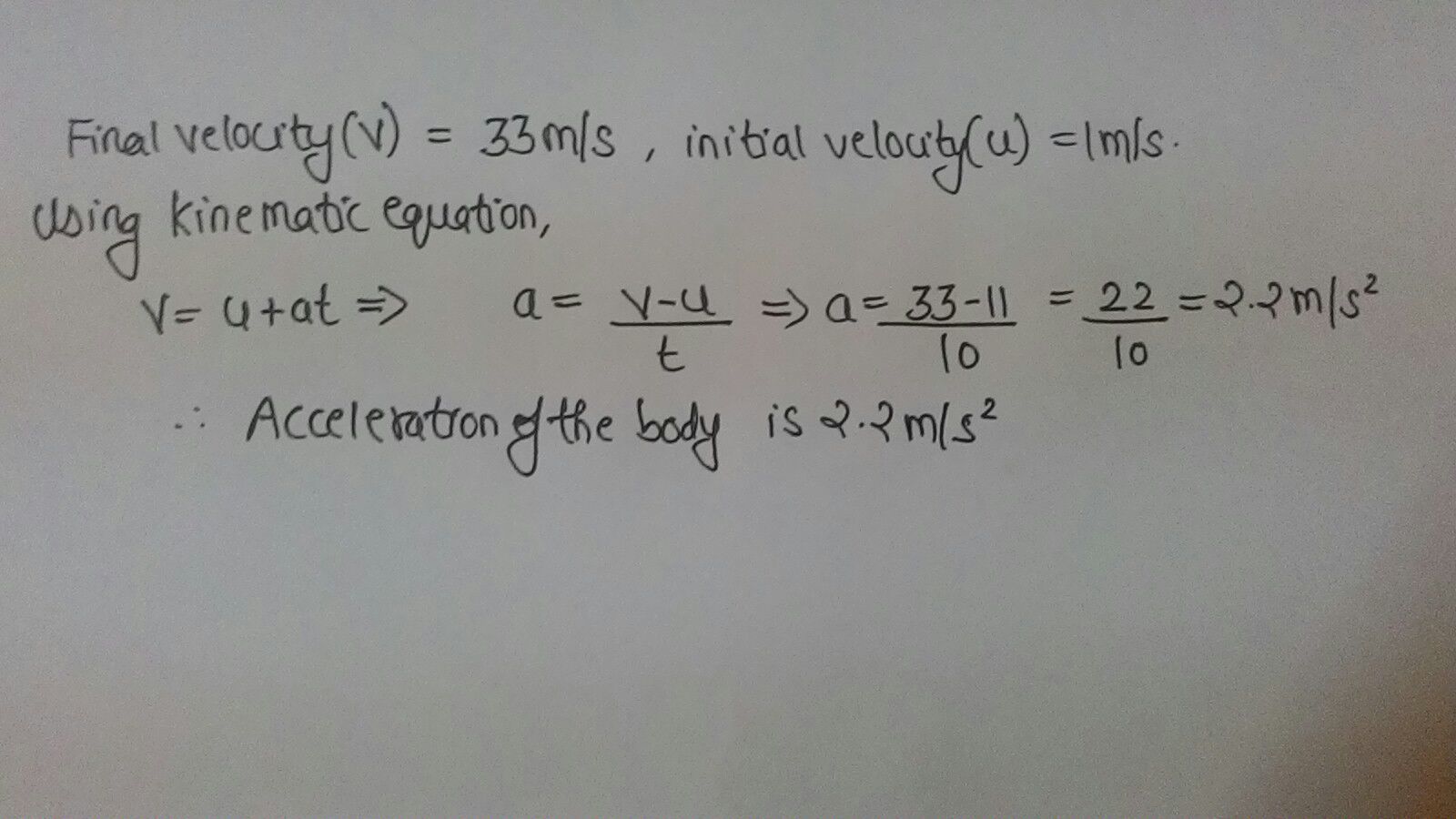
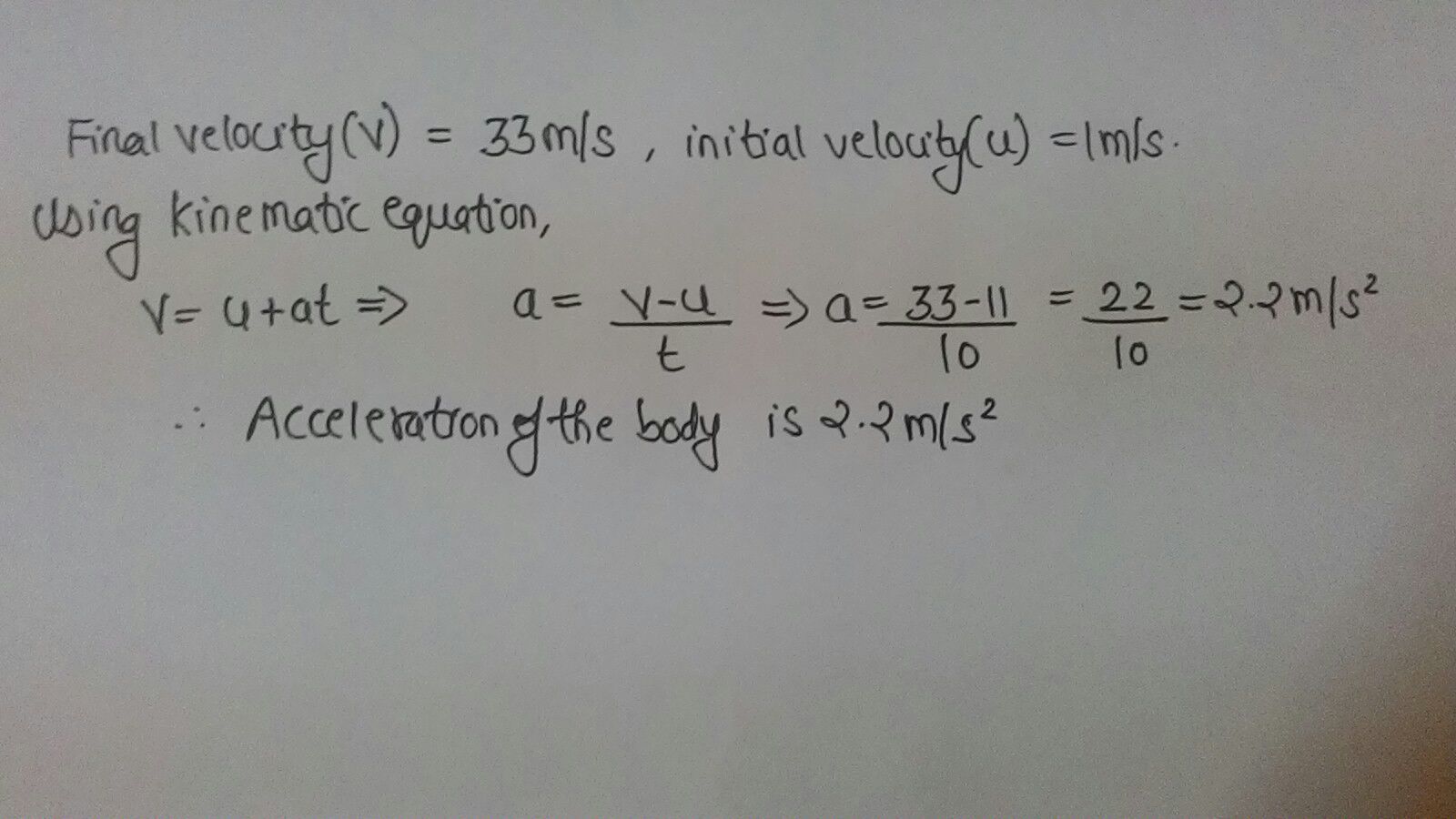
Find the acceleration of a body whose velocity increases from 11ms-1 to 33ms-1 in 10 seconds

Physics
2 answers:
Keith_Richards [3.2K]1 month ago
7 0
I trust this resolves your question.

kicyunya [3.2K]1 month ago
3 0
We know the formula a = (v₂ - v₁) / t.
Here, (v₂ - v₁) equals 33 - 11, giving us 22 m/s.
t is 10 seconds.

Substituting these values in, we have:
a = 22/10, thus a = 2.2 m/s².

In conclusion, your answer should be 2.2 m/s².

Hope this is helpful!
You might be interested in
The total conversion of 1.00 kilogram of the Sun's mass into energy yields​?
Yuliya22 [3333]
The well-known equation... E = m c²... does not address the origin of the mass involved.

Converting 1 kg of any mass entirely into energy generates

(1kg) · (c²) Joules of energy.

E = (1 kg) · (c²) = (1 kg) · (299,792,458 m/s)²

E = 8.9876 x 10¹⁶ Joules

To simplify, this equates to the energy needed to keep a 100-watt light bulb illuminated for about 10,402,259,010 days.

(This is roughly 28.5 million years, based on the current understanding of days and years.)

5 0
24 days ago
If an electronic circuit experiences a loss of 3 decibels with an input power of 6 watts, what would its output power be, to the
Yuliya22 [3333]

Answer:

The output power of the circuit is 3 Watts.

Given:

a loss in decibels = 3 dB

Input power = 6 Watts

To find:

What is the output power?

Formula used:

Output power = Input power × loss in ratio

Solution:

3 dB loss corresponds to a ratio of 0.5

Output power can be calculated as follows:

Output power = Input power × loss in ratio

Output power = 6 × 0.5

Output power = 3 Watts

Therefore, the output power of the circuit is 3 Watts.

4 0
1 month ago
Read 2 more answers
A Honda Civic travels in a straight line along a road. The car’s distance x from a stop sign is given as a function of time t by
serg [3582]

a) Average velocity: 2.8 m/s

b) Average velocity: 5.2 m/s

c) Average velocity: 7.6 m/s

Explanation:

a)

The car's position over time t can be described by

x(t)=\alpha t^2 - \beta t^3

where

\alpha = 1.50 m/s^2

\beta = 0.05 m/s^3

To find the average velocity, we divide the displacement by the elapsed time:

v=\frac{\Delta x}{\Delta t}

At time t = 0, the position is:

x(0)=\alpha \cdot 0^2 - \beta \cdot 0^3 = 0

At time t = 2.00 s, the position is:

x(2)=\alpha \cdot 2^2 - \beta \cdot 2^3=5.6 m

This leads us to the displacement of

\Delta x = x(2)-x(0)=5.6-0=5.6 m

The duration for this interval is

\Delta t = 2.0 s - 0 s = 2.0 s

Therefore, the average velocity during this period is

v=\frac{5.6 m}{2.0 s}=2.8 m/s

b)

At time t = 0, the position is:

x(0)=\alpha \cdot 0^2 - \beta \cdot 0^3 = 0

At time t = 4.00 s, the position is:

x(4)=\alpha \cdot 4^2 - \beta \cdot 4^3=20.8 m

Thus, the displacement is

\Delta x = x(4)-x(0)=20.8-0=20.8 m

The time interval is

\Delta t = 4.0 - 0 = 4.0 s

This yields an average velocity of

v=\frac{20.8}{4.0}=5.2 m/s

c)

The position at t = 2 s is:

x(2)=\alpha \cdot 2^2 - \beta \cdot 2^3=5.6 m

And at t = 4 s it is:

x(4)=\alpha \cdot 4^2 - \beta \cdot 4^3=20.8 m

This gives us a displacement of

\Delta x = 20.8 - 5.6 = 15.2 m

While the time interval is

\Delta t = 4.0 - 2.0 = 2.0 s

So the resulting average velocity is

v=\frac{15.2}{2.0}=7.6 m/s

Find out more about average velocity:

6 0
1 month ago
A positive point charge q is placed at the center of an uncharged metal sphere insulated from the ground. The outside of the sph
Softa [3030]
B. The charge on A is -q; B has no charge. Given that a positive charge is situated at the center of an uncharged metallic sphere which is insulated and disconnected from the ground, a negative charge (-q) will appear on the inner surface A of the sphere. Should the exterior surface B be grounded, it will become neutral, resulting in no charge remaining on surface B.
4 0
1 month ago
A transverse wave on a string has an amplitude A. A tiny spot on the string is colored red. As one cycle of the wave passes by,
Sav [3153]
Since it's classified as a transverse wave, the particle on the string moves horizontally as the wave progresses, without actual forward or backward travel. Consequently, the red dot shifts 'A' to the left, returns 'A' to the center, moves 'A' to the right, and goes back 'A' to the center once again. Thus, the red dot collectively travels a distance totaling 4A.
6 0
1 month ago
Other questions:
  • In a house the temperature at the surface of a window is 28.9 °C. The temperature outside at the window surface is 7.89 °C. Heat
    9·1 answer
  • The total energy of a 0.050 kg object travelling at 0.70 c is:
    8·2 answers
  • A negative oil droplet is held motionless in a millikan oil drop experiment. What happens if the switch is opened?
    9·1 answer
  • All forces on the bullets cancel so that the net force on a bullet is zero, which means the bullet has zero acceleration and is
    5·2 answers
  • How could the combustibility of a substance influence how the substances used
    11·1 answer
  • What is E(r), the radial component of the electric field between the rod and cylindrical shell as a function of the distance r f
    7·1 answer
  • Keisha finds instructions for a demonstration on gas laws. 1. Place a small marshmallow in a large plastic syringe. 2. Cap the s
    13·2 answers
  • Velocity is a vector quantity which has both magnitude and direction. ... Net force is also a vector quantity which has both mag
    10·2 answers
  • What factors might affect how the watermill works?
    14·2 answers
  • What is the total flux φ that now passes through the cylindrical surface? enter a positive number if the net flux leaves the cyl
    15·1 answer
Add answer
Login
Not registered? Fast signup
Signup
Login Signup
Ask question!