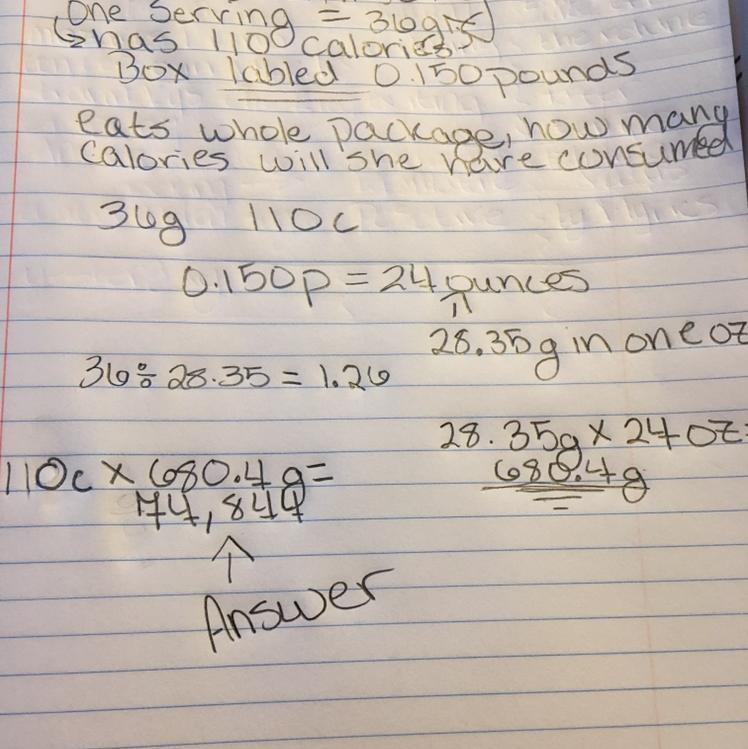
answer.
Ask question
Login Signup
Ask question
All categories
  • English
  • Mathematics
  • Social Studies
  • Business
  • History
  • Health
  • Geography
  • Biology
  • Physics
  • Chemistry
  • Computers and Technology
  • Arts
  • World Languages
  • Spanish
  • French
  • German
  • Advanced Placement (AP)
  • SAT
  • Medicine
  • Law
  • Engineering
monitta
1 day ago
14

Convert 338 L at 63.0 atm to its new volume at standard pressure.

Chemistry
1 answer:
lions [985]1 day ago
7 0

The new volume at a standard pressure of 1 atm is 21294 liters.

Explanation:

Provided data:

Initial volume of the gas V1 = 338 liters

Initial pressure on the gas P1 = 63 atm

Standard pressure P2 = 1 atm

Final volume at standard pressure V2 =?

The equation of Boyle's law is applied here:

P1V1 = P2V2

To find V2, rearranging gives us:

V2 = \frac{P1V1}{P2}

Substituting the values:

V2 = \frac{338X63}{1}

     = 21294 L

When the pressure is lowered to 1 atm, the gas volume expands significantly to 21294 liters.

You might be interested in
The graph above shows the changes in temperature recorded for the 2.00 l of h2o surrounding a constant-volume container in which
Alekssandra [968]

Answer:

25.2 kJ

Explanation:

The full question can be found in the image linked to this response.

It's important to highlight that the heat absorbed by the 2.00 L of water for increasing its temperature from the beginning to the end comes solely from the burning of benzoic acid, as there are no heat transfers to the container or the surroundings.

To find the heat released from benzoic acid combustion, we simply measure the heat needed to warm the water.

Q = mCΔT

To find the mass of the water,

Density = (mass)/(volume)

Mass = Density × volume

Density = 1 g/mL

Volume = 2.00 L = 2000 mL

Mass = 1 × 2000 = 2000 g

C = specific heat of water = 4.2 J/g.°C

ΔT = (final temperature) - (Initial temperature)

<pAccording to the graph,

Final water temperature = 25°C

Initial water temperature = 22°C

ΔT = 25 - 22 = 3°C

Q = (2000×4.2×3) = 25,200 J = 25.2 kJ

Hope this Helps!!!

6 0
8 days ago
Compaction is most significant as a lithification process for sedimentary rocks composed of sand-sized particles. True False
VMariaS [1037]

Response:

FALSE

Rationale:

Sedimentary rocks are defined as rocks formed through the processes of compaction and cementation. Initially, sediments derived from various locations must accumulate. Over time, these deposited sediments undergo substantial compaction due to the weight of the layers above. This process converts loose sediments into solid rock. This is the process through which sedimentary rocks, comprised of sand-sized particles, are formed. For instance, examples include Shale, Sandstone, and Mudstone.

Thus, both compaction and cementation are crucial in the formation of sedimentary rocks.

Therefore, the statement above is False.

8 0
5 days ago
Butane (c4h10) undergoes combustion in excess oxygen to generate gaseous carbon dioxide and water. given δh°f[c4h10(g)] = –124.7
KiRa [971]

The Δ H value for butane (g) is -124.7 kJ/mol.

The Δ H value for CO2 (g) is -393.5 kJ/mol.

The Δ H value for H2O (g) is -241.8 kJ/mol.

The mass of butane is 8.30 grams.

Butane has a molar mass of 58 g/mol.

Considering the reaction,

C₄H₁₀ + 6.5 O₂ = 4CO₂ + 5H₂O

To determine the Δ H° of the reaction:

ΔH°rxn = ∑nH° f (products) - ∑nH° f (reactants)

By substituting values, we find that

Δ H° rxn = 4 (-393.5) + 5 (-241.8) - (-124.7)

= -1574 -1209 + 124.7

= -2783 - 124.7

= -2658.3 kJ/mol

Now, we will calculate how many moles of butane are in 8.30 grams.

Number of moles = mass/molar mass

= 8.30 / 58

= 0.143 moles

Therefore, the total energy released during the reaction is given by,

Q = number of moles × ΔH° rxn

= 0.143 × (2658.3)

= 380.14 kJ

Thus, the total heat released in the reaction is 380.14 kJ.

6 0
6 days ago
Citric acid is a naturally occurring compound. what orbitals are used to form each indicated bond? be sure to answer all parts.2
alisha [964]

Response: Below are the orbitals responsible for each bond identified in citric acid per the attachment.

Response 1) σ Bond a: Carbon uses SP^{2} and Oxygen employs SP^{2}.

Clarification: The sigma bonds are formed through the hybrid orbitals of carbon and oxygen. This occurs at the 'a' location in the citric acid structure.

Response 2) π Bond a: Both Carbon and Oxygen have π orbitals.

Clarification: The π-bond at position 'a' consists of interactions between the π orbitals of carbon and oxygen.

Response 3) Bond b: Oxygen SP^{3} and Hydrogen solely utilizes the S orbital.

Clarification: The bonding at position 'b' includes oxygen and hydrogen atoms, with hydrogen utilizing its S orbital.

Response 4) Bond c: Carbon is SP^{3} and Oxygen is also SP^{3}.

Clarification: The bonding process at position 'c' involves both carbon and oxygen atoms with their respective hybrid orbitals.

Response 5) Bond d: Carbon atom has SP^{3} and the second carbon has SP^{3}.

Clarification: In position 'd', the bond formed between carbon atoms is SP^{3}, utilizing orbitals that underwent SP^{3} hybridization which are SP^{3}.

Response 6) Bond e: C1 has O SP^{2}.

C2 has SP^{3}.

Clarification: The carbon that contains oxygen and a double bond utilizes SP^{2} hybridized orbitals; conversely, carbon at C2 employs SP^{3} hybridized orbitals in this bonding at position 'e'.

7 0
9 days ago
You are given a piece of paper and a match. The paper has a mass of 2.5 g. You then light the match and light the piece of paper
KiRa [971]

Answer:

No

Explanation:

No. The demonstration in question does not infringe upon the conservation of mass.

The law of conservation of mass states that mass cannot be created or destroyed in a chemical reaction; however, mass can change from one form to another during the process.

In this instance, although the remnants of the paper weigh 0.5 g compared to the original weight of 2.5 g, the ashes and gases produced during combustion account for the missing mass of the paper.

The portion that has been burnt has transformed into other states. If the gas and ashes are adequately contained, they will correspond to the weight of the original paper when added to the remaining paper.

5 0
1 day ago
Other questions:
  • Why did we use a mixture of ethanol and water to perform the reaction between the oil and naoh?
    8·1 answer
  • What volume (ml) of a 0.2450 m koh(aq) solution is required to completely neutralize 55.25 ml of a 0.5440 m h3po4(aq) solution?
    9·1 answer
  • In a car crash, large accelerations of the head can lead to severe injuries or even death. A driver can probably survive an acce
    5·1 answer
  • 2. Your company currently uses a process with a similar cost of materials that has an
    6·1 answer
  • How would you convert 500cc of 2M H2SO4 into g/l?​
    14·2 answers
  • If 75.0% of the isotopes of an element have a mass of 35.0 amu and 25.0% of the isotopes have a mass of 37.0amu what is the atom
    10·2 answers
  • Calculate the molarity of a 23.55-ml solution which contains 28.24 mg of sodium sulfate (used in dyeing and printing textiles, =
    9·1 answer
  • A gas at 928 kpa, 129 C occupies a volume of 569 L. Calculate the volume at 319 kpa and<br> 32 C.
    10·1 answer
  • How many known elements have atoms, in their ground-state, with valence electrons whose quantum numbers are n = 5 and l = 1?a. 3
    9·1 answer
  • If 4.35 g of phosphoric acid are added to 5.25g of KOH, what is the percent yield of the reaction if only 3.15g of potassium pho
    10·1 answer
Add answer
Login
Not registered? Fast signup
Signup
Login Signup
Ask question!