answer.
Ask question
Login Signup
Ask question
All categories
  • English
  • Mathematics
  • Social Studies
  • Business
  • History
  • Health
  • Geography
  • Biology
  • Physics
  • Chemistry
  • Computers and Technology
  • Arts
  • World Languages
  • Spanish
  • French
  • German
  • Advanced Placement (AP)
  • SAT
  • Medicine
  • Law
  • Engineering
Yuri
1 month ago
5

In thionyl chloride, cl2so (s is the central atom), the formal charge on sulfur and number of lone pairs on sulfur are, respecti

vely, (assume all the atoms obey the octet rule) g

Chemistry
2 answers:
alisha [2.7K]1 month ago
5 0

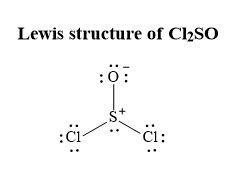
Sulfur in the thionyl compound carries a formal charge of +1 and possesses two lone electrons, which constitutes one lone pair.

Additional Explanation

Lewis Structures

To ascertain the formal charge and count of lone pairs, it is crucial to first construct the Lewis structure. The steps to delineate lone pairs are as follows:

  1. Calculate the total valence electrons by adding the valence electrons of each atom in the compound.
  2. Identify the central atom.
  3. Position the remaining atoms around the central atom, connecting each with a single bond. Each bond corresponds to 2 of the total valence electrons shared.
  4. Distribute any leftover valence electrons to the terminal atoms, prioritizing one until it reaches an octet, then proceed to the next. If all terminal atoms satisfy the octet rule, remaining electrons go to the central atom.

For thionyl chloride, sulfur serves as the central atom, and the overall valence electron count is:

Cl = 7 × 2 = 14

S = 6

O = 6

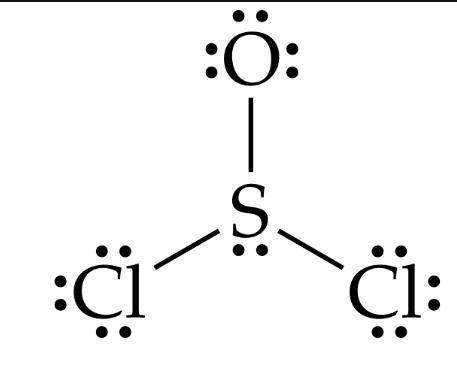
Total Valence Electrons = 14 + 6 + 6 = 26 electrons. Following these steps generates the corresponding Lewis structure shown in the attachment.

Having established the Lewis structure, the number of lone pairs on the central atom can be determined. In thionyl chloride, sulfur possesses two unshared electrons, signifying one lone pair.

Formal Charge Assessment

The electron distribution in a molecule is defined through the formal charges on its atoms. A formal charge reflects the disparity between the electrons surrounding an atom in a molecule versus when it is isolated. For molecular stability, formal charges across all atoms need to be minimized.

The formula for formal charge calculation is:

Formal Charge = # valence electrons for isolated atom - (# bonds + non-bonding electrons)

For the thionyl compound, sulfur's formal charge is evaluated using this formula in conjunction with the Lewis Structure:

  • Valence Electrons of a Sulfur atom = 6
  • Number of bonds surrounding Sulfur = 3
  • Number of non-bonding electrons on Sulfur = 2

Formal Charge of S = 6 - (3 + 2)

Formal Charge of S = +1

This indicates that sulfur possesses fewer electrons in the molecule than it would as an isolated atom.

Further Exploration

  1. Lewis Structure
  2. Valence Electrons

Key Terms: formal charge, lone pairs

KiRa [2.7K]1 month ago
4 0

In thionyl chloride, the formal charge on sulfur is \boxed{+1} while the number of lone pairs on sulfur is \boxed{1}. (For the structure, please refer to the attached image).

Additional Explanation:

Lewis structures are used to illustrate the bonding arrangements between atoms in covalent compounds. They are sometimes referred to as electron dot diagrams, Lewis dot structures, or Lewis dot formulas.

The Lewis structure of \text{Cl}_2\text{SO} (see the attached image for reference):

The total valence electrons of \text{Cl}_2\text{SO} can be calculated as follows:

\begin{aligned}\text{Total valence electrons}=&\text{(2)(valence electron in Cl)}\\&+\text{(1)(valence electron in S)}\\&+\text{(1)(valence electron in O)}\\ =&\text{[(2)(7)+(1)(6)+(1)(6)]}\\=&26\end{aligned}

Sulfur forms one double bond with an oxygen atom and two single bonds with chlorine atoms. From the total of 26 electrons, eight are used in creating one S-O double bond plus two S-Cl single bonds, leaving 18 electrons remaining. Each chlorine atom retains three lone pairs, the oxygen atom holds two lone pairs, and sulfur has one lone pair.

Formal charge on an atom considers equal sharing in chemical bonds irrespective of the atoms' electronegativities.

The formal charge calculation formula is:

\begin{aligned}\text{Formal charge}=&\text{(total number of valence electrons in the free atom)}\\&-\left(\text{total number of non-bonding electrons}\right)\\&-\left[\dfrac{\left(\text{total number of bonding electrons}\right)}{2}\right]\end{aligned}...... (1)

Sulfur participates in three single bonds—one with an oxygen atom and two with distinct chlorine atoms—and has one lone pair.

The total number of valence electrons for a free sulfur atom is 6.

The total number of non-bonding electrons in the sulfur atom is 2.

The total binding electrons around sulfur sum up to 6.

With these values substituted into equation (1), we can find sulfur's formal charge.

\begin{aligned}\text{Formal charge on S}&=\left[6-2-\dfrac{6}{2}\right]\\&=+1\end{aligned}

Further Insights:

1. Molecular geometry surrounding the central atoms in glycine:

2. Constructing resonance structures for the azide ion:

Response Details:

Grade: Senior School

Subject: Chemistry

Chapter: Molecular structure and chemical bonding

Key Terms: Lewis structure, valence electrons, sulfur, S atom, formal charge, +1, 6, 2, lone pair.
You might be interested in
Which of the options below show typical bonding patterns for a neutral nitrogen atom in a molecule or polyatomic ion?
alisha [2704]
More information is needed, but in general, a polyatomic ion consists of multiple atoms bonded together, often with instability that affects their bonding patterns.
7 0
1 month ago
A student puts 0.020 mol of methyl methanoate into an empty and rigid 1.0 L vessel at 450 K. The pressure is measured to be 0.74
KiRa [2711]

Explanation:

Initial moles of ethanoic acid = 0.020 mol

At equilibrium, half of the ethanoic acid molecules have reacted.

Thus, moles of ethanoic acid reacted = 0.020 mol * (50% / 100%)

                                                                     = 0.010 mol

Moles of ethanoic acid remaining = 0.020 mol - 0.010 mol = 0.010 mol

The moles of product (CH3COOH)^{2} gas formed are determined as follows:

0.010 mol CH3COOH * (1 mol (CH3COOH)^{2} / 2 mol CH3COOH)

= 0.005 mol (CH3COOH)^{2}

Consequently, the total moles of gas present in the vessel at equilibrium are 0.010 mol CH3COOH and 0.005 mol (CH3COOH)^{2}

Total gas moles at equilibrium = 0.010 mol + 0.005 mol = 0.015 mol

Next, let’s determine the pressure:

0.020 mol of gas has a pressure of 0.74 atm; so under the same conditions, we find the pressure exerted by 0.015 mol of gas:

P1/n1 = P2/n2

P2 = P1*(n2 / n1)

      = 0.74 atm * (0.015 mol / 0.020 mol)

     = 0.555 atm

4 0
1 month ago
What are the respective central-metal oxidation state, coordination number, and overall charge on the complex ion in Na2[Cr(NH3)
lions [2649]

Answer:

Central metal oxidation state: +2

Coordination number: 6

Overall charge: -2

Explanation:

For the ion complex:

Na₂[Cr(NH₃)₂(NCS)₄]

The central metal is chromium, with NH₃ and NCS as the ligands.

NH₃ acts as a neutral ligand, while NCS carries a negative charge.

The entire complex has a charge of:

2Na⁺ +  [Cr(NH₃)₂(NCS)₄]⁻² → -2

Since each NCS contributes -1 and there are four NCS, the Cr must possess an oxidation state of +2 to achieve an overall charge of -2.

With 2 NH₃ and 4 NCS attached, the coordination number sums to 2+4 = 6

I trust this clarifies the matter!

6 0
29 days ago
(a) The mass density of a gaseous compound was found to be 1.23 kg m^−3 at 330 K and 20 kPa. What is the molar mass of the compo
castortr0y [2731]

Answer:

La masa molar del compuesto es: 168.82 g/mol

La masa molar del gas es: 16.38 g/mol

Explanation:

(a)

Utilizando la ecuación de gases ideales:

PV=nRT

donde,

P es la presión

V es el volumen

n es el número de moles

T es la temperatura

R es la constante de los gases, cuyo valor es = 0.0821 L.atm/K.mol

Además,

Moles = masa (m) / Masa molar (M)

La densidad (d) = Masa (m) / Volumen (V)

Así, la ecuación de gases ideales se puede expresar como:

PM=dRt

Dado que:-

Presión = 20 kPa = 20000 Pa

La expresión para la conversión de presión en Pascal a presión en atm se muestra a continuación:

P (Pa) = \frac {1}{101325} P (atm)

20000 Pa = \frac {20000}{101325} atm

Presión = 0.1974 atm

Temperatura = 330 K

d = 1.23 kg/m³ = 1.23 g/L

Masa molar =?

Aplica la fórmula:

0.1974 atm × M = 1.23 g/L × 0.0821 L.atm/K.mol × 330 K

⇒M = 168.82 g/mol

La masa molar del compuesto es: 168.82 g/mol

(b)

Dado que:

Presión = 152 Torr

Temperatura = 298 K

Volumen = 250 cm³ = 0.25 L

Utilizando la ecuación de gases ideales:

PV=nRT

R = 62.3637\text{torr}mol^{-1}K^{-1}

Aplicando la fórmula:

152 Torr × 0.25 L = n × 62.3637 L.torr/K.mol × 298 K

⇒n = 0.002045 moles

Dado que:

Masa del gas = 33.5 mg = 0.0335 g

Masa molar =?

La fórmula para calcular los moles se muestra a continuación:

moles = \frac{Mass\ taken}{Molar\ mass}

Así,

0.002045\ moles
= \frac{0.0335\ g}{Molar\ mass}

La masa molar del gas es: 16.38 g/mol

5 0
1 month ago
The combustion of propane (c3h8) produces co2 and h2o: c3h8 (g) + 5o2 (g) → 3co2 (g) + 4h2o (g) the reaction of 2.5 mol of o2 wi
Anarel [2600]
The reaction will yield 2 mol of H₂O. The balanced chemical equation for this process is: c3h8 (g) + 5o2 (g) → 3co2 (g) + 4h2o (g). Since 5 moles of O₂ create 4 moles of H₂O, 2.5 mol of O₂ will produce: 2.5 x 4/5 = 2 mol of H₂O.
8 0
17 days ago
Other questions:
  • A 0.784 g sample of magnesium is added to a 250 ml flask and dissolved in 150 ml of water. magnesium hydroxide obtained from the
    11·1 answer
  • Convert 3.8 Km/sec to miles/year
    12·1 answer
  • Common additives to drinking water include elemental chlorine, chloride ions, and phosphate ions. Recently, reports of elevated
    8·1 answer
  • 3. For the reaction: 2X + 3Y 3Z, the combination of 2.00 moles of X with 2.00
    6·1 answer
  • Magnesium has an atomic mass of 24.3. there are two isotopes of magnesium - one contains 12 neutrons and the other contains 13 n
    7·1 answer
  • The Rydberg constant is 3.3 x 10 15 Hz. this value is also
    10·2 answers
  • Two substances in a mixture differ in density and particle size. These properties can be used to
    7·1 answer
  • The volume of the ideal gas in the container is 9 m3. What would the volume be if four more blocks were placed on top of the lid
    5·1 answer
  • How would a flood be a limitation for synthetic polymers that rely on natural rubber in its production?
    5·2 answers
  • H2PO4-(aq) ⇆ H+(aq) + HPO42-( which ion plays the role of hydrogen ion donor and which one plays the hydrogen ion acceptor in BP
    14·1 answer
Add answer
Login
Not registered? Fast signup
Signup
Login Signup
Ask question!