answer.
Ask question
Login Signup
Ask question
All categories
  • English
  • Mathematics
  • Social Studies
  • Business
  • History
  • Health
  • Geography
  • Biology
  • Physics
  • Chemistry
  • Computers and Technology
  • Arts
  • World Languages
  • Spanish
  • French
  • German
  • Advanced Placement (AP)
  • SAT
  • Medicine
  • Law
  • Engineering
yuradex
18 days ago
11

A 1200-ft equal-tangent crest vertical curve is currently designed for 50 mi/h. A civil engineering student contends that 60 mi/

h is safe in a van because of the higher driver’s-eye height. If all other design inputs are standard, what must the driver’s-eye height (in the van) be for the student’s claim to be valid?

Physics
1 answer:
serg [2.5K]18 days ago
7 0

Response:

8.95ft

Explanation:

For tackling this issue, two key concepts should be evaluated:

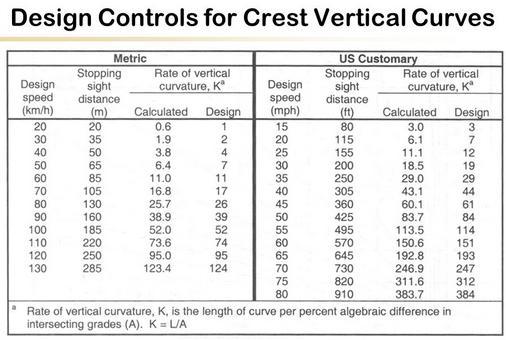
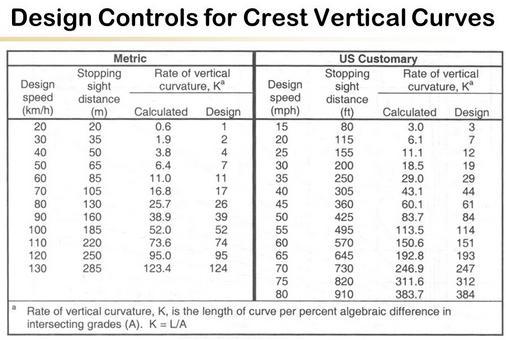
First, the design of vertical curves should be considered using the general equation defining the length of a vertical crest curve, based on the differences in gradients. Also, the Design Controls for Crest vertical curves table is useful (a table is attached at the bottom).

The equation for this is written as:

L = \frac{AS^2}{200(\sqrt{h_1}+\sqrt{h_2})^2}

Where,

L = length of vertical curve

S = Sight distance

A = Algebraic difference in gradients

h_1 = Height of eye above road level

h_2 = height of object above road surface

From the provided table, it's determined that at a design speed of 60 mi/h, S measures 570 ft. The vertical curve rate K at a design speed of 50 mi/h is 84.

Next, we can calculate the algebraic difference in gradients as follows:

A= \frac{L}{K}

A = \frac{1200}{84}

A = 14.285

Using the equation to calculate h_1, we find:

L = \frac{AS^2}{200(\sqrt{h_1}+\sqrt{h_2})^2}

1200 = \frac{14.32(570)^2}{200(\sqrt{h_1}+\sqrt{2})^2}

Solving for h_1

h_1 = 8.95ft

Thus, the height of the driver's eye is 8.95ft
You might be interested in
What is the angular acceleration of the pencil when it makes an angle of 10.0 degrees with the vertical?
Sav [2226]
<span>  </span><span>When the net torque and moment of inertia are given, calculating becomes straightforward.

Using the equation torque = I * alpha, where I represents the moment of inertia and alpha is the angular acceleration.

Consequently, 0.098 / 0.000075 results in 1306.666... rad / s^2

While the angular acceleration stays the same, you can also determine the angular velocity at that instance, which is 21.36 rad / s.</span>
6 0
18 days ago
Read 2 more answers
A transformer is to be designed to increase the 30 kV-rms output of a generator to the transmission-line voltage of 345 kV-rms.
inna [2205]

Answer:

n_s = 920 \turns

Explanation:

Given,

Voltage of the primary coil (V_p) = 30 kV-rms

Voltage of the secondary coils (V_s) = 345 kV-rms

number of turns in the primary coil (n_p) = 80 turns

number of turns in the secondary coil (n_s) =?

the ratio of turns between primary and secondary coils

     \dfrac{n_p}{n_s} = \dfrac{V_p}{V_s}

     \dfrac{n_s}{n_p} = \dfrac{V_s}{V_p}

     n_s = n_p \dfrac{V_s}{V_p}

     n_s = 80\times \dfrac{345}{30}

     n_s = 80\times 11.5

     n_s = 920 \turns

The number of turns in the secondary coil is equal to n_s = 920 \turns

4 0
21 day ago
If you accidentally touch the "hot" wire connected to the 120 V line, how much current will pass through your body?
serg [2593]

Complete Question:

Picture yourself on an aluminum ladder on the ground, attempting to fix an electrical connection with a metal screwdriver featuring a metallic handle. Since you are sweating profusely, your body has a resistance of 1.60 kΩ.

(a) If you accidentally contact the "hot" wire from the 120 V power line, what current will flow through your body?

(b) What is the amount of electrical power transferred to your body?

Answer:

(a) 0.075A

(b) 9W

Explanation:

According to Ohm's law, the voltage (V) applied to or passing through a body corresponds to the current (I) via the relationship:

V ∝ I

=> V = I x R                 ----------------------(i)

Where;

R denotes the resistance of the body

(a) As mentioned;

Due to wet conditions, the body will conduct electricity, and possesses the following values;

V = supplied voltage = 120V

R = resistance of the wet body = 1.60kΩ = 1.6 x 1000Ω = 1600Ω

Substituting these values into equation(i):

120 = I x 1600

To find I;

I = \frac{120}{1600}

I = 0.075A

Thus the current passing through your body is 0.075A

(b) Electrical power (P), which is expressed in Watts (W), delivered to the body is the product of current (I) and voltage (V) received. Thus:

P = I x V           ---------------------(ii)

Where;

I equates to 0.075A   [as derived above]

V is 120V     [as outlined in the question]

Plugging these values into equation (ii):

P = 0.075 x 120

P = 9W

Hence, the electrical power received by your body is 9W

7 0
14 days ago
A typical reaction time to get your foot on the brake in your car is 0.2 second. If you are traveling at a speed of 60 mph (88 f
inna [2205]

Explanation:

Insufficient details. It heavily relies on the technical specifications of the vehicle (the information supplied merely pertains to reaction time in humans, without accounting for the delay involved when the brakes are applied

5 0
6 days ago
Read 2 more answers
In this lab, you will use a dynamics track to generate collisions between two carts. If momentum is conserved, what variable cha
Ostrovityanka [2204]

Using momentum conservation, we can express it as

m_1v_{1i} + m_2v_{2i} = m_1v_{1f} + m_2v_{2f}

This implies that the speed following the collision is influenced by the mass of both objects involved.

If the masses of the two colliding objects are modified, the resulting speed shifts as well.

For instance,

When two objects share identical mass, their speeds will be exchanged post-collision.

In contrast, if one object is significantly heavier than the other, its velocity remains unchanged after the collision.

Thus, altering the mass will alter the speed of the object subsequent to the collision.

The resulting speed after the collision can be represented as

v_{1f} = \frac{m_1 - m_2}{m_1+m_2}v_{1i} + \frac{2m_2}{m_1+m_2}v_{2i}

v_{2f} = \frac{m_2 - m_1}{m_1+m_2}v_{2i} + \frac{2m_1}{m_1+m_2}v_{1i}

Through these formulas, we can demonstrate how the speeds are linked to the mass.

8 0
26 days ago
Read 2 more answers
Other questions:
  • A bus slows down uniformly from 75.0 km/h to 0 km/h in 21 s. How far does it travel before stopping?
    10·2 answers
  • Multiply the number 4.48E-8 by 5.2E-4 using Google. What is the correct answer in scientific notation?
    8·1 answer
  • A firecracker breaks up into several pieces, one of which has a mass of 200 g and flies off along the x-axis with a speed of 82.
    14·1 answer
  • A proton starts from rest and gains 8.35 x 10^-14 joule of kinetic energy as it accelerates between points A and B in an electri
    14·2 answers
  • A uniform 1.0-N meter stick is suspended horizontally by vertical strings attached at each end. A 2.0-N weight is suspended from
    8·1 answer
  • What is the number N0 of 99mTc atoms that must be present to have an activity of 15mCi?
    11·1 answer
  • Bursitis can affect many joints and can be caused by a numerous sporting activities, such as cycling, tennis, and long-distance
    7·2 answers
  • Driving down a quiet street on a summer day with the car windows down, you see a convertible approaching from the opposite direc
    12·1 answer
  • Suppose that A’, B’ and C’ are at rest in frame S’, which moves with respect to S at speed v in the +x direction. Let B’ be loca
    10·1 answer
  • The ____ button on the rehearsal toolbar clears the slide time box and resets the timer to 0:00:00.
    14·1 answer
Add answer
Login
Not registered? Fast signup
Signup
Login Signup
Ask question!