answer.
Ask question
Login Signup
Ask question
All categories
  • English
  • Mathematics
  • Social Studies
  • Business
  • History
  • Health
  • Geography
  • Biology
  • Physics
  • Chemistry
  • Computers and Technology
  • Arts
  • World Languages
  • Spanish
  • French
  • German
  • Advanced Placement (AP)
  • SAT
  • Medicine
  • Law
  • Engineering
Dominik
11 days ago
8

A chemist mixes two liquids A and B to form a homogeneous mixture. The densities of the liquids are 2.0514 g/mL for A and 2.6678

g/mL for B. When she drops a small object into the mixture, she finds that the object becomes suspended in the liquid; that is, it neither sinks nor floats. If the mixture is made of 41.37 percent A and 58.63 percent B by volume, what is the density of the object? Can this procedure be used in general to determine the densities of solids? What assumptions must be made in applying this method?
Chemistry
1 answer:
Anarel [2.5K]11 days ago
4 0

Answer:

a) The object's density measures 1.9302 g/mL

b) The method employed to ascertain the density of a solid utilizes the principle of Archimedes

c) To utilize this method, assumptions regarding the overall volume of the fluid mixture and the fraction of the solid that is submerged must be made

Explanation:

  • Assuming the mixture's total volume:  vAB = 1000 mL

From which we derive vA = 413.7 mL   ∧    vB = 586.3 mL

The density of the mixed solution (A+B) can be calculated as mass AB / volume AB

Thus, mAB = mA + mB

We find mA using vA * dA = 413.7 mL * 2.0514 g/mL = 848.664 g for A

And mB computes as vB * dB = 586.3 mL * 2.6678 g/mL = 1564.13 g for B

Leading to mAB = 2412.795 g for AB

Density of mixture = 2412.795 g / 1000 mL = 2.4127 g/mL for AB

Beginning with Archimedes' principle for finding the density of a solid within a liquid, we state:

  • E = dAB * g * Vs........ (1)

Where Vs is the submerged volume;

E is the fluid weight displaced by the solid

dAB is the density of the mixture

g is the acceleration due to gravity

In force equilibrium: ∑F = 0

This gives us E - Wsolid = 0

Thus, E = Wsolid

And Wsolid = msolid * g........... (2)

Equating (1) and (2) gives us msolid * g = dAB * g * Vs

Thus, msolid ultimately equals dsolid * Vs......(3)

In assuming that 80% of the solid is submerged in the mixture, we have:

Vs = 0.8 * Vsolid.....(4)

By substituting (4) into (3):

dsolid * Vsolid = dAB * 0.8 * Vsolid leads us to dsolid = dAB * 0.8

Thus, dsolid = 2.4127 g/mL * 0.8 = 1.9302 g/mL

You might be interested in
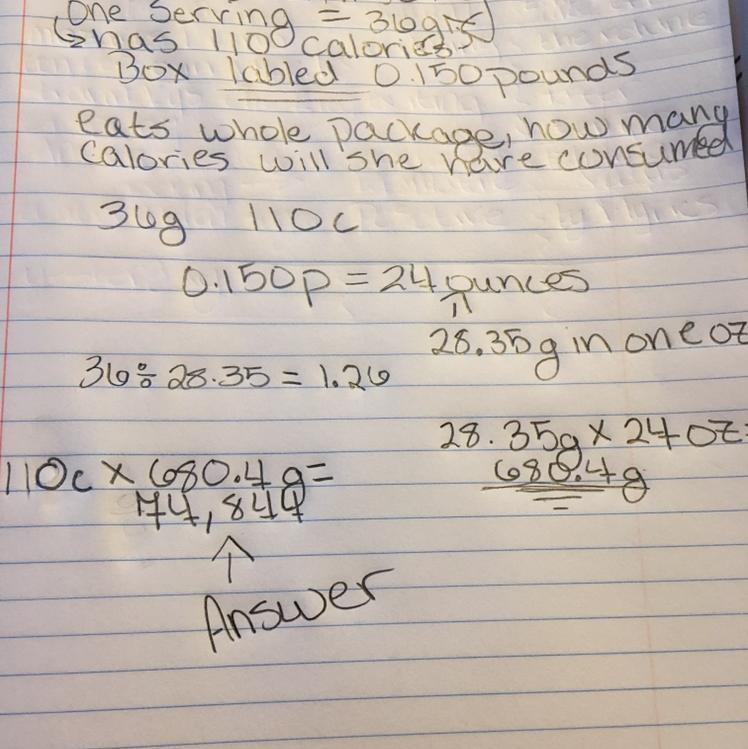
Eva buys a package of food, and the nutrition label says that
lorasvet [2495]

The answer is a total of 74,844 calories.

8 0
1 month ago
A 0.680 M Ca(OH)2 solution was prepared by dissolving 55.0 grams of Ca(OH)2 in enough water. What is the total volume of the sol
castortr0y [2694]
Convert 55.0g Ca(OH)2 to moles.

The calculation shows that 55.0g of Ca(OH)2 corresponds to 0.742 moles.

To find the volume, divide 0.742 mol of Ca(OH)2 by its molarity of 0.680M, yielding approximately 1.09L of Ca(OH)2.

If you disregard the negligible volume of the Ca(OH)2 itself, the resulting total volume of a 0.680M solution created by dissolving 55.0g of Ca(OH)2 in an appropriate amount of water would be 1.09L.
4 0
1 month ago
Read 2 more answers
Assuming equal concentrations of conjugate base and acid, which one of the following mixtures is suitable for making a buffer so
KiRa [2657]

Answer:NH₃/NH₄Cl

Explanation:

The pH of a buffer can be determined using Henderson-Hasselbalch's equation.

pH=pKa+log\frac{[base]}{[acid]}

When the concentration of acid equals that of the base, the pH aligns with the pKa of the buffer. The ideal pH range is pKa ± 1.

Below are the buffers and their corresponding pKa values:

  • CH₃COONa/CH3COOH (pKa = 4.74)
  • NH₃/NH₄Cl (pKa = 9.25)
  • NaOCl/HOCl (pKa = 7.49)
  • NaNO₂/HNO₂ (pKa = 3.35)
  • NaCl/HCl Not a buffer

Thus, the ideal buffer is NH₃/NH₄Cl.

4 0
18 days ago
11. If there are 8.24 x 10²² molecules of NaCl in a salt shaker, what is the mass of the salt?
lorasvet [2495]
To determine the mass of salt using Avogadro's number, we find the moles of NaCl: 8.24x10²² molecules NaCl divided by 6.022x10²³ molecules NaCl per mole gives 0.14 mole NaCl. We can convert moles to grams of NaCl by multiplying 0.14 mole by 58g NaCl per mole, yielding a total of 8.12 g NaCl.
6 0
10 days ago
mixture or pure substance: 1.blood 2.dyes 3.self-raising flour 4.muesli 5.copper wire 6.distilled water 7.table salt 8.milk 9.br
alisha [2704]

Answer: Mixture: Blood, Self raising flour,muesli,dyes, milk, tea, air, bronze

Pure substance: Copper wire, distilled water, table salt, oxygen.

Explanation:

A mixture is a substance composed of two or more compounds which are chemically independent and keep their individual chemical properties.

Examples: Blood, Self raising flour,muesli,dyes, milk, tea, air, bronze

A pure substance is defined as something with a uniform and constant composition and is called a pure substance.

Examples: Copper wire, distilled water, table salt, oxygen.

5 0
19 days ago
Other questions:
  • Clayton will mix xxx milliliters of a 10\%10%10, percent by mass saline solution with yyy milliliters of a 20\%20%20, percent by
    7·1 answer
  • Assuming that only the listed gases are present, what would be the mole fraction of oxygen gas be for each of the following situ
    5·1 answer
  • If the balloon described in Question 10.24 is released into the air and rises to an altitude of 10,000 ft where the atmospheric
    12·1 answer
  • Calculate the pressure of O2 (in atm) over a sample of NiO at 25.00°C if ΔG o = 212 kJ/mol for the reaction. For this calculatio
    7·1 answer
  • A pan containing 20.0 grams of water was allowed to cool from a temperature of 95.0 °C. If the amount of heat released is 1,200
    7·1 answer
  • Calculate the value of E°cell for the following reaction:2Au(s) + 3Ca2+(aq) → 2Au3+(aq) + 3Ca(s)Au3+(aq) + 3e- → Au(s) E° = 1.50
    14·1 answer
  • How many milliliters of 3.00 M H2SO4 are required to react with 4.35 g of solid containing 23.2 wt% Ba(NO3)2 if the reaction is
    8·1 answer
  • The solid compound, K2SO4, contains?
    5·1 answer
  • A mixture of KCl and KNO3
    7·2 answers
  • How many hydrogen atoms are in the following molecule of ammonium sulfide? (NH4)2S
    8·2 answers
Add answer
Login
Not registered? Fast signup
Signup
Login Signup
Ask question!