answer.
Ask question
Login Signup
Ask question
All categories
  • English
  • Mathematics
  • Social Studies
  • Business
  • History
  • Health
  • Geography
  • Biology
  • Physics
  • Chemistry
  • Computers and Technology
  • Arts
  • World Languages
  • Spanish
  • French
  • German
  • Advanced Placement (AP)
  • SAT
  • Medicine
  • Law
  • Engineering
gizmo_the_mogwai
1 day ago
15

Ocean waves are observed to travel to the right along the water surface during a developing storm. A Coast Guard weather station

observes that there is a vertical distance from high point to low point of 4.6 meters and a horizontal distance of 8.6 meters between adjacent crests. The waves splash into the station once every 6.2 seconds. Determine the amplitude, wavelength, frequency and period of these waves. Write out the equation that governs this behavior.

Physics
1 answer:
inna [2.2K]1 day ago
6 0
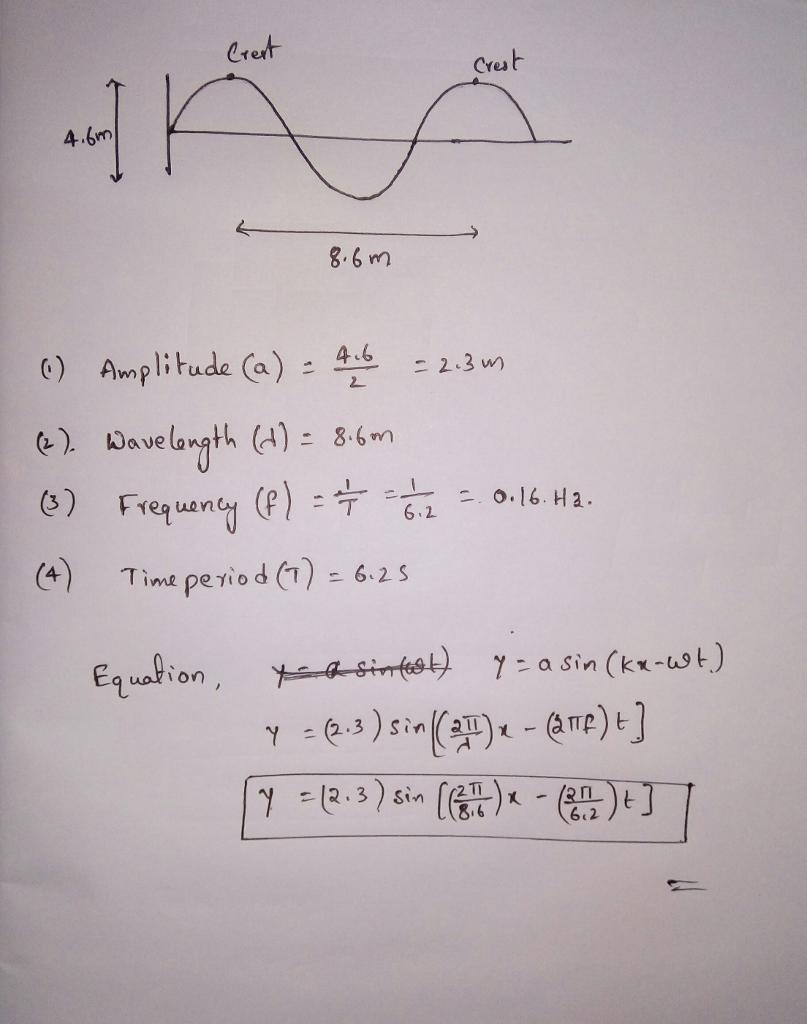
The amplitude is 2.3 m. The wavelength is 8.6 m. The frequency equals 0.16 Hz. The period lasts for 6.25 seconds. The governing equation for this behavior is. The details are illustrated in the initial uploaded image.
You might be interested in
A 5-kg concrete block is lowered with a downward acceleration of 2.8 m/s2 by means of a rope. The force of the block on the Eart
Maru [2355]

The moment the body impacts the ground, two types of Forces are produced: the gravitational pull and the Normal Force. This aligns with Newton's third law, indicating that every action has an equal and opposite reaction. If the downward force of gravity is directed toward the earth, the reactionary force from the block acts upwards, equivalent to its weight:

F = mg

Where,

m = mass

g = gravitational acceleration

F = 5*9.8

F = 49N

Consequently, the answer is E.

5 0
17 days ago
The amount of kinetic energy an object has depends on its mass and its speed. Rank the following sets of oranges and cantaloupes
Sav [2226]

mass₃<mass₁=mass₅<mass₂=mass₄

Explanation:

Data points:-

1. mass:  m      speed: v

2. mass: 4 m   speed: v

3. mass: 2 m   speed: ¼ v

4. mass: 4 m   speed: v

5. mass: 4 m   speed: ½ v

We know that the formula for Kinetic energy (KE) is ½ mv²

Where m represents the mass of the object

           v represents the object's velocity

<psubstituting the="" given="" values="" for="" mass="" and="" speed="" from="" previous="" data:="">

The KE of Body 1(mass₁) = ½*m*v²             = mv²/2

KE of Body 2(mass₂) = ½*4m*v²         = 2mv²

KE of Body 3(mass₃) = ½*2m*(1/4v)²  =  mv²/16

KE of Body 4(mass₄) = ½*4m*v ²        =  2mv ²

KE of Body 5(mass₅) = ½*4m*(1/2v)²  =   mv²/2

</psubstituting>
6 0
17 days ago
a 75 kg man is standing at rest on ice while holding a 4kg ball. if the man throws the ball at a velocity of 3.50 m/s forward, w
Keith_Richards [2256]

Answer:

The resulting velocity for him will be 0.187 m/s in reverse direction.

Explanation:

Given:

The mass of the man is, M=75\ kg

The mass of the ball is, m=4\ kg

The initial velocity of the man is, u_m=0\ m/s(rest)

The initial velocity of the ball is, u_b=0\ m/s(rest)

The final velocity of the ball is, v_b=3.50\ m/s

The final velocity of the man is, v_m=?\ m/s

To determine this scenario, we employ the principle of momentum conservation.

This principle states that the total initial momentum equals the total final momentum.

Momentum is calculated by multiplying mass by velocity.

Initial momentum = Initial momentum of the man and the ball

Initial momentum = Mu_m+mu_b=75\times 0+4\times 0 =0\ Nm

Final momentum = Final momentum of the man and the ball

Final momentum = Mv_m+mv_b=75\times v_m+4\times 3.50 =75v_m+14

Hence, the total initial momentum equals the total final momentum

0=75v_m+14\\\\75v_m=-14\\\\v_m=\frac{-14}{75}\\\\v_m=-0.187\ m/s

The negative sign indicates that the man moves backward.

Thus, his final velocity ends up being 0.187 m/s backward.

3 0
4 days ago
Considering the activity series given for nonmetals, what is the result of the below reaction? Use the activity series provided.
ValentinkaMS [2425]

Response: The result would be no reaction.

Clarification:

7 0
9 days ago
Read 2 more answers
A car with an initial velocity of 16.0 meters per second east slows uniformly to 6.0 meters per second east in 4.0 seconds. What
serg [2593]
(6-16)/4.0=-2.5 m/s²
The car's acceleration is -2.5 m/s²
5 0
20 days ago
Other questions:
  • A hydraulic lift raises a 2000 kg automobile when a 500 N force is applied to the smaller piston. If the smaller piston has an a
    8·1 answer
  • How many electrons does it take to make 80 μc (microcoulombs) of charge?
    10·1 answer
  • The magnitude of the electrical force acting between a +2.4 × 10⁻⁸ C charge and a +1.8 × 10⁻⁶ C charge that are separated by 0.0
    5·2 answers
  • A person travels distance πR along the circumference
    6·2 answers
  • Suppose that now you want to make a scale model of the solar system using the same ball bearing to represent the sun. How far fr
    9·1 answer
  • If a woman weighs 125 lb, her mass expressed in kilograms is x kg, where x is
    9·2 answers
  • Find the lengths of each of the following vectors
    6·1 answer
  • An infinite sheet of charge is located in the y-z plane at x = 0 and has uniform charge denisity σ1 = 0.51 μC/m2. Another infini
    13·1 answer
  • A charge Q is distributed uniformly along the x axis from x1 to x2. What would be the magnitude of the electric field at x0 on t
    8·1 answer
  • A 1500 kg car enters a section of curved road in the horizontal plane and slows down at a uniform rate from a speed of 100 km/h
    13·1 answer
Add answer
Login
Not registered? Fast signup
Signup
Login Signup
Ask question!