answer.
Ask question
Login Signup
Ask question
All categories
  • English
  • Mathematics
  • Social Studies
  • Business
  • History
  • Health
  • Geography
  • Biology
  • Physics
  • Chemistry
  • Computers and Technology
  • Arts
  • World Languages
  • Spanish
  • French
  • German
  • Advanced Placement (AP)
  • SAT
  • Medicine
  • Law
  • Engineering
GrogVix
1 month ago
11

A 6.0-cm-diameter, 11-cm-long cylinder contains 100 mg of oxygen (O2) at a pressure less than 1 atm. The cap on one end of the c

ylinder is held in place only by the pressure of the air. One day when the atmospheric pressure is 100 kPa, it takes a 173 N force to pull the cap off.
Physics
1 answer:
Softa [3K]1 month ago
6 0

Explanation:

Here is the provided information:

Mass of oxygen contained = 100 mg = 100 \times 10^{-3} g

Thus, the moles of oxygen can be calculated using the following formula:

n = \frac{100 \times 10^{-3}}{32}

= 3.125 \times 10^{-3} moles

Diameter of the cylinder = 6 cm = 6 \times 10^{-2} m

= 0.06 m

Next, we can determine the cross-sectional area (A) as follows:

A = \pi \times \frac{(0.06)^{2}}{4}

= 2.82 \times 10^{-3} m^{2}

Length of the tube = 11 cm = 0.11 m

Thus, the volume (V) is given by 2.82 \times 10^{-3} \times 0.11

= 3.11 \times 10^{-4} m^{3}

For our calculations, we'll assume the internal pressure is P.

Moreover, P_{atm} = 100 kPa = 100000 Pa,

The pressure difference amounts to 100000 - P

Thus, the force required to open is calculated as follows:

Force = Pressure difference × A

= (100000 - P) \times 2.82 \times 10^{-3}

We are provided with the information that the force equals 173 N.

Thus,

(100000 - P) \times 2.82 \times 10^{-3} = 173

By solving, we find,

P = 3.8650 \times 10^{4} Pa

= 38.65 kPa

Using the ideal gas equation, PV = nRT

Hence, we will input the values into the equation as follows:

PV = nRT

38.65 \times 3.11 \times 10^{-4} = 3.125 \times 10^{-3} \times 8.314 \times T

T = 462.66 K

Consequently, we can deduce that the gas temperature is 462.66 K.

You might be interested in
The parasailing system shown uses a winch to pull the rider in towards the boat, which is traveling with a constant velocity. Du
ValentinkaMS [3465]

Answer:

The force magnitude is  F_{net}= 1.837 *10^4N

and it is directed at 57.98° from the horizontal in a counterclockwise manner.

Explanation:

The problem states that

At t = 0, \theta = 20^o

The angular rate of increase is w = 2 \ ^o/s

Converting to revolutions per second gives us  \theta ' = 2 \ ^o/s * \frac{\pi}{180} =0.0349\ rps

The rope length is defined by

                      r = 125- \frac{1}{3}t^{\frac{3}{2} }    

    At \theta =30^o, Tension T of the rope is 18 kN.

     The weight of the para-sailor is M_p = 75kg

In analyzing the question, we observe that the equation for length can be represented as a linear displacement equation.

 The derivative of displacement results in velocity.

Hence,

           r' = -\frac{1}{3} [\frac{3}{2} ] t^{\frac{1}{2} }

signifies the velocity, and further differentiation yields acceleration.

Therefore,

         r'' = -\frac{1}{4} t^{-\frac{1}{2} }

Now considering the moment when the rope forms a 30° angle with the water,

typically angular velocity is expressed as

                      w = \frac{\Delta \theta}{\Delta t}

where \theta represents the angular displacement.

Next, evaluating the interval from 20^o \ to \ 30^o gives us

                 2 = \frac{30 -20 }{t -0}

making t the focal point.

             t = \frac{10}{2}

               = 5s

At this time, the displacement measures

             r = 125- \frac{1}{3}(5)^{\frac{3}{2} }  

                = 121.273 m

The linear velocity computes to

             r' = -\frac{1}{3} [\frac{3}{2} ] (5)^{\frac{1}{2} }

                = -1.118 m/s

Whereas linear acceleration calculates as

          r'' = -\frac{1}{4} (5)^{-\frac{1}{2} }

              = -0.112m/s^2

Generally, radial acceleration is given by

         \alpha _R = r'' -r \theta'^2

              = -0.112 - (121.273)[0.0349]^2

              = 0.271 m/s^2

Simultaneously, angular acceleration can be represented as

                 \alpha_t = r \theta'' + 2 r' \theta '

Then \theta '' = \frac{d (0.0349)}{dt} = 0

Thus,

             \alpha _t = 121.273 * 0 + 2 * (-1.118)(0.0349)

                   = -0.07805 m/s^2

The resultant acceleration is mathematically denoted as

                a = \sqrt{\alpha_R^2 + \alpha_t^2 }

                  = \sqrt{(-0.07805)^2 +(-0.027)^2}

                  = 0.272 m/s^2

Now the acceleration's direction is mathematically expressed as

                  tan \theta_a = \frac{\alpha_R }{\alpha_t }

                       \theta_a = tan^{-1} \frac{-0.271}{-0.07805}

                           = 73.26^o


The y-axis force acting on the para-sailor is mathematically shown as

               F_y = mg + Tsin 30^o + ma sin(90- \theta )

                    = (75 * 9.8) + (18 *10^3) sin 30 + (75 * 0.272)sin(90-73.26)

                    = 9.74*10^3 N

The x-axis force acting on the para-sailor is represented as

              F_x = mg + Tcos 30^o + ma cos(90- \theta )    

             = (75 * 9.8) + (18 *10^3) cos 30 + (75 * 0.272)cos(90-73.26)

             = 1.557 *10^4 N

The overall force is calculated as

                      F_{net} = \sqrt{F_x^2 + F_y^2}

                             =\sqrt{(1.557 *10^4)^2 + (9.74*10^3)^2}

                            F_{net}= 1.837 *10^4N

The directional force is evaluated as

              tan \theta_f = \frac{F_y}{F_x}

                   \theta_f = tan^{-1} [\frac{1.557*10^4}{9.74*10^3} ]

                       = tan^{-1} (1.599)

                       = 57.98^o


7 0
2 months ago
An arthroscope can be inserted into a knee joint through a very tiny incision to help a doctor examine the knee. A light is tran
inna [3103]

Example Response: The technology referenced is fiber optics. Their small size and flexibility allow doctors to visualize areas that would otherwise require surgical intervention to examine.

4 0
2 months ago
Read 2 more answers
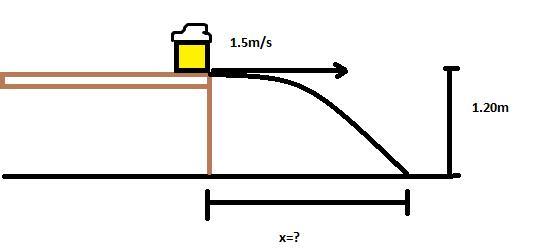
 A bartender slides a beer mug at 1.50 m/s toward a customer at the end of a frictionless bar that is 1.20 m tall. The customer
serg [3582]

Response:

a) The mug makes contact with the ground 0.7425m from the bar's end. b) |V|=5.08m/s θ= -72.82°

Clarification:

To address this issue, we begin with a diagram depicting the situation. (refer to the attached illustration).

a)

The illustration shows that the problem involves motion in two dimensions. To determine how far from the bar the mug lands, we need to find the time the mug remains airborne by examining its vertical motion.

To compute the time, we utilize the following formula with the known values:

y_{f}=y_{0}+v_{y0}t+\frac{1}{2}at^{2}

We have y_{f}=0 and v_{y0}=0, allowing us to simplify the equation to:

0=y_{0}+\frac{1}{2}at^{2}

Now, we can calculate for t:

-y_{0}=\frac{1}{2}at^{2}

-2y_{0}=at^{2}

\frac{-2y_{0}}{a}=t^{2}

t=\sqrt{\frac{-2y_{0}}{a}}

We know y_{0}=1.20m and a=g=-9.8m/s^{2}

The negative gravity indicates the downward motion of the mug. Hence, we substitute these values into the provided formula:

t=\sqrt{\frac{-2(1.20m)}{(-9.8m/s^{2})}}

Which results in:

t=0.495s

This time helps us evaluate the horizontal distance the mug traverses. Since:

V_{x}=\frac{x}{t}

Solving for x, we have:

x=V_{x}t

Substituting the known values yields:

x=(1.5m/s)(0.495s)

This calculates to:

x=0.7425m

b) With the time determining when the mug strikes the ground established, we can find the final velocity in the vertical direction using the formula:

a=\frac{v_{f}-v_{0}}{t}

The initial vertical velocity being zero simplifies our calculations:

a=\frac{v_{f}}{t}

Thus, we can determine the final velocity:

V_{yf}=at

Given that the acceleration equates to gravity (showing a downward effect), we substitute that alongside the previously found time:

V_{yf}=(-9.8m/s^{2})(0.495s)

This leads to:

V_{yf}=-4.851m/s

Now, we ascertain the velocity components:

V_{xf}=1.5m/s and V_{yf]=-4.851m/s

Next, we find the speed by calculating the vector's magnitude:

|V|=\sqrt{V_{x}^{2}+V_{y}^{2}}

<pThus:

|V|=\sqrt{(1.5m/s)^{2}+(-4.851m/s)^{2}

Yielding:

|V|=5.08m/s

Lastly, to ascertain the impact direction, we apply the equation:

\theta = tan^{-1} (\frac{V_{y}}{V_{x}})

<pFulfilling this provides:

\theta = tan^{-1} (\frac{-4.851m/s}{(1.5m/s)})

<pLeading to:

\theta = -72.82^{o}

4 0
2 months ago
If a metal wire is 4m long and a force of 5000n causes it to stretch by 1mm, what is the strain?
serg [3582]

Answer:

2.5\cdot 10^{-4}

Explanation:

Strain is defined as the ratio of an object's dimensional change when subjected to a force:

S=\frac{\Delta L}{L_0}

where

\Delta L indicates the alteration in length of the object

L_0 signifies the object's initial length

In this case, we have L_0 = 4 m and \Delta L=1 mm=0.001 m, hence the strain is

S=\frac{\Delta L}{L_0}=\frac{0.001 m}{4 m}=2.5\cdot 10^{-4}


5 0
1 month ago
A 1200-kilogram space vehicle travels at 4.8 meters per second along the level surface of Mars. If the magnitude of the gravitat
Ostrovityanka [3204]
The vehicle experiences a normal force of 4440 N. The normal force acts perpendicular to the ground surface. Key details include the vehicle's mass of 1200 kg and the gravitational force of 3.7 N/kg. We calculate the normal force in Newtons by multiplying these two figures: force = field strength * mass = 3.7 N/kg * 1200 kg = 4440 N.
8 0
1 month ago
Read 2 more answers
Other questions:
  • A group of physics students hypothesize that for an experiment they are performing, the speed of an object sliding down an incli
    13·2 answers
  • HELP ASAP! GIVING BRAINLIEST!
    13·2 answers
  • The resultant of the concurrent forces is 300 lb pointing up along the Y axis. Compute the values of F and the angle required to
    12·2 answers
  • Vinny is on a motorcycle at rest, 200 m away from a ramp that jumps over a gully. Calculate the minimum constant acceleration Vi
    9·1 answer
  • Write a conclusion to this lab in which you discuss when a person on a roller coaster ride would have sensations of weightlessne
    9·1 answer
  • From the top of a tall building, a gun is fired. The bullet leaves the gun at a speed of 340 m/s, parallel to the ground. As the
    12·1 answer
  • An electron is moving horizontally in a laboratory when a uniform electric field is suddenly turned on. This field points vertic
    6·1 answer
  • A hunter on a frozen, essentially frictionless pond uses a rifle that shoots 4.20 g bullets at 965 m/s. The mass of the hunter (
    5·1 answer
  • A charged cell phone has chemical energy stored in its battery. As you use your phone, the amount of chemical energy in the batt
    13·1 answer
  • Two ropes in a vertical plane exert equal-magnitude forces on a hanging weight but pull with an angle of 72.0° between them. Wha
    6·1 answer
Add answer
Login
Not registered? Fast signup
Signup
Login Signup
Ask question!