answer.
Ask question
Login Signup
Ask question
All categories
  • English
  • Mathematics
  • Social Studies
  • Business
  • History
  • Health
  • Geography
  • Biology
  • Physics
  • Chemistry
  • Computers and Technology
  • Arts
  • World Languages
  • Spanish
  • French
  • German
  • Advanced Placement (AP)
  • SAT
  • Medicine
  • Law
  • Engineering
spin
2 months ago
12

What is the hybridization of the C atoms in C2Cl4 ?

Chemistry
1 answer:
castortr0y [3K]2 months ago
8 0

Answer:

sp2

Explanation:

Orbital hybridization refers to how atomic orbitals change when they combine with electrons from different atoms for bond formation.

Within C2Cl4 or tetrachloroethene, each C atom has three bond pairs—two with chlorine atoms and one with another carbon atom—along with no lone pairs. Therefore, the C atoms in C2Cl4 are categorized as  sp2 hybridized.

Thus, the correct designation is "sp2".

You might be interested in
Barbiturates, including "truth serums" seen in movies like Meet the Fockers and sedatives that may have led to the untimely deat
Alekssandra [3086]

Answer:

Explanation:

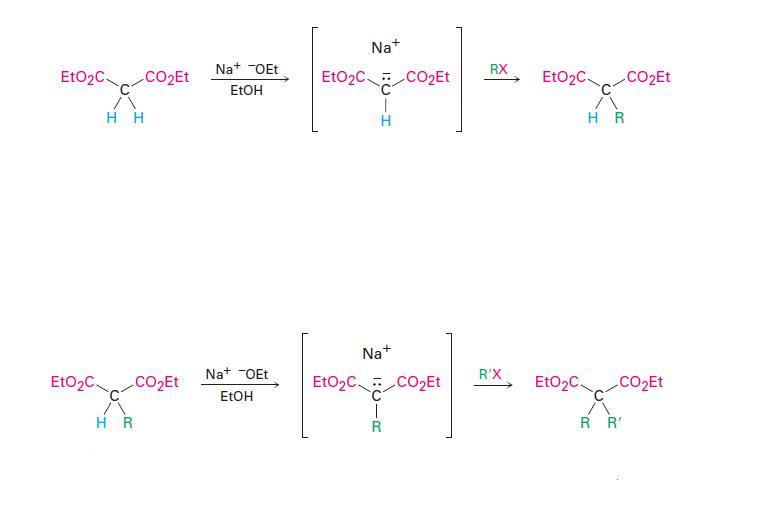
Diethyl malonate possesses greater acidity compared to monocarbonyl substances (pKa=13) because its alpha hydrogens are linked to two carbonyl groups. Consequently, the malonic ester can be readily changed into its enolate ion by reacting it with sodium ethoxide in ethanol. When the malonic ester undergoes alkylation, a hydrogen atom in the alpha position becomes acidic, permitting another round of alkylation to yield a dialkylated malonic ester.

In this scenario, when diethyl malonate interacts with urea in the presence of sodium ethoxide base, the second alkylation step occurs within the molecule, producing a cyclic compound known as barbituric acid.

8 0
1 month ago
A characteristic feature of any form of chromatography is the ________.a. calculation of an Rf value for the molecules separated
castortr0y [3046]

Answer: The right choice is (c) application of both a mobile phase and a stationary phase.

Explanation:

Chromatography: This refers to a technique for separating a mixture where the mixture is distributed between two phases at varying rates, one being stationary and the other moving.

Mobile phase: The component in which the mixture is dissolved is referred to as the mobile phase.

Stationary phase: This is an adsorbent medium that remains in place while a liquid or gas passes over its surface, thus remaining stationary.

Consequently, a key characteristic of any chromatography technique involves utilizing both a mobile and a stationary phase.

4 0
2 months ago
Suppose you held a lighted match to a solid hunk of wood and another match to a pile of wood shavings. Which form of wood will c
Tems11 [2777]

Answer:

Wood

Explanation:

0 0
2 months ago
the image above shows a chamber with a fixed volume filled with gas at a pressure of 1560 mmHg and a temperature of 445.0 K. If
VMariaS [2998]

Answer:

The new gas pressure within the chamber registers at 1,093.75 mmHg

Explanation:

The Gay-Lussac Law establishes a relationship between a gas's pressure and temperature when volume remains constant. This principle asserts that gas pressure is directly tied to its temperature: as temperature increases, pressure rises, and conversely, as temperature falls, pressure also diminishes. Therefore, the Gay-Lussac law can be depicted mathematically as:

\frac{P}{T} =k

Given an initial and final state of gas, we can apply the following formula:

\frac{P1}{T1} =\frac{P2}{T2}

In this scenario:

  • P1= 1560 mmHg
  • T1= 445 K
  • P2=?
  • T2= 312 K
<psubstituting:>

\frac{1560 mmHg}{445 K} =\frac{P2}{312 K}

Calculating:

P2=\frac{1560 mmHg}{445 K} *312K

P2=1,093.75 mmHg

The new gas pressure inside the chamber is 1,093.75 mmHg

</psubstituting:>
7 0
2 months ago
A student adds 10.00 mL of a 2.0 M nitric acid solution to a 100.00 mL volumetric flask. Next, 50.00 mL of a 0.00500 M solution
Anarel [2989]

Answer:

0.20M of nitric acid

0.00250M of KSCN

Explanation:

In the case of nitric acid, the solution's dilution changes from 10.00mL to 100.00mL, resulting in a 1/10 dilution. Given the original concentration of nitric acid is 2.0M, the updated concentration becomes: 2.0M×(1/10)=0.20M of nitric acid

Similarly, the dilution of KSCN extends from 50.00mL to 100.00mL, equal to a 1/2 dilution. Consequently, the new concentration of KSCN turns out to be:

0.00500M × (1/2) = 0.00250M of KSCN

I hope it aids you!

5 0
1 month ago
Other questions:
  • Phosphine, ph3(g), combusts in oxygen gas to form water vapor and solid tetraphosphorus decaoxide. express your answer as a bala
    10·1 answer
  • Two glasses labeled A and B contain equal amounts of water at different temperatures. Kim put an antacid tablet into each of the
    8·2 answers
  • A galvanic (voltaic) cell contains a copper cathode immersed in a copper(ii) chloride solution and a nickel anode immersed in a
    13·1 answer
  • Citric acid is a naturally occurring compound. what orbitals are used to form each indicated bond? be sure to answer all parts.2
    8·1 answer
  • The next 3 questions will walk you through using the Henderson-Hasselbalch equation for the following question. For each step pr
    11·1 answer
  • In the same condition, what happens to the net force acting on the rope?
    7·1 answer
  • Why is it important to ensure that treated water remains safe to drink when it is stored after treatment? what is one way to mak
    5·1 answer
  • This is a document that each chemical manufacturer, distributor, or importer must provide for each hazardous chemical. It contai
    9·2 answers
  • When a stable diatomic molecule spontaneously forms from its atoms, what are the signs of Delta H, Delta S, and Delta G? A. + +
    14·1 answer
  • Samantha &amp; Ryan are investigating an unknown substance. They make the following observations about the substance: 1. it is b
    8·2 answers
Add answer
Login
Not registered? Fast signup
Signup
Login Signup
Ask question!