answer.
Ask question
Login Signup
Ask question
All categories
  • English
  • Mathematics
  • Social Studies
  • Business
  • History
  • Health
  • Geography
  • Biology
  • Physics
  • Chemistry
  • Computers and Technology
  • Arts
  • World Languages
  • Spanish
  • French
  • German
  • Advanced Placement (AP)
  • SAT
  • Medicine
  • Law
  • Engineering
mr Goodwill
1 month ago
8

Samantha & Ryan are investigating an unknown substance. They make the following observations about the substance: 1. it is b

lack 2. it has a dull luster 3. it weighs 6.50 g 4. it is solid 5. it is roughly 2 inches long 6. it does not conduct electricity 7. it takes up a volume of 2.00 mL 8. it has a density of 3.25 g/mL Some of these properties will change if more sample were added to their observations. Some will stay the same. Which properties will change? Choose the numbers A) 1,2,3,8 B) 3,5,7,8 C) 3,5,7 Eliminate D) 3,6,8
Chemistry
2 answers:
VMariaS [2.9K]1 month ago
7 0
The correct answer is C). Adding more of the sample would extend beyond 2 inches, resulting in more weight and volume. Despite this, the density remains unchanged since density is defined as m/V, and an increase in both mass and volume happens at an equivalent rate.
lorasvet [2.7K]1 month ago
5 0
The answer is definitely C.
You might be interested in
Sodium carbonate (Na2CO3) is used to neutralize the sulfuric acid spill. How many kilograms of sodium carbonate must be added to
Anarel [2989]

5.451 X 10³ kg of sodium carbonate is required to neutralize 5.04×10³ kg of sulfuric acid solution.

Explanation:

  • Sodium carbonate neutralizes sulfuric acid (H₂SO₄). This compound is derived from a strong base (NaOH) and a weak acid (H₂CO₃). The chemical equation for this neutralization process is represented as:

Na₂CO₃ + H₂SO₄ ----> Na₂SO₄ + H₂CO₃

  • The balanced equation indicates that one mole of Na₂CO₃ is needed to neutralize one mole of H₂SO₄.
  • Molar mass of Na₂CO₃= 106 g/mol = 0.106 kg/mol, while Molar mass of H₂SO₄= 98 g/mol = 0.098 kg/mol.
  • To neutralize 0.098 kg of H₂SO₄, the required Na₂CO₃ is 0.106 kg, thus, to neutralize 5.04×10³ kg of H₂SO₄, Na₂CO₃ needed is 5.451 X 10³ kg.

5 0
2 months ago
At 400K both compounds are gases. At this temperature, which compound, CH4(g) or CCl4(g) , behaves more like an ideal gas
Alekssandra [3086]

Answer:

CH4

Explanation:

The ideal behavior of gases generally depends on the strength of intermolecular forces between gas molecules and whether polar bonds are present.

In the case of CCl4, polar bonds exist along with the more electronegative chlorine atom, leading to stronger intermolecular forces at 400K, as opposed to CH4 which contains only non-polar bonds.

Thus, at 400K, CH4 behaves more like an ideal gas compared to CCl4.

6 0
2 months ago
Consider butter (density= 0.860 g/mL) and sand (density= 2.28 g/mL). If 1.00 mL of butter were mixed with 1.00 mL of sand and mi
Anarel [2989]

The mixture’s density is 1.57 g/cm³.


Step 1: Determine the mass of the butter.


\text{Mass} = \text{1.00 cm}^{3 } \times \frac{\text{0.680 g} }{\text{1 cm}^{3 }} = \text{0.860 g}\\

Step 2: Determine the mass of the sand.


\text{Mass} = \text{1.00 cm}^{3 } \times \frac{\text{2.28 g} }{\text{1 cm}^{3 }} = \text{2.28 g}\\

Step 3: Determine the density of the mixture.

Total mass = 0.860 g + 2.28 g = 3.14 g.

Total volume = 1 cm³ + 1 cm³ = 2 cm³

\text{Density} = \frac{\text{mass}}{\text{volume}} = \frac{\text{3.14 g} }{\text{2 cm}^{3 }} = \textbf{1.57 g/cm}{^{3}\\

6 0
2 months ago
Equimolar samples of CH3OH(l) and C2H5OH(l) are placed in separate, previously evacuated, rigid 2.0 L vessels. Each vessel is at
Alekssandra [3086]

Answer:

Complete Question:  

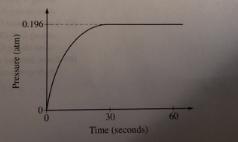
Equimolar quantities of CH3OH(l) and C2H5OH(l) are placed in separate 2.0 L containers that have been evacuated beforehand. Pressure gauges are attached to each container, and the temperature is maintained at 300 K. In both containers, liquid is consistently visible at the bottom. The varying pressure within the vessel that contains CH3OH(l) is illustrated below.

In comparison to the equilibrium vapor pressure of CH3OH(l) at 300 K, the equilibrium vapor pressure of C2H5OH(l) at 300 K is

ANSWER : lower, since the London dispersion forces among C2H5OH molecules surpass those among CH3OH molecules.

Explanation:

To clarify the answer provided, let’s begin by defining some concepts.

The London dispersion force is the least strong type of intermolecular force. It is a temporary force that arises when the electron arrangement in two neighboring atoms creates transient dipoles.  

The vapor pressure of a liquid reflects the equilibrium pressure of its vapor above the liquid (or solid); specifically, it represents the pressure associated with the evaporation of a liquid (or solid) in a sealed environment above the substance.

The pressure will be lower due to the stronger London dispersion forces acting between C2H5OH molecules compared to those between CH3OH molecules. This implies that when intermolecular forces are stronger, they intensify the interactions binding the substance together, thereby reducing the liquid's vapor pressure at any given temperature and making it more difficult to vaporize the substance.

Note: The London dispersion force for C2H5OH is more substantial than for CH3OH because C2H5OH has more electrons than CH3OH.

3 0
3 months ago
4. Which of the following statements correctly describe atoms? Select all that apply.
castortr0y [3046]

Answer:

A, B, and C

Explanation:

Indeed, atoms possess mass and serve as the fundamental building blocks of chemical elements. While matter is composed of atoms, these particles themselves do not occupy physical space.

Atoms consist mostly of void, which excludes them from the other responses.

This confirms that A, B, and C are the right choices.

6 0
2 months ago
Other questions:
  • When benzene (c6h6) reacts with bromine (br2) bromobenzene(c6h5br) is obtained: c6h6 + br2 → c6h5br + hbr what is the theoretica
    8·1 answer
  • In a particular mass of kau(cn)2, there are 6.66 × 10²⁰ atoms of gold. What is the total number of atoms in this sample?
    15·1 answer
  • Batteries work by letting charged ions flow through an electrolyte solution.
    9·1 answer
  • Write a hypothesis for Part II of the lab, which is about the type of material an object is made of, and its ability to absorb o
    15·2 answers
  • At 900.0 K, the equilibrium constant (Kp) for the following reaction is 0.345. 2SO2 + O2(g) → 2SO3(g) At equilibrium, the partia
    13·1 answer
  • Acidosis is a human body disorder caused by too much acid in the stomach. If a patient was tested for this using their saliva an
    15·1 answer
  • Gina made a poster for plastic recycling week and included this information on her poster: What corrections should Gina make? Ch
    15·2 answers
  • A 10.1 g sample of NaOH is dissolved in 250.0 g of water in a coffee-cup calorimeter. The temperature increases from 23.0 °C to
    14·2 answers
  • Be sure to answer all parts. Enter your answers in scientific notation. The following reactions have the indicated equilibrium c
    14·1 answer
  • If the volume occupied by the gas molecules shown below were doubled, what would happen to the pressure they exert? (Assume cons
    13·1 answer
Add answer
Login
Not registered? Fast signup
Signup
Login Signup
Ask question!