answer.
Ask question
Login Signup
Ask question
All categories
  • English
  • Mathematics
  • Social Studies
  • Business
  • History
  • Health
  • Geography
  • Biology
  • Physics
  • Chemistry
  • Computers and Technology
  • Arts
  • World Languages
  • Spanish
  • French
  • German
  • Advanced Placement (AP)
  • SAT
  • Medicine
  • Law
  • Engineering
alexgriva
1 day ago
6

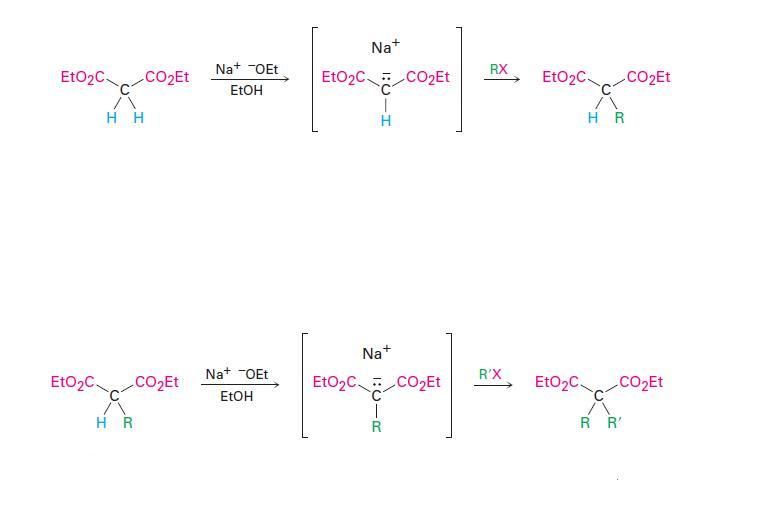
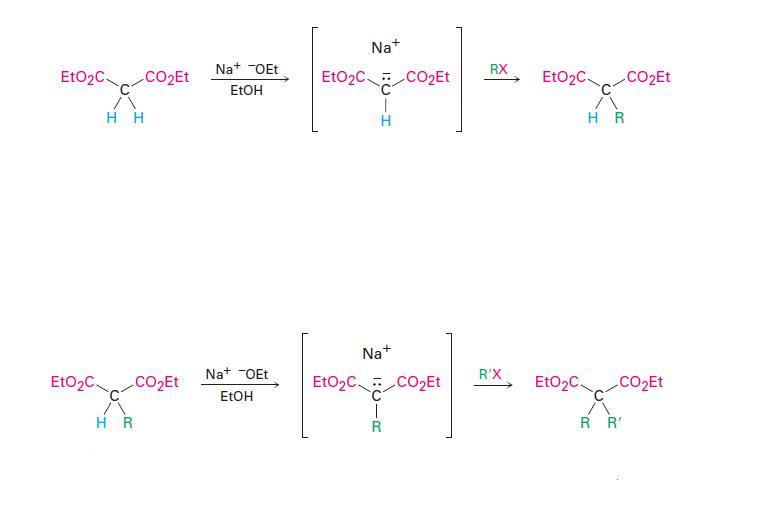
Barbiturates, including "truth serums" seen in movies like Meet the Fockers and sedatives that may have led to the untimely deat

h of Jimi Hendrix, are often synthesized using what type of reaction sequence involving two consecutive enolate alkylations

Chemistry
1 answer:
Alekssandra [968]1 day ago
8 0

Answer:

Explanation:

Diethyl malonate possesses greater acidity compared to monocarbonyl substances (pKa=13) because its alpha hydrogens are linked to two carbonyl groups. Consequently, the malonic ester can be readily changed into its enolate ion by reacting it with sodium ethoxide in ethanol. When the malonic ester undergoes alkylation, a hydrogen atom in the alpha position becomes acidic, permitting another round of alkylation to yield a dialkylated malonic ester.

In this scenario, when diethyl malonate interacts with urea in the presence of sodium ethoxide base, the second alkylation step occurs within the molecule, producing a cyclic compound known as barbituric acid.

You might be interested in
66.667 mL of 3.000 M H2SO4 (aq) solution was neutralized by the stoichiometric amount of 4.000 M Al(OH)3 solution in a coffee cu
eduard [944]

Answer:

\large \boxed{\Delta_{\textbf{r}}H =\text{-4600 J$\cdot$ mol}^{-1}}

Explanation:

This scenario is unrealistic since Al(OH)₃ is not soluble in water.

The question consists of two parts:

A. Stoichiometry — where we determine volumes, masses, and moles for the products

B. Calorimetry — where we assess the enthalpy of the reaction.

A. Stoichiometry

1. Determine the volume of Al(OH)₃

(a) The balanced chemical equation:

                 2Al(OH)₃ + 3H₂SO₄ ⟶ Al₂(SO₄)₃ + 6H₂O

M/V:            66.667

c/mol·L⁻¹:   4.000       3.000

(b) Moles of H₂SO₄

\rm \text{66.667 mL H$_{2}$}SO_{4} \times \dfrac{\text{3.000 mmol H$_{2}$SO}_{4}}{\text{1 mL H$_{2}$SO}_{4}} = \text{200.00 mmol H$_{2}$SO}_{4}

(c) Moles of Al(OH)₃

The molar ratio stands at 2 mmol Al(OH)₃: 3 mmol H₂SO₄

\text{Moles of Al(OH)}_{3} = \text{200.00 mmol of H$_{2}$SO}_{4} \times \dfrac{\text{2 mmol Al(OH)}_{3}}{\text{3 mmol H$_{2}$SO}_{4}}\\\\= \text{133.33 mmol Al(OH)}_{3}

(d) Volume of Al(OH)₃

\text{Moles of Al(OH)}_{3} = \text{200.00 mmol of H$_{2}$SO}_{4} \times \dfrac{\text{1 mL Al(OH)}_{3}}{\text{4 mmol H$_{2}$SO}_{4}} = \text{50.000 mL Al(OH)}_{3}

B. Calorimetry

This reaction has two energy exchanges.

q₁ = heat from the reaction

q₂ = heat used to heat the calorimeter

 q₁ + q₂ = 0

nΔH + mCΔT = 0

Data:

Moles of Al₂(SO₄)₃ = 0.066 667 mol

C = 1.10 J°C⁻¹g⁻¹

T_initial = 22.3 °C

T_final = 24.7 °C

Calculations

(a) Mass of solution

Assume solutions are as dense as water (though not realistic).

Mass of sulfuric acid solution            =   66.667 g 

Mass of aluminium hydroxide solution =  50.000    

                                             TOTAL =  116.667 g

(b) ΔT

ΔT = T_final - T_initial = 24.7 °C - 22.3 °C = 2.4°C

(c) ΔH

\begin{array}{ccccl}n\Delta H & +& mC \Delta T& = &0\\\text{0.066 667 mol }\times \Delta H& + & \text{116.667 g} \times 1.10 \text{ J$^{\circ}$C$^{-1}$g$^{-1}$} \times 2.4 \, ^{\circ}\text{C} & = & 0\\0.066667 \Delta H \text{ mol} & + & \text{310 J} & = & 0\\&&0.066667 \Delta H \text{ mol} & = & \text{-310 J} & & \\\end{array}\\

\begin{array}{ccccl}& &\Delta H & = & \dfrac{\text{-310 J}}{\text{0.066667 mol}}\\\\& &\Delta H & = & \textbf{-4600 kJ/mol}\\\end{array}\\\large \boxed{\mathbf{\Delta_{\textbf{r}}H} =\textbf{-4600 J$\cdot$ mol}^{\mathbf{-1}}}

This result appears nonsensical, but it is derived from your given figures.

6 0
4 days ago
A characteristic feature of any form of chromatography is the ________.a. calculation of an Rf value for the molecules separated
castortr0y [923]

Answer: The right choice is (c) application of both a mobile phase and a stationary phase.

Explanation:

Chromatography: This refers to a technique for separating a mixture where the mixture is distributed between two phases at varying rates, one being stationary and the other moving.

Mobile phase: The component in which the mixture is dissolved is referred to as the mobile phase.

Stationary phase: This is an adsorbent medium that remains in place while a liquid or gas passes over its surface, thus remaining stationary.

Consequently, a key characteristic of any chromatography technique involves utilizing both a mobile and a stationary phase.

4 0
2 days ago
Calculate the molarity of 48.0 mL of 6.00 M H2SO4 diluted to 0.250 L
lorasvet [956]

Answer:

The molality is 1.15 m.

Molality is calculated by dividing the number of moles of solute by the kilograms of solvent, which in this case is water.

Calculate moles of H₂SO₄ from molarity:

C = n/V → n = C × V = 6.00 mol/L × 0.048 L = 0.288 moles

Mass of solvent (water) based on density:

m = ρ × V = 1.00 kg/L × 0.250 L = 0.250 kg

Therefore, molality is:

m = moles/solvent mass = 0.288 moles / 0.250 kg = 1.15 m

4 0
14 days ago
Read 2 more answers
You want to prepare a solution with a concentration of 200.0μM from a stock solution with a concentration of 500.0mM. At your di
lorasvet [956]

Answer:

1) This dilution plan will yield a 200μM solution.

2) This dilution plan will not yield a 200μM solution.

3) This dilution plan will not yield a 200μM solution.

4) This dilution plan will yield a 200μM solution.

5) This dilution plan will yield a 200μM solution.

Explanation:

Convert the initial molarity into molar form as shown.

500mM = 500mM \times (\frac{1M}{1000M})= 0.5M

Let's examine the following serial dilution processes.

1)

Dilute 5.00 mL of the stock solution to 500 mL. Then take 10.00 mL of this new solution and dilute it further to 250 mL.

Concentration of 500 mL solution:

M_{2}= \frac{M_{1}V_{1}}{V_{2}}= \frac{(0.5M)(5.00mL)}{500 mL}= 5 \times 10^{-3}M

10 mL of this solution is further diluted to 250 mL

M_{final}= \frac{M_{2}V_{2}}{V_{final}}= \frac{(5 \times 10^{-3}M)(10.0mL)}{250 mL}= 2 \times 10^{-4}M

Convert μM:

2 \times 10^{-4}M = (2 \times 10^{-4}M)(\frac{1 \mu M}{10^{-6}M})= 200 \mu M

Thus, this dilution scheme will yield a 200μM solution.

2)

Dilute 5.00 mL of the stock solution to 100 mL. Then take 10.00 mL of this new solution and dilute to 1000 mL.

Concentration of 100 mL solution:

M_{2}= \frac{M_{1}V_{1}}{V_{2}}= \frac{(0.5M)(5.00mL)}{100 mL}= 2.5 \times 10^{-2}M

10 mL of this solution is further diluted to 1000 mL

M_{final}= \frac{M_{2}V_{2}}{V_{final}}= \frac{(2.5 \times 10^{-2}M)(10.0mL)}{1000 mL}= 2.5 \times 10^{-4}M

Convert μM:

2.5 \times 10^{-4}M = (2.5 \times 10^{-4}M)(\frac{1 \mu M}{10^{-6}M})= 250 \mu M

Thus, this dilution scheme will not yield a 200μM solution.

3)

Dilute 10.00 mL of the stock solution to 100 mL, followed by diluting 5 mL of that new solution to 100 mL.

Concentration of 100 mL solution:

M_{2}= \frac{M_{1}V_{1}}{V_{2}}= \frac{(0.5M)(10mL)}{100 mL}= 0.05M

5 mL of this solution is diluted to 1000 mL

M_{final}= \frac{M_{2}V_{2}}{V_{final}}= \frac{(0.05M)(5mL)}{1000 mL}= 0.25 \times 10^{-4}M

Convert μM:

0.25 \times 10^{-4}M = (0.25 \times 10^{-4}M)(\frac{1 \mu M}{10^{-6}M})= 25 \mu M

Thus, this dilution scheme will not yield a 200μM solution.

4)

Dilute 5 mL of the stock solution to 250 mL. Then take 10 mL of this new solution and further dilute it to 500 mL.

Concentration of 250 mL solution:

M_{2}= \frac{M_{1}V_{1}}{V_{2}}= \frac{(0.5M)(5mL)}{250 mL}= 0.01M

10 mL of this solution is further diluted to 500 mL

M_{final}= \frac{M_{2}V_{2}}{V_{final}}= \frac{(0.01M)(10mL)}{500 mL}= 2 \times 10^{-4}M

Convert μM:

2 \times 10^{-4}M = (2 \times 10^{-4}M)(\frac{1 \mu M}{10^{-6}M})= 200 \mu M

Thus, this dilution scheme will yield a 200μM solution.

5)

Dilute 10 mL of the stock solution to 250 mL. Then take another 10 mL of this new solution and dilute it to 1000 mL.

Concentration of 250 mL solution:

M_{2}= \frac{M_{1}V_{1}}{V_{2}}= \frac{(0.5M)(10mL)}{250 mL}= 0.02M

10 mL of this solution is further diluted to 1000 mL

M_{final}= \frac{M_{2}V_{2}}{V_{final}}= \frac{(0.02M)(10mL)}{1000 mL}= 2 \times 10^{-4}M

Convert μM:

2 \times 10^{-4}M = (2 \times 10^{-4}M)(\frac{1 \mu M}{10^{-6}M})= 200 \mu M

Thus, this dilution scheme will yield a 200μM solution.

7 0
9 days ago
What features of this model will help Armando answer the question?
lions [985]

Answer:

The adjustable legs along with the sand table.

Note: The question is incomplete. The full question is presented below.

Using Models to Address Questions Regarding Systems

Armando’s class was examining images of rivers shaped by flowing water. Most rivers appeared wide and shallow, except for one, which was narrow and deep. The students theorized that this river's narrowness and depth are due to:

  • the steepness of the hill from which the water descends, or
  • the diminutive size of the sand grains the water flows through.

To explore the answer to the question of why this river is so narrow and deep, Armando created the model outlined below.

Explanation:

The model constructed by Armando will facilitate addressing the question due to specific features:

1. Adjustable leg - as one theory proposed by the class suggests that the steep hill affecting the water's path could be the reason for the river's dimensions, the adjustable legs are designed to be raised or lowered to alter the slope, allowing testing of this theory.

2. Sand table - this acts as the streambed. By modifying the size of the sand grains, students can examine the second hypothesis that smaller sand grains contribute to the river's narrowness and depth.

The outcomes of their experimentation will lead them to a conclusion.

5 0
5 days ago
Read 2 more answers
Other questions:
  • A 0.784 g sample of magnesium is added to a 250 ml flask and dissolved in 150 ml of water. magnesium hydroxide obtained from the
    11·1 answer
  • A solid mixture weighs 0.6813 g. It contains gallium bromide (GaBr3) and other inert impurities. When the solid mixture was diss
    9·2 answers
  • What is the mass of 0.75 moles of (NH4)3PO4?
    6·2 answers
  • Leonard adds 5 grams of sugar to 1 liter of water to make one sugar solution. Then he adds 10 grams of sugar to 1 liter of water
    9·1 answer
  • The Michaelis‑Menten equation models the hyperbolic relationship between [S] and the initial reaction rate V 0 V0 for an enzyme‑
    15·1 answer
  • The standard heat of combustion of ethanol, C2H5OH, is 1372 kJ/mol ethanol. How much heat (in kJ) would be liberated by complete
    13·1 answer
  • What is the molar mass of citric acid (C6H8O7) and baking soda (NaHCO3)?
    15·1 answer
  • You have a racemic mixture of d-2-butanol and l-2-butanol. the d isomer rotates polarized light by +13.5∘. what is the rotation
    15·1 answer
  • The label on a container of margarine lists "hydrogenated vegetable oil" as the major ingredient. Hydrogenated vegetable oil ___
    8·1 answer
  • How many moles are there in 20.0 grams of<br> FeCl3?
    9·1 answer
Add answer
Login
Not registered? Fast signup
Signup
Login Signup
Ask question!