answer.
Ask question
Login Signup
Ask question
All categories
  • English
  • Mathematics
  • Social Studies
  • Business
  • History
  • Health
  • Geography
  • Biology
  • Physics
  • Chemistry
  • Computers and Technology
  • Arts
  • World Languages
  • Spanish
  • French
  • German
  • Advanced Placement (AP)
  • SAT
  • Medicine
  • Law
  • Engineering
atroni
2 months ago
5

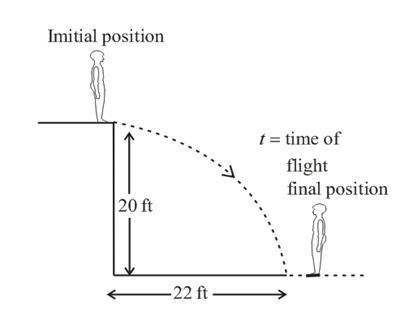
What is the minimum speed with which he’d need to run off the edge of the cliff to make it safely to the far side of the river?

the answer was 6 m/s the world-record time for the 100 m dash is approximately 10 s. given this, is it reasonable to expect brady to be able to run fast enough to achieve brady's leap?
a.yes, the obtained speed is less than the world-record.
b.yes, the obtained speed is almost equal to the world-record.
c.no, the obtained speed is greater than the world-record.
d.no, the obtained speed is almost equal to the world-record.

Physics
2 answers:
Ostrovityanka [3.2K]2 months ago
7 0

Part (a): Brady must achieve a minimum speed of \boxed{6\text{ m/s}} to make the jump across the river.

Part (b): Brady’s leap speed is feasible since it is below the world record speed.

Further details:

(a)

Brady attempts to jump a horizontal span of 22\text{ ft} from a height of 20\text{ft}, obeying Newtonian motion laws.

Given:

Horizontal distance: 22\text{ ft}

Vertical height: 20\text{ft}

Concept:

The horizontal measurement in meters is 6.71\text{ m}.

The vertical measurement in meters is 6.10\text{ m}.

The time of flight is calculated using the equation of motion:

s=ut+\dfrac{1}{2}at^2

Replacing 0\text {m/s} with u and rearranging to solve for t:

t=\sqrt{\dfrac{2s}{a} }

Substitute values: 6.10\text{ m} for s and 9.81\text{ m}/\text{s}^2 for a in the equation.

\begin{aligned}t&=\sqrt{\dfrac{2\times6.10}{9.81}}\text{ s}\\&=1.12\text{ s}\end{aligned}

The flight time equals the duration to cover the horizontal distance.

Brady’s horizontal velocity is:

\begin{aligned}v&=\dfrac{6.71}{1.12}\text{ m/s}\\&\approx6\text{ m/s}\end{aligned}

Therefore, Brady’s minimum speed must be \boxed{6\text{ m/s}} to cross successfully.

(b)

The minimum speed Brady must run at is 6\text{ m/s}.

The world record speed is:

\begin{aligned}V&=\frac{100}{10}\text{ m/s}\\&=10\text{ m/s}\end{aligned} 

Thus, Brady’s required speed is achievable because it remains below the world record.
Keith_Richards [3.2K]2 months ago
4 0

Answer:

A. Yes, because the calculated speed is below the world record

Explanation:

The speed obtained is 6 m/s.

World record speed is distance over time: 100 m divided by 10 s equals 10 m/s.

Consequently, the required speed is less than the record speed.

Not only is it less, but this speed is a reasonable estimate for an athletic individual's average pace, making the jump feasible.

-Samuel Brady became famous for his leap over the Cuyahoga River near Kent, Ohio around 1780. Pursued by a group of Indians after an unsuccessful ambush, he escaped by jumping across a 22-foot (6.7 m) wide section of the river (which was expanded in the 1830s for canal construction). He then hid underwater using a reed for breathing by a fallen tree near a lake.

You might be interested in
Two bricks are resting on the edge of the lab table. Shirley Sheshort stands on her toes and spots the two bricks. She acquires
Keith_Richards [3271]
Applying the formula of force equals mass times acceleration, and considering acceleration approximated as g at 10 m/s², the brick possessing the greater mass will hit the ground first due to its superior force that counteracts resistive forces like air resistance.
4 0
1 month ago
A spherically symmetric charge distribution has a charge density given by ρ = a/r , where a is constant. Find the electric field
Yuliya22 [3333]
The infinitesimal charge dQ on a layer with thickness dr is expressed as

dQ = (charge density) × (surface area) × dr

dQ = ρ(r)4πr²dr

∫ dQ = ∫ (a/r)4πr²dr

∫ dQ = 4πa ∫ rdr

Q(r) = 2πar² - 2πa0²

Q = 2πar² (= total charge confined within a spherical surface of radius r)

According to Gauss's Law:

(Flux through surface) = (charge enclosed by surface)/ε۪

(Surface area of sphere) × E = Q/ε۪

4πr²E = 2πar²/ε۪

<span>E = a/2ε۪


I trust my response has been helpful. Thank you for your question! We hope to assist with your future inquiries. Have a great day!

</span>
3 0
1 month ago
Read 2 more answers
A football game begins by flipping a penny to decide which team will get the ball first. The 5.25 g penny has a speed of 3.27 m/
ValentinkaMS [3465]
To start, we first need to determine the kinetic energy of the penny before it strikes the ground. This is calculated using the formula where m equals 5.25 g, which is 0.00525 kg for the penny's mass, and v equals 3.27 m/s for its speed. Replacing the values into the equation provides: When the penny lands, all this kinetic energy transforms into internal energy for both the penny and the ground. If half of this energy goes into the penny's internal energy, the change is determined by a specific formula where m is the penny's mass, Cs is its specific heat capacity (2.03 J/gC), and \Delta T, the change in temperature. To find the last element, the equation will be solved.
3 0
22 days ago
Carbon dioxide (CO2) gas in a piston-cylinder assembly undergoes three processes in series that begin and end at the same state
inna [3103]

Answer:

a) W =400 kJ

b) W = 0 kJ

c) W =-160.944 KJ

Explanation:

Given

Process 1 ---> 2

Pressure at point (1) P1 = 10 bar = P2

Volume at point (1) V1 = 1 m^3

Volume at point (2) V2 =4 m^3

For Process 2 ---> 3, where V = constant

Pressure at point (3) P3 = 10 bar

Volume at point (3) V3 = 4 m^3

Process 3 ---> 1 defined as PV = constant.

Required

Sketch the processes on the PV coordinates To calculate the work in kJ

Work is calculated by W=

a=V2

b=V1

x=Pdx=dV

For Process 1 ---> 2 where P3 = P4 = 5 bar  

\int\limits^a_b {x} \, dxW=

a=V3

b=V2

x=4dx=dV

substituting the values here into the integral gives

W=400 kJFor Process 2 ---> 3

As V = constant in this case, the volume remains unchanged, resulting in W = 0 kJ  

For Process 3 ---> 1  By applying point (1) --> 5 x.2 = C ---> C = 1 P = 5V^-1  

 W=

a=V1\int\limits^a_b {x} \, dx

b=V3

x=1V^-1dx=dVsubstituting values into this integral results in

W=| ln V | limits a and b

  = -160.944 KJ

5 0
28 days ago
Which of the following statements about ycarrier(x,t) is correct?
serg [3582]

Answer: Option D: indicates rapid travel with slow oscillation.

Clarification:

ycarrier(x,t) is traveling quickly but has slow oscillations.


8 0
25 days ago
Other questions:
  • The height of a typical playground slide is about 6 ft and it rises at an angle of 30 ∘ above the horizontal.
    7·1 answer
  • 2) Billy jumps upward with a velocity of 4.2 m/s off a 6m high diving board. What is his final velocity once he hits the water?
    15·1 answer
  • What is the minimum frequency of light necessary to emit electrons from titanium via the photoelectric effect?
    6·2 answers
  • A tube with a cap on one end, but open at the other end, produces a standing wave whose fundamental frequency is 130.8 Hz. The s
    11·1 answer
  • Conductance is directly proportional to the length of a conductor. true false user: resistance is inversely proportional to the
    11·2 answers
  • Point charge A with a charge of +4.00 μC is located at the origin. Point charge B with a charge of +7.00 μC is located on the x
    12·2 answers
  • Ferns that eject spores generally do so in pairs, with two spores flying off in opposite directions. The structure from which th
    9·1 answer
  • A student is trying to classify an unidentified, solid gray material as a metal or a nonmetal. Which question will best help the
    13·2 answers
  • A satellite that weighs 4900 N on the launchpad travels around the earth's equator in a circular orbit with a period of 1.667 h.
    14·1 answer
  • o illustrate the work-energy concept, consider the case of a stone falling from xi to xf under the influence of gravity. Using t
    12·1 answer
Add answer
Login
Not registered? Fast signup
Signup
Login Signup
Ask question!
