answer.
Ask question
Login Signup
Ask question
All categories
  • English
  • Mathematics
  • Social Studies
  • Business
  • History
  • Health
  • Geography
  • Biology
  • Physics
  • Chemistry
  • Computers and Technology
  • Arts
  • World Languages
  • Spanish
  • French
  • German
  • Advanced Placement (AP)
  • SAT
  • Medicine
  • Law
  • Engineering
ioda
8 days ago
12

Fermium-253 is a radioactive isotope of fermium that has a half-life of 3.0 days. A scientist obtained a sample that contained 2

16 micrograms of fermium-253.
Complete the table to show how much fermium-253 should remain in the sample at the indicated times after the scientist obtained the sample.

Chemistry
2 answers:
lions [985]8 days ago
5 0

Problem 2

You begin with 216 micrograms of Fermium - 253. After three days, the quantity halves, resulting in 108 micrograms left.

Another three days pass. Beginning with 108 micrograms, this amount gets halved again, leaving 54 micrograms.

Finally, after another three-day span, starting from 54 micrograms, you again halve this amount to reach 27 micrograms.

#days              Amount in micrograms

0                              216

3                               108

6                                54

9                                27

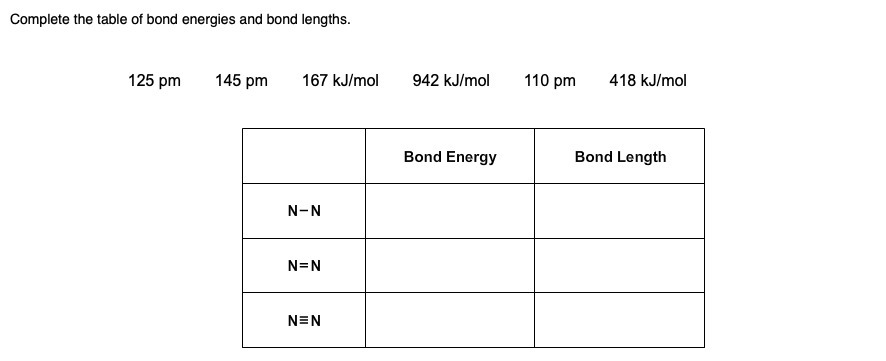
Problem One

Your example is Nitrogen. Begin by completing the table, then formulate some rules to help prepare for possible alternate elements in the test. This approach is quite useful.

Table

Bond               Energy Kj/Mol               Bond Length pico meters

N - N                 167                                                145

N=N                  418                                                125

N≡N                  942                                               110

Rules

As the number of bonds INCREASES, the energy within the bond also INCREASES

As the number of bonds INCREASES, the distance of the bond DECREASES.
VMariaS [1K]8 days ago
5 0

1. Radioactive decay

The half-life of Fm-198 (3.0 days) represents the duration required for half of the Fm to decay.

After the first half-life, 50% of the initial amount remains.

Following a second half-life, only 25% of that initial mass stays, and this pattern continues.

The table can be outlined as follows:

 No. of                   Fraction         Amount

half-lives  t/days  remaining   remaining/µg

<p        1          3.0             ½                  216

       2         6.0             ¼                  108

       3         9.0             ⅛                    54

2. Bond length and bond energy

The bond order indicates the number of electrons engaged in bonding between the two atomic nuclei.

As the number of bonding electrons rises, the nuclei experience a stronger pull toward each other (resulting in increased bond energy) and the bond length shortens.

A table can be devised as follows:

Bond  Bond energy/kJ·mol⁻¹  Bond length/pm

N-N                 167                                 145

N=N                 418                                 125

N≡N                 942                                 110

You might be interested in
A 6.1-kg solid sphere, made of metal whose density is 2600 kg/m3, is suspended by a cord. When the sphere is immersed in a liqui
castortr0y [923]

Answer:

The calculated density of the liquid is 1470.43 kg/m³.

Explanation:

Given:

Mass of the solid sphere (m) = 6.1 kg

Density of the metal = 2600 kg/m³

To find the volume of the liquid:

Volume(V)=\frac{Mass(m)}{Density (\rho)}

Volume of the sphere can be calculated as 6.1 kg / 2600 kg/m³ = 0.002346 m³.

According to Archimedes' principle, the volume of water displaced is equal to the volume of the sphere.

Volume displaced = 0.002346 m³

The buoyant force formula is:\rho\times gV

Where:

\rho is the fluid's density,

g represents the acceleration due to gravity,

V indicates the volume displaced.

Referencing the free-body diagram of the sphere shown in the image:

mg=\rho\times gV+T

Acceleration due to gravity = 9.81 ms⁻²

Tension force = 26 N

Using these in the equation to ascertain the liquid density yields:

6.1\times 9.81=\rho\times 9.81\times 0.002346+26

33.841=\rho\times 9.81\times 0.002346

\rho=\frac{33.841}{9.81\times 0.002346}

\rho=1470.43 kgm^3

Thus, the density of the liquid = 1470.43 kg/m³

6 0
8 days ago
HCl(aq)+NaOH(aq)→NaCl(aq)+H2O(l)
Alekssandra [968]

Answer:

Quantity of H_{2}O generated will be reduced to fifty percent of its initial amount.

Explanation:

Equilibrium reaction: HCl+NaOH\rightarrow NaCl+H_{2}O

In accordance with the balanced equation, 1 mol of HCl interacts with 1 mol of NaOH leading to the formation of 1 mol of H_{2}O

<pif the="" quantities="" of="" reactants="" and="" hcl="" are="" diminished="" by="" half="" it="" results="" in:="">

0.5 mol of HCl interacting with 0.5 mol of NaOH yielding 0.5 mol of H_{2}O.

Consequently, it is clear that the total of H_{2}O produced will be halved if the quantities of the reactants are halved.

</pif>
5 0
14 days ago
A laboratory analysis of an unknown sample yields 74.0% carbon, 7.4% hydrogen, 8.6% nitrogen, and 10.0% oxygen. What is the empi
Tems11 [846]
Assuming we have a 100g sample, the mass of each element is as follows:
C: 74 g
H: 7.4 g
N: 8.6 g
O: 10 g
Next, we calculate the moles of each by dividing the mass of each element by its molar mass:
C: (74 / 12) = 6.17
H: (7.4 / 1) = 7.4
N: (8.6 / 14) = 0.61
O: (10 / 16) = 0.625
Now, we take the smallest value to determine the ratio:
C: 10
H: 12
N: 1
O: 1
Thus, the empirical formula can be expressed as
C10H12NO
3 0
6 days ago
A characteristic feature of any form of chromatography is the ________.a. calculation of an Rf value for the molecules separated
castortr0y [923]

Answer: The right choice is (c) application of both a mobile phase and a stationary phase.

Explanation:

Chromatography: This refers to a technique for separating a mixture where the mixture is distributed between two phases at varying rates, one being stationary and the other moving.

Mobile phase: The component in which the mixture is dissolved is referred to as the mobile phase.

Stationary phase: This is an adsorbent medium that remains in place while a liquid or gas passes over its surface, thus remaining stationary.

Consequently, a key characteristic of any chromatography technique involves utilizing both a mobile and a stationary phase.

4 0
2 days ago
Given the connection between Aw and K (Aw=2k) could you use the ideal gas law and derive the Boltzmann constant. Water freezes a
lions [985]

Answer:

Explanation:

The relationship between the new temperature scale and the absolute temperature scale is defined as follows

Aw = 2 K

for K = 273.15 (the freezing point of water on the absolute scale)

Aw = 2 x 273.15 = 546.3 K

Each division of the new scale is equivalent to half that of each division on the absolute scale

each division of the new scale is minimal.

The value of R = 8.314 J per mole per K

Here, per K corresponds to 2Aw

Hence, the value of R in the new scale = 8.314/2 J per mole per Aw

= 4.157 J per mole per Aw

k = R / N

= 4.157 / 6.02 x 10²³

= .69 x 10⁻²³

= 6.9 x 10⁻²⁴ J per molecule per Aw .

7 0
15 days ago
Read 2 more answers
Other questions:
  • When benzene (c6h6) reacts with bromine (br2) bromobenzene(c6h5br) is obtained: c6h6 + br2 → c6h5br + hbr what is the theoretica
    8·1 answer
  • You've just solved a problem and the answer is the mass of an electron, me=9.11×10⁻³¹ kilograms. How would you enter this number
    5·1 answer
  • The secondary structure of a protein results from _____. the secondary structure of a protein results from _____. bonds between
    9·1 answer
  • In a particular mass of kau(cn)2, there are 6.66 × 10²⁰ atoms of gold. What is the total number of atoms in this sample?
    15·1 answer
  • In a car crash, large accelerations of the head can lead to severe injuries or even death. A driver can probably survive an acce
    5·1 answer
  • The decomposition of nitramide, O2NNH2, in water has the chemical equation and rate law O2NNH2(aq)⟶N2O(g)+H2O(l)rate=k[O2NNH2][H
    13·1 answer
  • A laboratory utilizes a mixture of 10% dimethyl sulfoxide (DMSO) in the freezing and long-term storage of embryonic stem cells.
    5·1 answer
  • Nitric acid + mg(no3)35.0 ml of 0.255 m nitric acid is added to 45.0 ml of 0.328 m mg(no3)2. what is the concentration of nitrat
    12·2 answers
  • For the chemical equation SO 2 ( g ) + NO 2 ( g ) − ⇀ ↽ − SO 3 ( g ) + NO ( g ) SO2(g)+NO2(g)↽−−⇀SO3(g)+NO(g) the equilibrium co
    12·1 answer
  • The label on a container of margarine lists "hydrogenated vegetable oil" as the major ingredient. Hydrogenated vegetable oil ___
    8·1 answer
Add answer
Login
Not registered? Fast signup
Signup
Login Signup
Ask question!
