answer.
Ask question
Login Signup
Ask question
All categories
  • English
  • Mathematics
  • Social Studies
  • Business
  • History
  • Health
  • Geography
  • Biology
  • Physics
  • Chemistry
  • Computers and Technology
  • Arts
  • World Languages
  • Spanish
  • French
  • German
  • Advanced Placement (AP)
  • SAT
  • Medicine
  • Law
  • Engineering
jolli1
1 month ago
6

A block of mass m1 = 3.5 kg moves with velocity v1 = 6.3 m/s on a frictionless surface. it collides with block of mass m2 = 1.7

kg which is initially stationary. the blocks stick together and encounter a rough surface. the blocks eventually come to a stop after traveling a distance d = 1.85 m . what is the coefficient of kinetic friction on the rough surface? μk =
Physics
1 answer:
serg [3.4K]1 month ago
3 0
To determine the speed v_i of the combined blocks m1 and m2 post-collision, we will apply the principle of momentum conservation. Initially, only block 1 possesses momentum since block 2 is at rest, which can be expressed as:
p_i = m_1 v_1
After the collision, both blocks merge and are effectively one mass m_1 +m_2 moving at a speed v_i:
p_f = (m_1 + m_2)v_i
Using momentum conservation:
p_i=p_f
We can rewrite this as:
m_1 v_1 = (m_1 +m_2)v_i
This leads to:
v_i = \frac{m_1 v_1}{m_1+m_2}= \frac{(3.5 kg)(6.3 m/s)}{3.5 kg+1.7 kg}=4.2 m/s

As the blocks hit the rough terrain, they start to slow down due to friction \mu (m_1+m_2)g. The friction does work to bring the two blocks to a stop over a distance d:
\mu (m_1+m_2)g d
where d represents the distance traveled before they come to a halt.
The total kinetic energy of the blocks just before they hit the rough surface is:
\frac{1}{2} (m_1+m_2)v_i^2
Once the blocks cease moving, the kinetic energy is lost as their speed drops to zero; according to the work-energy principle, the loss in kinetic energy equates to the work done by friction:
\frac{1}{2} (m_1+m_2)v_i^2 =\mu (m_1+m_2)g d
From this equation, we can derive the coefficient of kinetic friction:
\mu = \frac{v_i^2}{2gd}= \frac{(4.2 m/s)^2}{2(9.81 m/s^2)(1.85 m)}=0.49
You might be interested in
Which of these nebulae is the odd one out?
Softa [2948]

The correct choice is D!

Clarification:

5 0
26 days ago
Read 2 more answers
An electric toaster is rated 1200 watts at 120 volts. what is the total electrical energy used to operate the toaster for 30 sec
Yuliya22 [3228]
Energy can be determined using the formula power multiplied by time, thus for a power of 1200 W (or 1200 Joules per second) and a duration of 30 seconds, the calculation yields 36000 J or 36 kJ of electrical energy.

If you need the electrical charge or current: Power equals voltage times current. Therefore, with a power of 1200 watts and a voltage of 120 V, the current can be found as 1200 W divided by 120 V, which results in 10 Amperes. The charge is obtained by multiplying 10 A by 30 s, yielding 300 C.
3 0
4 days ago
4. We have 4 identical strain gauges of the same initial resistance (R) and the same gauge factor (GF). They will be used as R1,
Softa [2948]
Idhdhdhdhdjdfjfjnfnfnffnfnfnfnfnfjfnfjfoddidjdifjdjffucjfjffjfuf
3 0
29 days ago
The same physics student jumps off the back of her Laser again, but this time the Laser is
Yuliya22 [3228]

a) The student's speed after jumping is 1.07 m/s

b) The final speed of the laser is 10.4 m/s

Explanation:

a)

This issue can be approached through the momentum conservation principle: In the absence of external forces, the combined momentum of the student and the laser must remain unchanged. Hence, we can express:

p_i = p_f\\0=mv+MV

where:

The initial momentum is zero

m = 42 kg signifies the mass of the laser

v = 1.5 m/s is the laser's final velocity

M = 59 kg is the mass of the student

V denotes the student's final velocity

Solving this for V, we can determine the student's speed:

V=-\frac{mv}{M}=-\frac{(42)(1.5)}{59}=-1.07 m/s

Thus, the student's final speed calculates to 1.07 m/s.

b)

Here, both the laser and the student have a combined speed of 3.1 m/s prior to the student's jump; thus, the initial momentum isn't zero.

<pSo, we formulate the equation of momentum conservation as:

(m+M)u=mv+MV

where:

m = 42 kg denotes the mass of the laser

M = 59 kg is the student’s mass

u = 3.1 m/s is their starting velocity

V = -2.1 m/s indicates the student's speed post-jump (she jumps backward)

v signifies the laser's final speed

When we resolve for v, we have:

v=\frac{(m+M)u-MV}{m}=\frac{(42+59)(3.1)-(59)(-2.1)}{42}=10.4 m/s

Learn more about momentum:

3 0
1 month ago
Read 2 more answers
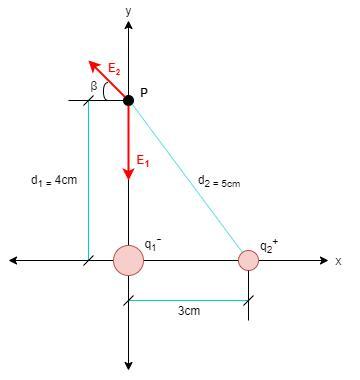
Fields of Point Charges Two point charges are fixed in the x-y plane. At the origin is q1 = -6.00 nC . and at a point on the x-a
Maru [3263]

Answer:

Part A) Electric fields at the designated point due to charges q₁ and q₂:

E₁ = 33.75 * 10³ N/C (-j), E₂ = (6.48 (-i) + 8.64 (+j)) * 10³ N/C

Part B) The overall electric field at P (Ep)

Ep = (6.48 * 10³ (-i) + 25.11 * 10³ (-j)) N/C

Explanation:

Conceptual analysis

The electric field at point P caused by a point charge is calculated as:

E = k*q/d²

E: Electric field measured in N/C

q: charge magnitude in Newtons (N)

k: electric constant measured in N*m²/C²

d: distance from the charge q to point P in meters (m)

Equivalence:

1 nC = 10⁻⁹ C

1 cm = 10⁻² m

Data:

k = 9 * 10⁹ N*m²/C²

q₁ = -6.00 nC = -6 * 10⁻⁹ C

q₂ = +3.00 nC = +3 * 10⁻⁹ C

d₁ = 4 cm = 4 * 10⁻² m

d_{2} =\sqrt{(4*10^{-2})^{2}+((3*10^{-2})^{2} }

d₂ = 5 * 10⁻² m

Part A) Calculation for electric fields at point from q₁ and q₂:

Refer to the attached illustration:

E₁: Electric Field at point P(0,4) cm due to charge q₁. Since q₁ is negative (q₁-), the electric field approaches the charge.

E₂: Electric Field at point P(0,4) cm due to charge q₂. Since q₂ is positive (q₂+), the electric field emanates from the charge.

E₁ = k*q₁/d₁² = 9 * 10⁹ * 6 * 10⁻⁹ / (4 * 10⁻²)² = 33.75 * 10³ N/C

E₂ = k*q₂/d₂²= 9 * 10⁹ * 3 * 10⁻⁹ / (5 * 10⁻²)² = 10.8 * 10³ N/C

E₁ = 33.75 * 10³ N/C (-j)

E₂x = E₂cosβ = 10.8 * (3/5) = 6.48 * 10³ N/C

E₂y = E₂sinβ = 10.8 * (4/5) = 8.64 * 10³ N/C

E₂ = (6.48 (-i) + 8.64 (+j)) * 10³ N/C

Part B) Calculation for net electric field at P (Ep)

The electric field at point P from multiple point charges is the vector sum of the individual electric fields.

Ep = Epx (i) + Epy (j)

Epx = E₂x = 6.48 * 10³ N/C (-i)

Epy = E₁y + E₂y = (33.75 * 10³ (-j) + 8.64 * 10³ (+j)) N/C = 25.11 * 10³ (-j) N/C

Ep = (6.48 * 10³ (-i) + 25.11 * 10³ (-j)) N/C

Ep = (6.48 * 10³ (-i) + 25.11 * 10³ (-j)) N/C

3 0
29 days ago
Other questions:
  • A pole-vaulter is nearly motionless as he clears the bar, set 4.2 m above the ground. he then falls onto a thick pad. the top of
    15·2 answers
  • If a radio wave has a period of 1 μs what is the wave's period in seconds
    14·1 answer
  • A sports car can move 100.0 m in the first 4.5 s of constant acceleration.
    13·2 answers
  • A displacement vector is 34.0 m in length and is directed 60.0° east of north. What are the components of this vector? Northward
    15·1 answer
  • How many times could Haley fly bewteen the two flowers in 1 minute (60 seconds)​
    7·2 answers
  • Point charge A with a charge of +4.00 μC is located at the origin. Point charge B with a charge of +7.00 μC is located on the x
    12·2 answers
  • The period of a pendulum is the time it takes the pendulum to swing back and forth once. If the only dimensional quantities that
    11·1 answer
  • Rita throws a ball straight up into the air and catches it at the same position from which she threw it. The ball has 18 J of me
    11·2 answers
  • A model of a spring/mass system is 4x'' + e−0.1tx = 0. By inspection of the differential equation only, discuss the behavior of
    9·1 answer
  • o illustrate the work-energy concept, consider the case of a stone falling from xi to xf under the influence of gravity. Using t
    12·1 answer
Add answer
Login
Not registered? Fast signup
Signup
Login Signup
Ask question!