answer.
Ask question
Login Signup
Ask question
All categories
  • English
  • Mathematics
  • Social Studies
  • Business
  • History
  • Health
  • Geography
  • Biology
  • Physics
  • Chemistry
  • Computers and Technology
  • Arts
  • World Languages
  • Spanish
  • French
  • German
  • Advanced Placement (AP)
  • SAT
  • Medicine
  • Law
  • Engineering
stira
14 days ago
11

Fields of Point Charges Two point charges are fixed in the x-y plane. At the origin is q1 = -6.00 nC . and at a point on the x-a

xis 3.00 cm from the origin is q2 = +3.00 n C. Now consider Point P, which is on the y-axis. 4.00 cm from the origin. Part A Find the electric fields E1 and E2 at point P due to the charges q1 and q2. Express your results in terms of unit vectors. Express your answer in terms of the unit vectors i, j. Enter your answers separated by a comma. Part B Determine the net electric field at P. expressing your answer in unit vector form. Express your answer in terms of the unit vectors i, j.

Physics
1 answer:
Maru [2.3K]14 days ago
3 0

Answer:

Part A) Electric fields at the designated point due to charges q₁ and q₂:

E₁ = 33.75 * 10³ N/C (-j), E₂ = (6.48 (-i) + 8.64 (+j)) * 10³ N/C

Part B) The overall electric field at P (Ep)

Ep = (6.48 * 10³ (-i) + 25.11 * 10³ (-j)) N/C

Explanation:

Conceptual analysis

The electric field at point P caused by a point charge is calculated as:

E = k*q/d²

E: Electric field measured in N/C

q: charge magnitude in Newtons (N)

k: electric constant measured in N*m²/C²

d: distance from the charge q to point P in meters (m)

Equivalence:

1 nC = 10⁻⁹ C

1 cm = 10⁻² m

Data:

k = 9 * 10⁹ N*m²/C²

q₁ = -6.00 nC = -6 * 10⁻⁹ C

q₂ = +3.00 nC = +3 * 10⁻⁹ C

d₁ = 4 cm = 4 * 10⁻² m

d_{2} =\sqrt{(4*10^{-2})^{2}+((3*10^{-2})^{2} }

d₂ = 5 * 10⁻² m

Part A) Calculation for electric fields at point from q₁ and q₂:

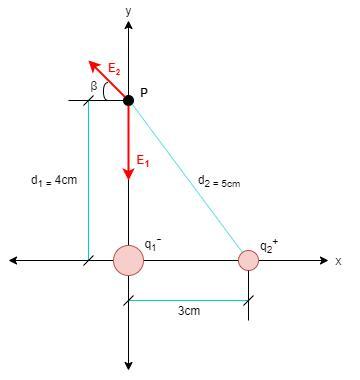
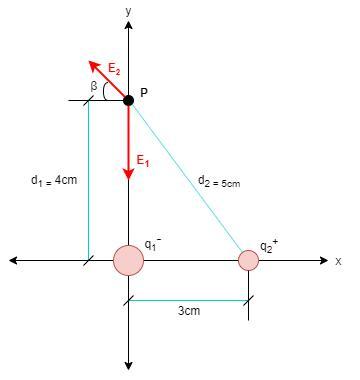
Refer to the attached illustration:

E₁: Electric Field at point P(0,4) cm due to charge q₁. Since q₁ is negative (q₁-), the electric field approaches the charge.

E₂: Electric Field at point P(0,4) cm due to charge q₂. Since q₂ is positive (q₂+), the electric field emanates from the charge.

E₁ = k*q₁/d₁² = 9 * 10⁹ * 6 * 10⁻⁹ / (4 * 10⁻²)² = 33.75 * 10³ N/C

E₂ = k*q₂/d₂²= 9 * 10⁹ * 3 * 10⁻⁹ / (5 * 10⁻²)² = 10.8 * 10³ N/C

E₁ = 33.75 * 10³ N/C (-j)

E₂x = E₂cosβ = 10.8 * (3/5) = 6.48 * 10³ N/C

E₂y = E₂sinβ = 10.8 * (4/5) = 8.64 * 10³ N/C

E₂ = (6.48 (-i) + 8.64 (+j)) * 10³ N/C

Part B) Calculation for net electric field at P (Ep)

The electric field at point P from multiple point charges is the vector sum of the individual electric fields.

Ep = Epx (i) + Epy (j)

Epx = E₂x = 6.48 * 10³ N/C (-i)

Epy = E₁y + E₂y = (33.75 * 10³ (-j) + 8.64 * 10³ (+j)) N/C = 25.11 * 10³ (-j) N/C

Ep = (6.48 * 10³ (-i) + 25.11 * 10³ (-j)) N/C

Ep = (6.48 * 10³ (-i) + 25.11 * 10³ (-j)) N/C
You might be interested in
A positive charge moves in the direction of an electric field. Which of the following statements are true?
kicyunya [2264]

Answer:

The potential energy tied to the charge diminishes.

The electric field performs negative work on the charge.

Explanation:

3 0
1 month ago
Read 2 more answers
Ben walks 500 meters from his house to the corner store. He then walks back toward his house, but continues 200 meters past his
Keith_Richards [2263]
Velocity = 71 meters per minute (MPM)
S stands for Speed
D means Distance
T represents Time
To calculate Speed, divide Distance by Time.
6 0
1 month ago
Read 2 more answers
Water is made of two hydrogen atoms and one oxygen atom bonded together. Julia is describing how water undergoes a physical chan
kicyunya [2264]
Steam transforms into gas as it escapes into the atmosphere. Even if you manage to capture the steam as it ascends, it can revert to H2O when it cools down. Due to the evaporation process, the final volume of water will differ from the original amount.
8 0
1 month ago
Read 2 more answers
A tennis ball bounces on the floor three times. If each time it loses 22.0% of its energy due to heating, how high does it rise
Ostrovityanka [2208]

Answer:

H = 109.14 cm

Explanation:

Given,                                                            

Assume that the total energy equals 1 unit.                                

Energy remaining after the first collision = 0.78 x 1 unit

Balance after the first impact = 0.78 units

Remaining energy after the second impact = 0.78 ^2 units

Balance after the second impact = 0.6084 units

Remaining energy after the third impact = 0.78 ^3 units

Balance after the third impact = 0.475 units

The height reached after the third collision is equivalent to the remaining energy.

Let H denote the height achieved after three bounces.

0.475 (m g h) = m g H                  

H = 0.475 x h                                    

H = 0.475 x 2.3 m                          

H = 1.0914 m                      

H = 109.14 cm                      

6 0
16 days ago
You are standing at the midpoint between two speakers, a distance D away from each. The speakers are playing the exact same soun
ValentinkaMS [2425]

Answer:

Explanation:

The wavelength of sound can be calculated using the formula: wavelength = velocity / frequency.

Thus, it becomes:

λ = 340 / 170

λ = 2 m.

When the person stands ideally in the center between the speakers, the sound waves reaching him are perfectly aligned (no path difference), resulting in maximum sound intensity.

As he moves closer to one of the speakers, his proximity to that speaker increases while the distance to the other speaker decreases, creating a path difference in the sound waves reaching his ears.

If he walks 0.5 m toward one speaker, the created path difference becomes:

0.5 x 2 = 1 m.

This path difference equals λ / 2, leading to destructive interference, resulting in minimal sound being audible.

As he continues walking a full 1 m, the created path difference totals 2 m.

This corresponds to a path difference of λ, causing constructive interference and maximum sound perception.

Finally, if he moves an additional 1.5 m, the resulting path difference increases to 3 m.

Thus, we arrive at a path difference of 3 λ / 2, producing destructive interference once more, leading to minimum sound being perceived again.

In summary, the man begins at a maximum intensity point, moves to minimum intensity, then back to a maximum, and ultimately ends at another minimum sound intensity position.

3 0
19 days ago
Other questions:
  • A new roller coaster contains a loop-the-loop in which the car and rider are completely upside down. If the radius of the loop i
    13·1 answer
  • An object is released from rest near and above Earth’s surface from a distance of 10m. After applying the appropriate kinematic
    8·1 answer
  • Charge is placed on two conducting spheres that are very far apart and connected by a long thin wire. The radius of the smaller
    7·1 answer
  • A 60.0-kg crate rests on a level floor at a shipping dock. The coefficients of static and kinetic friction are 0.760 and 0.410,
    15·1 answer
  • "a very light ideal spring stretches by 21.0 cm when it is used to hang a 135-n object. what is the weight of a piece of electro
    11·2 answers
  • A rock has mass 1.80 kg. When the rock is suspended from the lower end of a string and totally immersed in water, the tension in
    10·1 answer
  • A roller coaster moving along its track rolls into a circular loop of radius r. In the loop, it is only affected by its initial
    7·2 answers
  • Which graph represents the motion of an object traveling with a positive velocity and a negative acceleration?
    5·2 answers
  • A 1.0-kg block and a 2.0-kg block are pressed together on a horizontal frictionless surface with a compressed very light spring
    13·2 answers
  • An ideal gas is allowed to expand isothermally from 2.00 l at 5.00 atm in two steps:
    8·1 answer
Add answer
Login
Not registered? Fast signup
Signup
Login Signup
Ask question!