answer.
Ask question
Login Signup
Ask question
All categories
  • English
  • Mathematics
  • Social Studies
  • Business
  • History
  • Health
  • Geography
  • Biology
  • Physics
  • Chemistry
  • Computers and Technology
  • Arts
  • World Languages
  • Spanish
  • French
  • German
  • Advanced Placement (AP)
  • SAT
  • Medicine
  • Law
  • Engineering
Lelu
22 days ago
11

A current is induced in a conducting loop that lies in a horizontal plane, and the induced current is clockwise when viewed from

above. Which of the following statements could be true? (more than one right answer , i think )
a. constant magnetic field is directed vertically upward
b. constant magnetic field is directed vertically downward
c. A magnetic field whose magnitude is decreasing is directed vertically downward
d. A magnetic field whose magnitude is decreasing is directed vertically upward
e. A magnetic field whose magnitude is increasing is directed vertically downward
Physics
1 answer:
Softa [2K]22 days ago
4 0

Answer:

option (c)

Explanation:

The current induced in the coil flows clockwise when viewed from above, hence the induced magnetic field points downwards. According to Lenz's law, the applied magnetic field across the coil is directed downwards and diminishes in strength. As a result, the current induced will circulate in a manner that seeks to enhance the applied magnetic field.

You might be interested in
A 5-kg concrete block is lowered with a downward acceleration of 2.8 m/s2 by means of a rope. The force of the block on the Eart
Maru [2360]

The moment the body impacts the ground, two types of Forces are produced: the gravitational pull and the Normal Force. This aligns with Newton's third law, indicating that every action has an equal and opposite reaction. If the downward force of gravity is directed toward the earth, the reactionary force from the block acts upwards, equivalent to its weight:

F = mg

Where,

m = mass

g = gravitational acceleration

F = 5*9.8

F = 49N

Consequently, the answer is E.

5 0
17 days ago
-. What is the acceleration of 4 kg trolling bag pulled by a girl with a<br> force of 3 N?
inna [2210]

Answer:

Acceleration(a) = 0.75 m/s²

Explanation:

Given:

Force(F) = 3 N

Mass of object(m) = 4 kg

Find:

Acceleration(a)

Computation:

Force(F) = ma

3 = (4)(a)

Acceleration(a) = 3/4

Acceleration(a) = 0.75 m/s²

3 0
1 month ago
A brick is dropped (zero initial speed) from the roof of a building. The brick strikes the ground in 1.90 s. You may ignore air
Sav [2230]

Answer:

Height (h) = 17 m

Velocity (v) = 18.6 m/s

Explanation: This problem can be solved using kinematic motion equations.

Given Data

Initial velocity (u) = 0

Acceleration (a) = g

Time (t) = 1.9 seconds

First, we calculate the height.

s=ut+0.5at^2\\h=ut+0.5at^2\\h=0*1.9+0.5*9.81*1.9^2\\h=17.707 m

Then, we find the final velocity

v=u+at\\v=0+9.81*1.9\\v=18.639

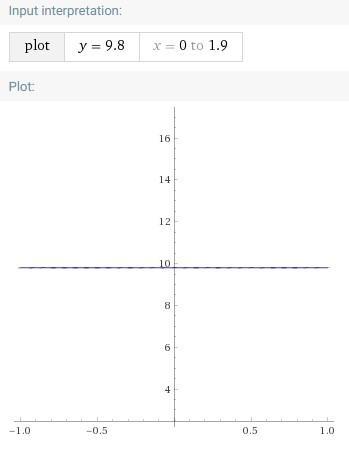
The acceleration graph is a linear representation described by y=9.8, as it remains constant:

The velocity graph can be represented by y=9.8x (where y signifies velocity and x indicates time):

The displacement graph can be described as y=4.9x^2 (with x as time and y as displacement):

These graphs apply exclusively from x=0 to x=1.9, so disregard other sections of the graphs.

5 0
1 month ago
Three pendulums with strings of the same length and bobs of the same mass are pulled out to angles θ1, θ2, and θ3, respectively,
Sav [2230]

Answer:

All three pendulums will have the same angular frequencies.

Explanation:

For a simple pendulum, the time period using the approximation sin(\theta )\approx \thetais expressed as:

T=2\pi\sqrt{\frac{l}{g}}

The angular frequency \omega is defined as

\omega =\frac{2\pi }{T}\\\\\omega =\frac{2\pi}{2\pi \sqrt{\frac{l}{g}}}\\\\\therefore \omega =\sqrt{\frac{g}{l}}

Since the angular frequency remains unaffected by the initial angle (valid strictly for small angle approximations), we deduce that the angular frequencies of the three pendulums are identical.

6 0
4 days ago
Several charges in the neighborhood of point P produce an electric potential of 6.0 kV (relative to zero at infinity) and an ele
ValentinkaMS [2425]

Answer:

0.018 J

Explanation:

The work required to bring the charge from infinity to the point P is equal to the change in its electric potential energy. This can be expressed as

W = q \Delta V

where

q=3.0 \mu C = 3.0 \cdot 10^{-6} C represents the charge's magnitude

and \Delta V = 6.0 kV = 6000 V signifies the potential difference between point P and infinity.

After substituting into the formula, we arrive at

W=(3.0\cdot 10^{-6}C)(6000 V)=0.018 J

4 0
28 days ago
Other questions:
  • You and your friend Peter are putting new shingles on a roof pitched at 20degrees . You're sitting on the very top of the roof w
    5·1 answer
  • A cylindrical tank of methanol has a mass of 40 kgand a volume of 51 L. Determine the methanol’s weight, density,and specific gr
    10·1 answer
  • What is the number N0 of 99mTc atoms that must be present to have an activity of 15mCi?
    11·1 answer
  • A straight wire 20 cm long, carrying a current of 4 A, is in a uniform magnetic field of 0.6 T. What is the force on the wire wh
    15·2 answers
  • Explain why is not advisable to use small values of I in performing an experiment on refraction through a glass prism?
    8·1 answer
  • (a) A 15.0 kg block is released from rest at point A in the figure below. The track is frictionless except for the portion betwe
    12·1 answer
  • A block spring system oscillates on a frictionless surface with an amplitude of 10\text{ cm}10 cm and has an energy of 2.5 \text
    5·1 answer
  • Calculate the de broglie wavelength (in picometers) of a hydrogen atom traveling at 440 m/s.
    6·1 answer
  • On a hot summer day, you decide to make some iced tea. First, you brew 1.50 LL of hot tea and leave it to steep until it has rea
    12·1 answer
  • What is the speed u of the object at the height of (1/2)hmax? Express your answer in terms of v and g. Use three significant fig
    15·1 answer
Add answer
Login
Not registered? Fast signup
Signup
Login Signup
Ask question!