answer.
Ask question
Login Signup
Ask question
All categories
  • English
  • Mathematics
  • Social Studies
  • Business
  • History
  • Health
  • Geography
  • Biology
  • Physics
  • Chemistry
  • Computers and Technology
  • Arts
  • World Languages
  • Spanish
  • French
  • German
  • Advanced Placement (AP)
  • SAT
  • Medicine
  • Law
  • Engineering
Advocard
1 day ago
9

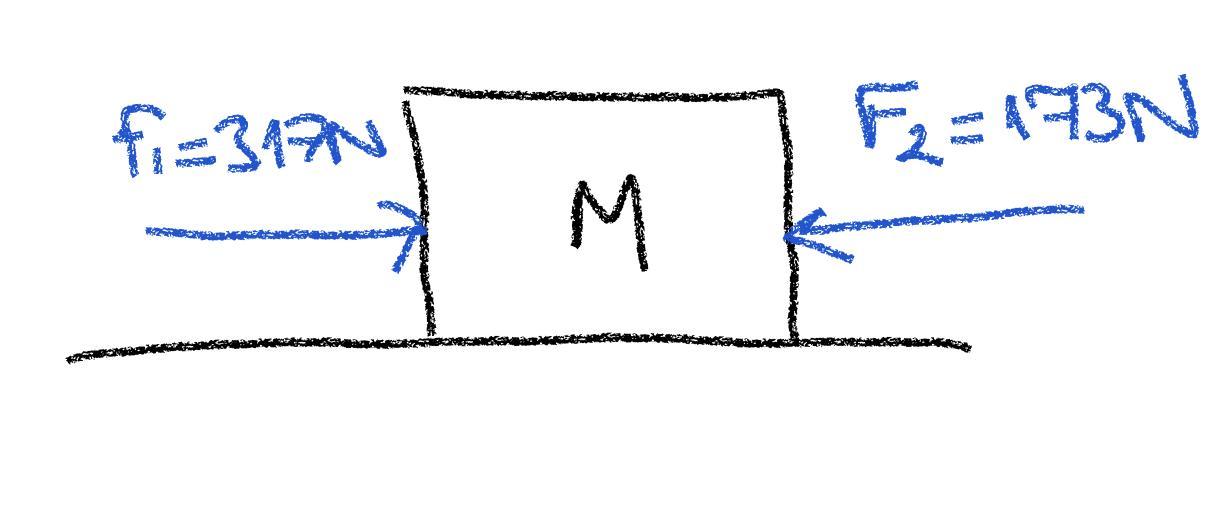
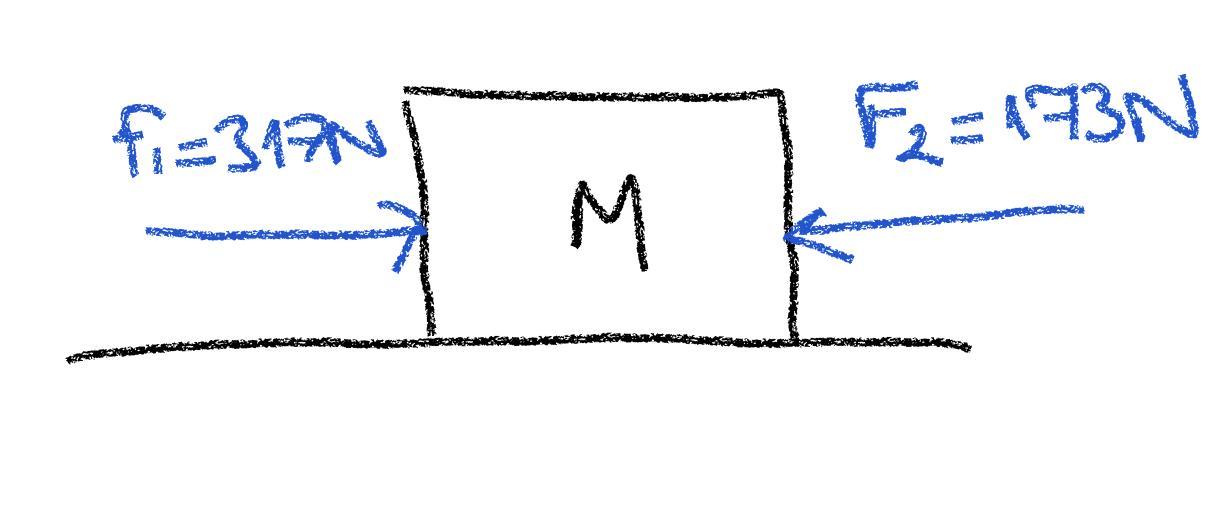
Two horizontal forces are exerted on a large crate. The first force is 317 N to the right. The second force is 173 N to the left

a. Draw a force diagram for the horizontal forces acting on the crate. b. What is the net force acting on the crate? c. The box is initially at rest. Five seconds later, its velocity is 6.5 m/s to the right. What is the crate's mass?

Physics
1 answer:
Maru [1K]1 day ago
7 0

Answer:

A. Reference the figure.

B. The resultant force acting on the crate is

F_{net} = F_1 - F_2 = 317 - 173 = 144N

C. Initially, we should determine the acceleration of the crate using this kinematics equation:

v = v_0 + at\\6.5 = 0 + 5a\\a = 1.3 m/s^2

The crate's mass can be derived through Newton’s Second Law:

F = Ma\\M = F/a = 144/1.3 = 110.7 kg

You might be interested in
Starting with only the Balmer series light (visible light), how could we ensure that the solar panels generate a current that Ma
ValentinkaMS [1149]

The right answer is (a).

Solar panels create electric current through the photoelectric effect, which describes how photons strike certain material surfaces, resulting in the release of electrons when light with the correct frequency hits them. A photon will interact with an electron on the panel, causing it to be ejected from the panel's surface.

As the illumination on the panel becomes brighter, the intensity of the light rises, indicating an increase in the number of photons. Each photon has the potential to liberate an electron; thus, as the number of incoming photons rises, so does the quantity of freed electrons. Given that the photoelectric current reflects the rate at which these electrons flow, an increase in light intensity leads to a corresponding rise in the photoelectric current.

If the frequency of the light is increased without a change in brightness, the photoelectric current remains the same because the total number of photons does not increase. Yet, the electrons that are ejected do escape with higher kinetic energy. However, since the total number of electrons liberated stays unchanged, the current remains constant regardless of the electrons' increased energy. Thus, option b is incorrect.

Increasing the wavelength of the light means the energy of the photons decreases. This would cause the emitted electrons to have lower energy. However, if the brightness is consistent, the number of electrons remains the same, and as a result, there would be no change in the photoelectric current. Therefore, choice (c) is also incorrect.

The correct answer is (a). To generate the needed current, the brightness of the incident light must be increased.

8 0
6 days ago
Read 2 more answers
A common small-molecular weight (and therefore fast diffusing for an organic molecule) ingredient in perfumes is vanillin, the p
Softa [913]
What's the response shshshsbshsbsbs sbo
7 0
9 days ago
Read 2 more answers
A crate with a mass of m = 450 kg rests on the horizontal deck of a ship. The coefficient of static friction between the crate a
Sav [1105]

Answer:F_{v} =\mu_{k} mg

The force required has a magnitude of 2601.9 N

Explanation:

m = 450 kg

Static friction coefficient μs = 0.73

Kinetic friction coefficient μk = 0.59

The force necessary to initiate movement of the crate is F_{s} =\mu_{s} mg.

Once the crate begins to move, the frictional force decreases to F_{v} =\mu_{k} mg.

To maintain the motion of the crate at a steady velocity, we must lower the pushing force to F_{v} =\mu_{k} mg.

Subsequently, the pushing force aligns with the frictional force stemming from kinetic friction, enabling balanced forces and consistent velocity.

<pMagnitude of the force

F_{v} =\mu_{k} mg\\F_{v} =0.59 \times 450 \times 9.8\\F_{v} =2601.9 N

4 0
6 days ago
A system uses 2380 I of energy to do work as 12,900 j of heat are added to the system. The change in internal energy of the syst
Softa [913]
The equation U = Q + W defines the internal energy of the system, where U represents internal energy, Q corresponds to heat, and W is work done. You have an input of 2,380 J for work alongside 12,900 J of heat, which totals 15,280 J for internal energy.
4 0
11 days ago
Which of the following statements are true about an object in two-dimensional projectile motion with no air resistance? (There c
kicyunya [1025]

Response:

The accurate statements are

Concerning an object in two-dimensional projectile motion devoid of air resistance:

D) The object's speed reaches zero at its peak elevation.

E) Horizontal acceleration remains zero while vertical acceleration is consistently a non-zero downward value

Clarification:

A) The object maintains constant speed, yet its velocity changes.

False; vertical velocity increases during descent.

B) The object's acceleration remains constant, but it is +g while ascending and -g while descending.

False; acceleration is -g when the object ascends.

C) At the peak altitude, the object's acceleration becomes zero.

False; acceleration maintains a consistent magnitude throughout the trajectory.

D) The speed of the object is zero at its peak elevation.

True; at the highest point, the direction alters, causing the object to momentarily cease motion, resulting in zero speed.

E) The horizontal acceleration is always at zero, while the vertical acceleration is a non-zero constant directed downward.

True; horizontal acceleration does not maintain any force during motion. In contrast, vertical acceleration results from gravity and remains constant in the downward direction.

6 0
2 days ago
Other questions:
  • Any ferrous metal object within or near the mri magnet has the potential of becoming a projectile. this is commonly referred to
    6·1 answer
  • Kayla, a fitness trainer, develops an exercise that involves pulling a heavy crate across a rough surface. The exercise involves
    6·1 answer
  • A clever inventor has created a device that can launch water balloons with an initial speed of 85.0 m/s. Her goal is to pass a b
    8·1 answer
  • If 100 grams of vinegar and 5 grams of baking soda are poured in a container, a small amount of gas will be produced. What will
    11·1 answer
  • Calculate the average time it took the car to travel 0.25 and 0.50 meters with three washers attached to the pulley. Record the
    10·3 answers
  • A steel plate shine but wooden vessel desnt
    15·3 answers
  • Compressed air is used to fire a 60 g ball vertically upward from a 0.70-m-tall tube. The air exerts an upward force of 3.0 N on
    8·1 answer
  • A quantum system has three energy levels, so three wavelengths appear in its emission spectrum. the shortest observed wavelength
    7·1 answer
  • A charge of 4.9 x 10⁻¹¹ C is to be stored on each plate of a parallel-plate capacitor having an area of 150 mm2 and a plate sepa
    5·1 answer
  • Use the momentum equation for photons found in this week's notes, the wavelength you found in #3, and Plank’s constant (6.63E-34
    14·2 answers
Add answer
Login
Not registered? Fast signup
Signup
Login Signup
Ask question!