answer.
Ask question
Login Signup
Ask question
All categories
  • English
  • Mathematics
  • Social Studies
  • Business
  • History
  • Health
  • Geography
  • Biology
  • Physics
  • Chemistry
  • Computers and Technology
  • Arts
  • World Languages
  • Spanish
  • French
  • German
  • Advanced Placement (AP)
  • SAT
  • Medicine
  • Law
  • Engineering
dmitriy555
2 months ago
12

Compound W, C8H17Br, and X, C8H17Cl, are products of the radical bromination (W), and chlorination (X), of 2,4-dimethylhexane. W

and X are each chiral. W reacts readily in water to form a chiral substitution product Y, C8H17OH. Reaction of a single enantiomer of W produces a single enantiomer of Y as the only substitution product. X likewise reacts readily in water though at a slower rate than W; a chiral substitution product Z, C8H17OH, is again formed. Unlike W, however, reaction of a single enantiomer of X produces Z that is nearly racemic. Propose structures for W and X.

Chemistry
1 answer:
eduard [2.7K]2 months ago
5 0

Respuesta:

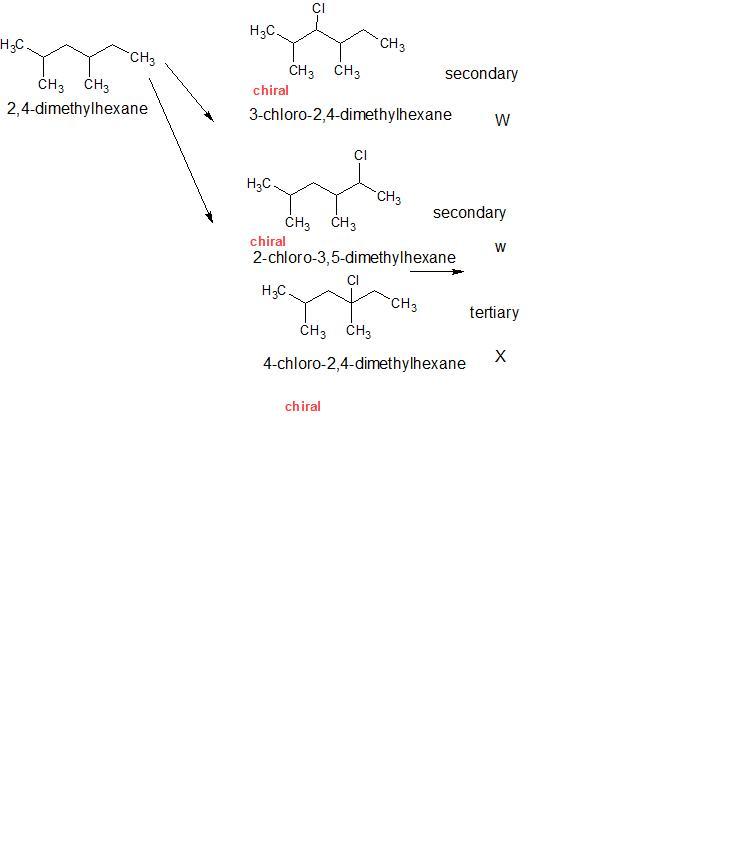
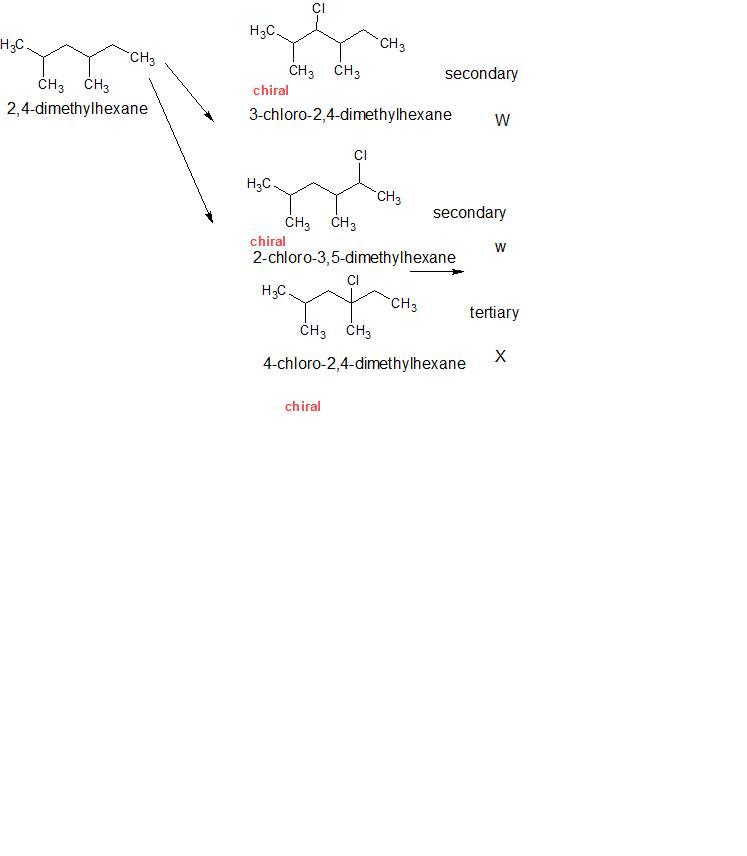
Las posibles estructuras se muestran en la figura.

Explicación:

Los siete isómeros que se podrían formar a partir del compuesto dado debido a la halogenación radicalaria se ilustran en la figura.

Hemos mencionado solo el cloro como grupo para mostrar simplemente la naturaleza quiral del compuesto.

Un compuesto quiral tiene un carbono con los cuatro grupos diferentes entre sí.

Existen tres estructuras que son quirales (como se muestra).

W es el producto bromado

X es el producto clorado.

1) W reacciona fácilmente en agua para formar un producto de sustitución quiral Y, C8H17OH.

La reacción de un solo enantiómero de W produce un único enantiómero de Y como único producto de sustitución: lo que indica que la sustitución es SN2, lo cual es posible si el compuesto no es terciario.

2) X también reacciona fácilmente en agua, aunque a un ritmo más lento que W; de nuevo se forma un producto de sustitución quiral Z, C8H17OH. A diferencia de W, la reacción de un enantiómero de X produce Z que es casi racémico.

Esto significa que sufrirá una reacción SN1, por lo que el haluro de alquilo debe ser terciario.

Las posibles estructuras se presentan en la figura.
You might be interested in
1. Bailey wants to find out which frozen solid melts the fastest: soda, gatorade, or orange juice. She pours each of the three l
VMariaS [2998]

First scenario:

IV: soda, gatorade, orange juice, and water

DV: state of the liquids listed above

Control: freezer and ice tray

Second scenario:

IV: laundry detergent, water

DV: cleanliness of the squares post-wash

Control: chocolate, cloth type, cloth squares

Third scenario:

IV: type of water used, pea plant

DV: growth of the pea plant

Control: pots and daily water amount for the plant

4 0
3 months ago
Read 2 more answers
Assume the weight of an average adult is 70. kg, and that 420. kJ of heat are evolved per mole of oxygen consumed as a result of
castortr0y [3046]
The temperature difference after 3 hours is 5.16 K. Given that the moles of O₂ inhaled rate at 0.02 mole/min, which converts to 1.2 mole/hour, we know the average heat released during metabolism is 7.2 kJ/h·kg. Therefore, the amount of heat generated within 3 hours will be 7.2 kJ/h·kg multiplied by 3 hours, giving a result of 21.6 kJ/kg, or 21.6 x 10³ J/kg. Applying the formula Qp = Cp x ΔT, and taking the body's heat capacity to be 4.18 J/g·K, we find ΔT = 5.16 K.
6 0
2 months ago
If you pump air into cycle tyre a slight warming effect is noticed at valve stem why
castortr0y [3046]
The slight warm feeling noticed at the valve stem when air is pumped into the tire is likely due to the kinetic energy generated by the friction from the pump and the resultant increase in gas pressure within the tire.
8 0
2 months ago
What is [h3o ] in a solution of 0.25 m ch3co2h and 0.030 m nach3co2?
Anarel [2989]

Hello!

To find [H₃O⁺], we will employ the Henderson-Hasselbalch equation, as this involves an acid and its conjugate base:

pH=pKa+log( \frac{[A^{-}] }{[HA]} )

pH=4,76+log( \frac{0,030M}{0,25M} ) \\ \\ pH=3,84

Next, we derive [H₃O⁺] using the definition of pH:

pH=-log[H_3O^{+}]

[H_3O^{+}] = 10^{-pH} =10^{-3,84}=0,00014 M

Hence, the concentration of [H₃O⁺] comes out to be 0.00014 M

Wishing you a good day!

4 0
3 months ago
41. A 13.0% solution of K2CO3 by mass has a density of 1.09 g/cm3. Calculate the molality of the solution.
lions [2927]

Answer:

The molality of the solution is 1.08 m.

Explanation:

First, determine the mass of the solvent.

A 13% solution by mass indicates that 13 grams are found in every 100 grams of solution.

Thus, solution mass = solute mass + solvent mass

100 g = 13 g + solvent mass

Therefore, solvent mass = 100 g - 13 g → 87 g

Next, we calculate the moles of solute (mass / molar mass):

13 g / 138.2 g/mol = 0.094 moles

Finally, to find the molality, which is the moles of solute per 1 kg of solvent (mol/kg), we convert the solvent mass to kg:

87 g. 1 kg / 1000 g = 0.087 kg

Then, molality → 0.094 mol / 0.087 kg = 1.08 m

5 0
2 months ago
Other questions:
  • The electron configuration of an element is 1s22s22p4. Describe what most likely happens when two atoms of this element move tow
    15·2 answers
  • The graph shows the distribution of energy in the particles of two gas samples at different temperatures, T1 and T2. A, B, and C
    14·1 answer
  • Solving applied density problems Mr. Auric Goldfinger, criminal mastermind, intends to smuggle several tons of gold across Inter
    5·1 answer
  • summarize what you read on the two articles by identifying the advantages and disadvantages of using plastics
    11·2 answers
  • A chemist combined chloroform (CHCl3) and acetone (C3H6O) to create a solution where the mole fraction of chloroform is 0.187. T
    5·1 answer
  • All faculty members are happy to see students help each other. Dumbledore is particularly pleased with Hermione. Though, it shou
    9·1 answer
  • A gas of potassium chlorate molecules KClO3 all decompose into potassium chloride, KCl, and diatomic oxygen, O2. The products an
    9·1 answer
  • Notice that "SO4" appears in two different places in this chemical equation. SO42− is a polyatomic ion called "sulfate." What nu
    14·1 answer
  • At 800 K, the equilibrium constant, Kp, for the following reaction is 3.2 × 10⁻⁷. 2 H2S(g) ⇌ 2 H2(g) + S2(g) A reaction vessel a
    9·1 answer
  • II. Pure magnesium metal is often found as ribbons and can easily burn in the presence of oxygen. When 3.86 g of magnesium ribbo
    7·1 answer
Add answer
Login
Not registered? Fast signup
Signup
Login Signup
Ask question!