answer.
Ask question
Login Signup
Ask question
All categories
  • English
  • Mathematics
  • Social Studies
  • Business
  • History
  • Health
  • Geography
  • Biology
  • Physics
  • Chemistry
  • Computers and Technology
  • Arts
  • World Languages
  • Spanish
  • French
  • German
  • Advanced Placement (AP)
  • SAT
  • Medicine
  • Law
  • Engineering
xeze
8 days ago
14

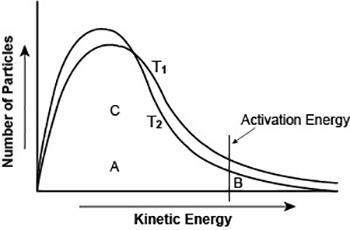
The graph shows the distribution of energy in the particles of two gas samples at different temperatures, T1 and T2. A, B, and C

represent individual particles.
A graph is shown with two inverted graph curves running close to each other. One of the curves labeled T1 is slightly more spread out than the other labeled T2. The x axis of the graph has the title Kinetic Energy. The y axis of the graph has the title Number of Particles. A vertical line perpendicular to the x axis is shown. This vertical line is labeled Activation Energy. A point labeled B is shown on the right hand side of the vertical line. A point labeled A is shown in the lower left side of the vertical line. A particle labeled C is shown in the upper left side of the vertical line.

Based on the graph, which of the following statements is likely to be true?
Particle A and C are more likely to participate in the reaction than particle B.
Most of the particles of the two gases have very high speeds.
A fewer number of particles of gas at T1 are likely to participate in the reaction than the gas at T2.
The average speed of gas particles at T2 is lower than the average speed of gas particles at T1.

Chemistry
1 answer:
lions [985]8 days ago
7 0

Answer:

  • The average velocity of gas molecules at T₂ is less than the average velocity of gas molecules at T₁.

Explanation:

Particles A and C appear aligned vertically, suggesting they share the same kinetic energy. Given that both are positioned to the left of particle B, it indicates that A and C possess lesser kinetic energy than B.

The likelihood of a particle engaging in a reaction is directly proportional to its kinetic energy, meaning that particle B is more prone to react compared to A and C. Thus, the first statement is incorrect.

The graph resembles a bell curve, demonstrating a mixture of many molecules with low and high kinetic energy. Therefore, one cannot conclude that most particles in both gases have high velocities. As a result, the second statement is also incorrect.

Examining the higher kinetic energy values (to the right of the curve), the line for T₁ exceeds that for T₂, indicating that more molecules possess high kinetic energy at T₁ compared to T₂.

Conversely, for lower kinetic energy values (to the left of the curve), T₂'s line is above T₁'s, which implies that at T₂ there are more molecules with low kinetic energy than at T₁.

Thus, the observations from the previous two paragraphs suggest that the average kinetic energy of gas particles at T₂ is lower than the average kinetic energy of particles at T₁.

Since average speed is proportional to the square root of temperature, the relationship that applies to average kinetic energy equally pertains to average speed, leading us to conclude that the last statement holds true: "The average speed of gas particles at T₂ is lower than at T₁.".

Additionally, given that there are more gas molecules at T₁ with higher kinetic energy compared to those at T₂, it indicates that gas particles at T₁ are more likely to react than those at T₂, marking the third statement as incorrect.
You might be interested in
The molecular formula of aspartame, the artificial sweetener marketed as NutraSweet, is C14H18N2O5. a. What is the molar mass of
alisha [964]

Answer:

a-294

b-3.401×10^-6

c and d - 2.048×10^18

Explanation:

Multiply the RAM for each individual element by its molecular number, e.g., (c-12×14), and then sum to find the molar mass.

b-The molar mass is expressed in grams/mol, hence convert 1 mg to g, which equals 0.001, and divide it by the molar mass.

c/d-1 mole of any substance consists of 6.023×10^23 (ions, molecules, etc.), therefore we need to find the moles here as

(3.401×10^-6) × (6.023×10^23).

8 0
1 day ago
Kayla owns a food truck that sells tacos and burritos. She sells each taco for $3 and each burrito for $7.25. Yesterday Kayla ma
VMariaS [1037]
They overcomplicated things with lots of words. Your initial equation deals with the revenue. I’ll denote tacos as x and burritos as y.
The first equation would be 3x + 7.25y = 595, given that you already have the prices but need the quantities. The second equation will reflect that double the burritos were sold compared to tacos, expressed as y = x + 2.
Hope this clarifies things. If you need further explanation, I can elaborate more.
6 0
10 days ago
"The compound K2O2 also exists. A chemist can determine the mass of K in a sample of known mass that consists of either pure K2O
lorasvet [956]

Answer:

Indeed, the chemist is capable of identifying the compound present in the sample.

Explanation:

In one mole of K₂O, potassium has a mass of 2 × 39.1 g = 78.2 g, while the total mass of K₂O is 94.2 g. The mass ratio of K compared to K₂O is calculated as 78.2 g / 94.2 g = 0.830.

For 1 mole of K₂O₂, potassium's mass remains the same at 78.2 g, but the total mass of K₂O₂ is 110.2 g. The mass ratio of K to K₂O₂ then equates to 78.2 g / 110.2 g = 0.710.

When the chemist measures the mass of K in relation to the overall sample, the mass ratio can be computed.

  • If the mass ratio is 0.830, then it indicates a pure K₂O compound.
  • If the mass ratio is 0.710, it indicates a pure K₂O₂ compound.
  • If the mass ratio falls outside of 0.830 or 0.710, the sample is assessed to be a mixture.
6 0
13 days ago
Dicarbon monoxide, C2O, is found in dust clouds in space. Analysis of it shows that the sequence of atoms in this molecule is C–
castortr0y [923]

Greetings,


The number of lone pairs of electrons in a C2O molecule is...

4

Each Oxygen atom forms two bonds with Carbon.


I hope this was useful!

-Char

8 0
9 days ago
Read 2 more answers
A student puts 0.020 mol of methyl methanoate into an empty and rigid 1.0 L vessel at 450 K. The pressure is measured to be 0.74
KiRa [971]

Explanation:

Initial moles of ethanoic acid = 0.020 mol

At equilibrium, half of the ethanoic acid molecules have reacted.

Thus, moles of ethanoic acid reacted = 0.020 mol * (50% / 100%)

                                                                     = 0.010 mol

Moles of ethanoic acid remaining = 0.020 mol - 0.010 mol = 0.010 mol

The moles of product (CH3COOH)^{2} gas formed are determined as follows:

0.010 mol CH3COOH * (1 mol (CH3COOH)^{2} / 2 mol CH3COOH)

= 0.005 mol (CH3COOH)^{2}

Consequently, the total moles of gas present in the vessel at equilibrium are 0.010 mol CH3COOH and 0.005 mol (CH3COOH)^{2}

Total gas moles at equilibrium = 0.010 mol + 0.005 mol = 0.015 mol

Next, let’s determine the pressure:

0.020 mol of gas has a pressure of 0.74 atm; so under the same conditions, we find the pressure exerted by 0.015 mol of gas:

P1/n1 = P2/n2

P2 = P1*(n2 / n1)

      = 0.74 atm * (0.015 mol / 0.020 mol)

     = 0.555 atm

4 0
8 days ago
Other questions:
  • How many carbon atoms are contained in 84.3 g of ethyne (c2h2)?
    13·1 answer
  • Give the atomic symbol for an element that does not exist as a molecule or extended structure. that is, an element that exists o
    14·2 answers
  • A neutral isotope has 45 neutrons and 36 electrons. Identify the element symbol of this isotope and determine the mass number an
    8·1 answer
  • The graph above shows the changes in temperature recorded for the 2.00 l of h2o surrounding a constant-volume container in which
    9·1 answer
  • What elements are in NaC2HO4 and how many atoms are in each element​
    12·1 answer
  • For each set of dilutions (bleach and mouthwash), the first tube contained a 1:11 dilution (0.5 mL of agent was added to 5.0 mL
    5·1 answer
  • The Museum of West Namibia wants to know if the Mesosaurus fossils were separated in one or a series of quick, huge movements, o
    13·1 answer
  • Question 1: Which of the following statement is false about conjugated systems?
    7·1 answer
  • Children’s chewable tylenol contains 80 mg of acetaminophen per tablet. if the recommended dosage is 10 mg/kg, how many tablets
    13·2 answers
  • How many moles are there in 20.0 grams of<br> FeCl3?
    9·1 answer
Add answer
Login
Not registered? Fast signup
Signup
Login Signup
Ask question!
