There might be a quicker and simpler method to approach this, but since I don’t work with these calculations regularly, this is how I do it:
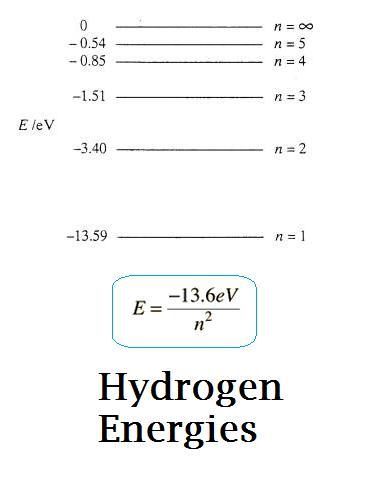
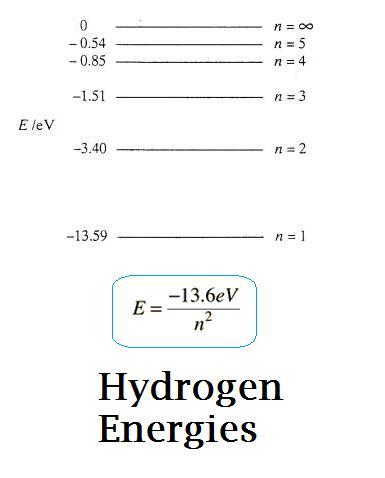
First, I looked up "ionization energy" for Hydrogen on Floogle. This indicates the energy needed to remove one electron from a Hydrogen atom, which is 13.6 eV (electron-volts).
To find the frequency or wavelength of a photon carrying that energy, I must convert the value into Joules.
1 eV = 1.602 x 10⁻¹⁹ Joules (as found on Floogle)
Thus, 13.6 eV = 2.179 x 10⁻¹⁸ Joules
Now we can utilize the familiar formula for photon energy:
Energy = h · (frequency)
or Energy = h · (speed of light/wavelength)
Here, 'h' refers to Max Planck's constant: 6.626 × 10⁻³⁴ m²-kg / s
Excellent! The only unknown in this formula is the wavelength, which we're trying to determine. This should be straightforward now since we know the energy, 'h', and the speed of light.
Wavelength = h · c / energy
Wavelength =
(6.626 x 10⁻³⁴ m²-kg/sec) · (3 x 10⁸ m/s) / (2.179 x 10⁻¹⁸ joule)
Wavelength = 9.117 x 10⁻⁸ meters
This corresponds to 91.1 nanometers.
This wavelength falls short of the visible light spectrum (which ranges from approximately 390 to 780 nm) but is not as brief as I anticipated. I expected it to be classified as X-rays, yet it doesn't reach that short range. X-rays are generally defined within a range of 0.1 to 10 nanometers. The resulting wavelength emerges at the upper end of the Ultra-violet spectrum.
(I am quite pleased with this outcome. I followed the steps I shared with you without any hints. After arriving at my answer, I checked Floogle to see if it matched known values. According to an article on the "Lyman Series," the wavelength for the energy emitted by an electron falling from infinity to the n=1 energy level of Hydrogen is 91.175 nm! I'm thrilled with how close my calculation was, and I am ready to call it a day.)