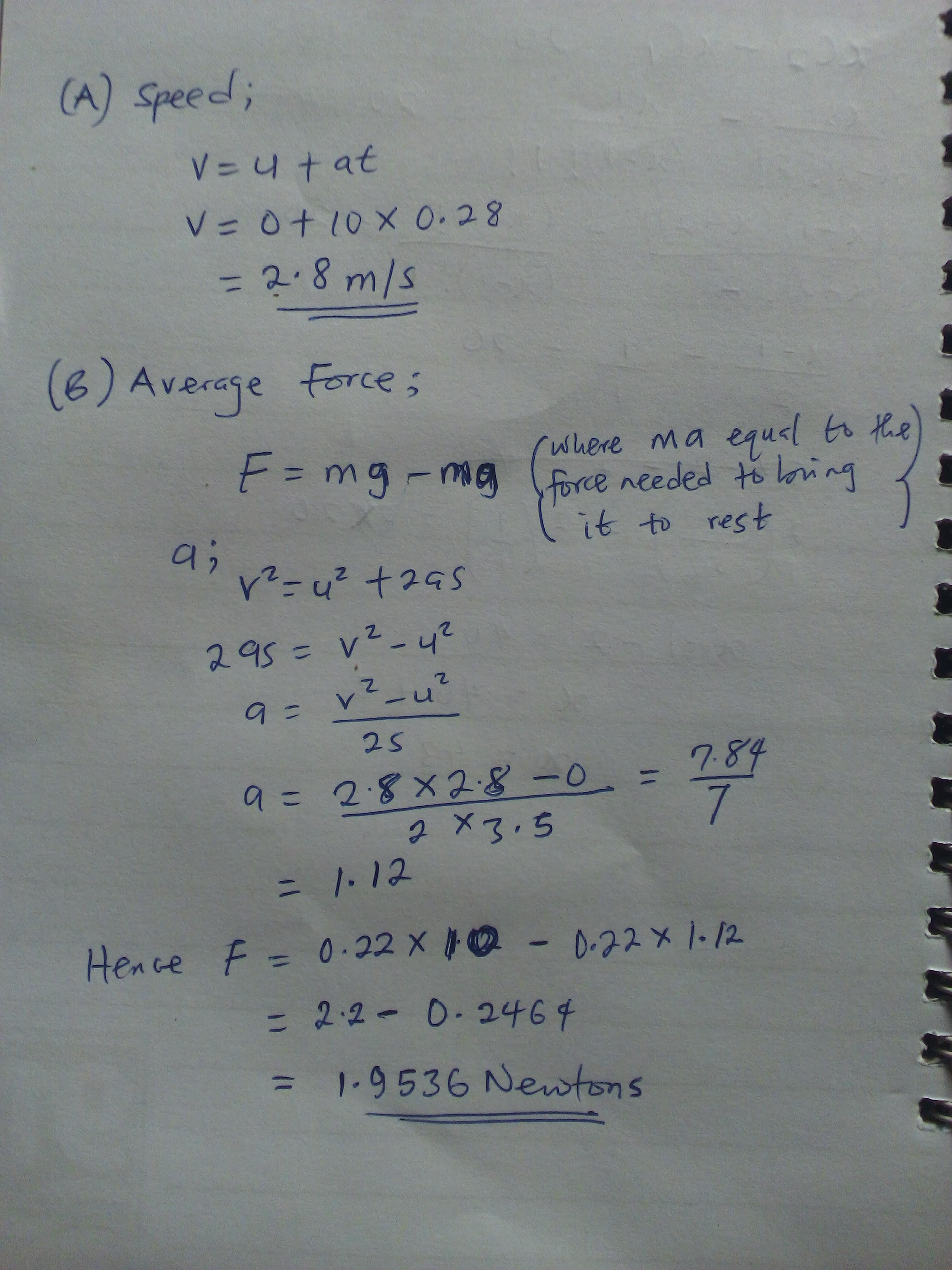
answer.
Ask question
Login Signup
Ask question
All categories
  • English
  • Mathematics
  • Social Studies
  • Business
  • History
  • Health
  • Geography
  • Biology
  • Physics
  • Chemistry
  • Computers and Technology
  • Arts
  • World Languages
  • Spanish
  • French
  • German
  • Advanced Placement (AP)
  • SAT
  • Medicine
  • Law
  • Engineering
zysi
1 month ago
11

A friend climbs an apple tree and drops a 0.22-kg apple from rest to you, standing 3.5 m below. When you catch the apple, you br

ing it to rest in 0.28 s.
A.) What was the speed of the apple just before you caught it?

B.) What average force did you exert on the apple to bring it to rest? (Be sure to include both the weight of the apple and the force needed to bring it to rest.)

Physics
1 answer:
Keith_Richards [3.2K]1 month ago
3 0
(A) velocity = 2.8 m/s (B) Average force = 1.9536 Newtons.
You might be interested in
Suppose that an owner of the same dog breed has also taken some measurements. They notice that the surface area of the dog has i
inna [3103]

Answer:

The surface area of the dog changes from A to 3A

Explanation:

It is stated that the dog's surface area has increased by a factor of 3 over four years.

We need to calculate the change in the relative surface area of the dog over this timeframe.

Let’s assume the initial surface area is A.

Since the surface area has been multiplied by 3,

it follows that the surface area after four years is equal to 3×A = 3A.

Thus, the dog's surface area transitions from A to 3A.

7 0
2 months ago
When listening to tuning forks of frequency 256 Hz and 260 Hz, one hears the following number of beats per second. (A) 0 (B) 2 (
inna [3103]
The answer is (C) 4 beats per second. The number of beats is computed as the difference between the frequencies of the two tuning forks. Plugging in the frequency values yields a result. Thus, the number of observable beats per second will be 4.
3 0
1 month ago
A soft drink (mostly water) flows in a pipe at a beverage plant with a mass flow rate that would fill 220 cans, 0.355 - l each,
Keith_Richards [3271]
Flow rate calculations yield 220 cans, each with a volume of 0.355 l, leading to 78.1 l/min or 1.3 l/s or 0.0013 m³/s.

At Point 2:
A2 = 8 cm² = 0.0008 m²
V2 = Flow rate/A2 = 0.0013/0.0008 = 1.625 m/s
P1 = 152 kPa = 152000 Pa

At Point 1:
A1 = 2 cm² = 0.0002 m²
V1 = Flow rate/A1 = 0.0013/0.0002 = 6.5 m/s
P1 =?
Height = 1.35 m

Using Bernoulli’s principle;
P2 + 1/2 * V2² / density = P1 + 1/2 * V1² / density + density * gravitational acceleration * height
=> 152000 + 0.5 * (1.625)² * 1000 = P1 + 0.5 * (6.5)² * 1000 + (1000 * 9.81 * 1.35)
=> 153320.31 = P1 + 34368.5
=> P1 = 1533210.31 - 34368.5 = 118951.81 Pa = 118.95 kPa
3 0
2 months ago
Read 2 more answers
A permeability test was run on a compacted sample of dirty sandy gravel. The sample was 175 mm long and the diameter of the mold
Maru [3345]

Answer:

(a). The coefficient of permeability is 8.6\times10^{-3}\ cm/s.

(b). The seepage velocity is 0.0330 cm/s.

(c). The discharge velocity during the test is 0.0187 cm/s.

Explanation:

Given that,

Length = 175 mm

Diameter = 175 mm

Time = 90 sec

Volume= 405 cm³

We need to calculate the discharge

Using formula of discharge

Q=\dfrac{V}{t}

Insert the values into the formula

Q=\dfrac{405}{90}

Q=4.5\ cm^3/s

(a). We will compute the coefficient of permeability

Applying the formula for permeability

Q=kiA

k=\dfrac{Q}{iA}

k=\dfrac{Ql}{Ah}

Where, Q=discharge

l = length

A = cross-sectional area

h=constant head that causes flow

Plugging the value into the formula

k=\dfrac{4.5\times175\times10^{-1}}{\dfrac{\pi(175\times10^{-1})^2}{4}\times38}

k=8.6\times10^{-3}\ cm/s

The coefficient of permeability measures as 8.6\times10^{-3}\ cm/s.

(c). To ascertain the discharge velocity during the testing phase

Utilizing the discharge velocity formula

v=ki

v=\dfrac{kh}{l}

Substituting the values into the equation

v=\dfrac{8.6\times10^{-3}\times38}{17.5}

v=0.0187\ cm/s

The discharge velocity during the test measures 0.0187 cm/s.

Thus, (a). The coefficient of permeability is 8.6\times10^{-3}\ cm/s.

(b). The seepage velocity computes at 0.0330 cm/s.

(c). The observed discharge velocity during the test equals 0.0187 cm/s.

8 0
1 month ago
Part a consider another special case in which the inclined plane is vertical (θ=π/2). in this case, for what value of m1 would t
serg [3582]

The solution leads to the conclusion that m1 = m2

For mass m1, the force balance in the y direction equals zero:
0 = T - m1*g
Rearranging gives:
m1*g = T

For mass m2, the force balance in the y direction equals zero:
0 = T - m2*g
Rearranging provides:
m2*g = T

Setting these two equal allows us to solve for m1:
m1*g = m2*g

= m1 = m2


Explanation:

The force acting on each individual mass pulls down while the tension created by the other mass exerts an upward force due to the operation of the pulley system, resulting in balanced forces on both masses.

6 0
2 months ago
Other questions:
  • A 2600-m-high mountain is located on the equator. how much faster does a climber on top of the mountain move than a surfer at a
    14·1 answer
  • Each plate of a parallel-plate capacator is a square with side length r, and the plates are separated by a distance d. The capac
    13·1 answer
  • In the sport of parasailing, a person is attached to a rope being pulled by a boat while hanging from a parachute-like sail. A r
    10·1 answer
  • An electron is trapped in a square well of unknown width, L. It starts in unknown energy level, n. When it falls to level n-1 it
    15·1 answer
  • Theresa is swinging a 4.0 kg ball on a 1.2 m long rope with a tangential speed of 1.8 m/s. What is the centripetal force exerted
    9·2 answers
  • A 68 kg hiker walks at 5.0 km/h up a 9% slope. The indicated incline is the ratio of the vertical distance and the horizontal di
    11·1 answer
  • Smoking increases ____ levels in the blood, thus increasing the possibility of unwanted clotting.
    14·1 answer
  • A grasshopper floating in water generates waves at a rate of three per second with a wavelength of two centimeters. (a) What is
    9·1 answer
  • A person using an oxygen mask is breathing air that is 33% oxygen. what is the partial pressure of the o2, when the air pressure
    6·1 answer
  • An infinite charged wire with charge per unit length lambda lies along the central axis of a cylindrical surface of radius r and
    14·1 answer
Add answer
Login
Not registered? Fast signup
Signup
Login Signup
Ask question!