answer.
Ask question
Login Signup
Ask question
All categories
  • English
  • Mathematics
  • Social Studies
  • Business
  • History
  • Health
  • Geography
  • Biology
  • Physics
  • Chemistry
  • Computers and Technology
  • Arts
  • World Languages
  • Spanish
  • French
  • German
  • Advanced Placement (AP)
  • SAT
  • Medicine
  • Law
  • Engineering
ser-zykov
6 days ago
9

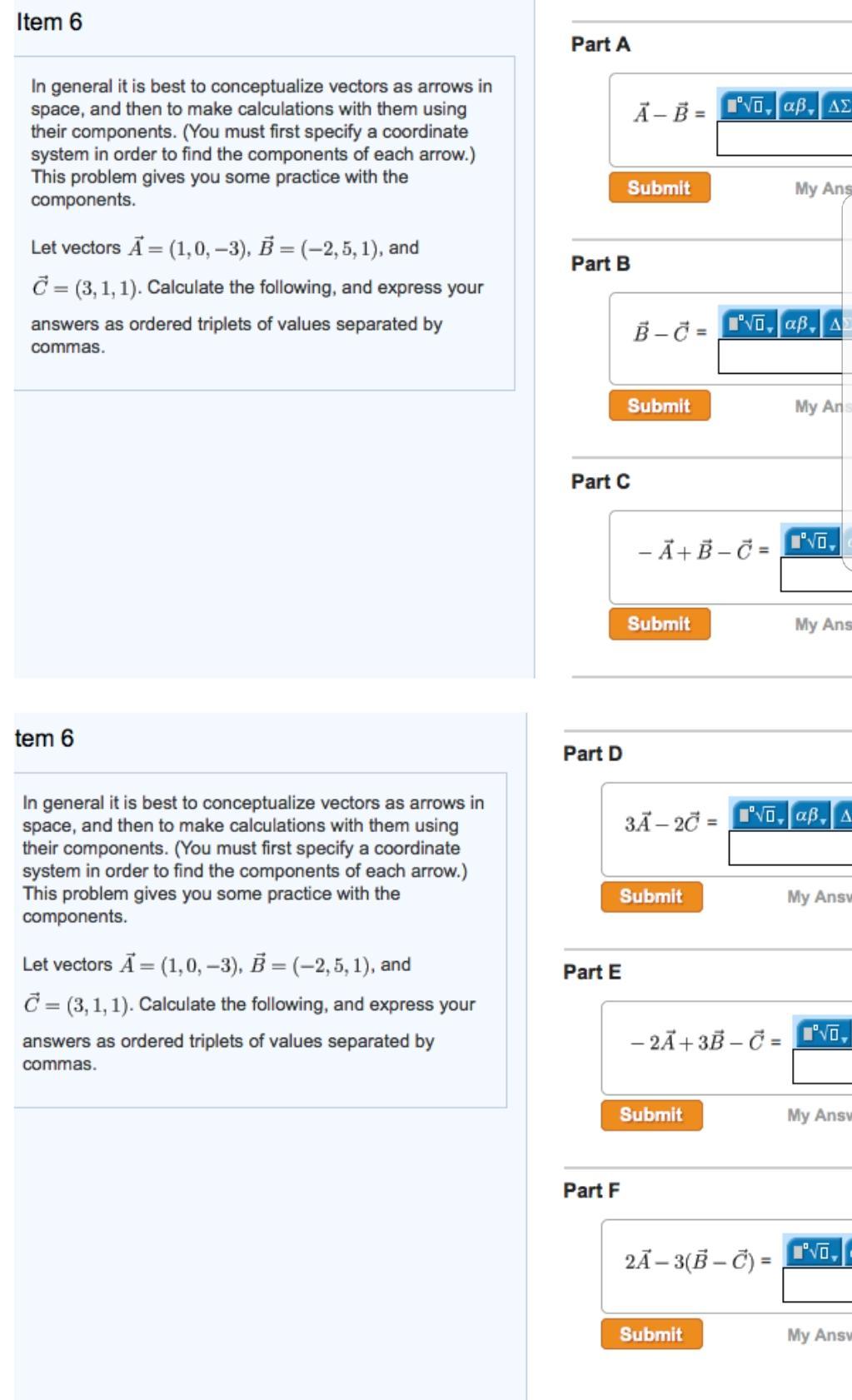
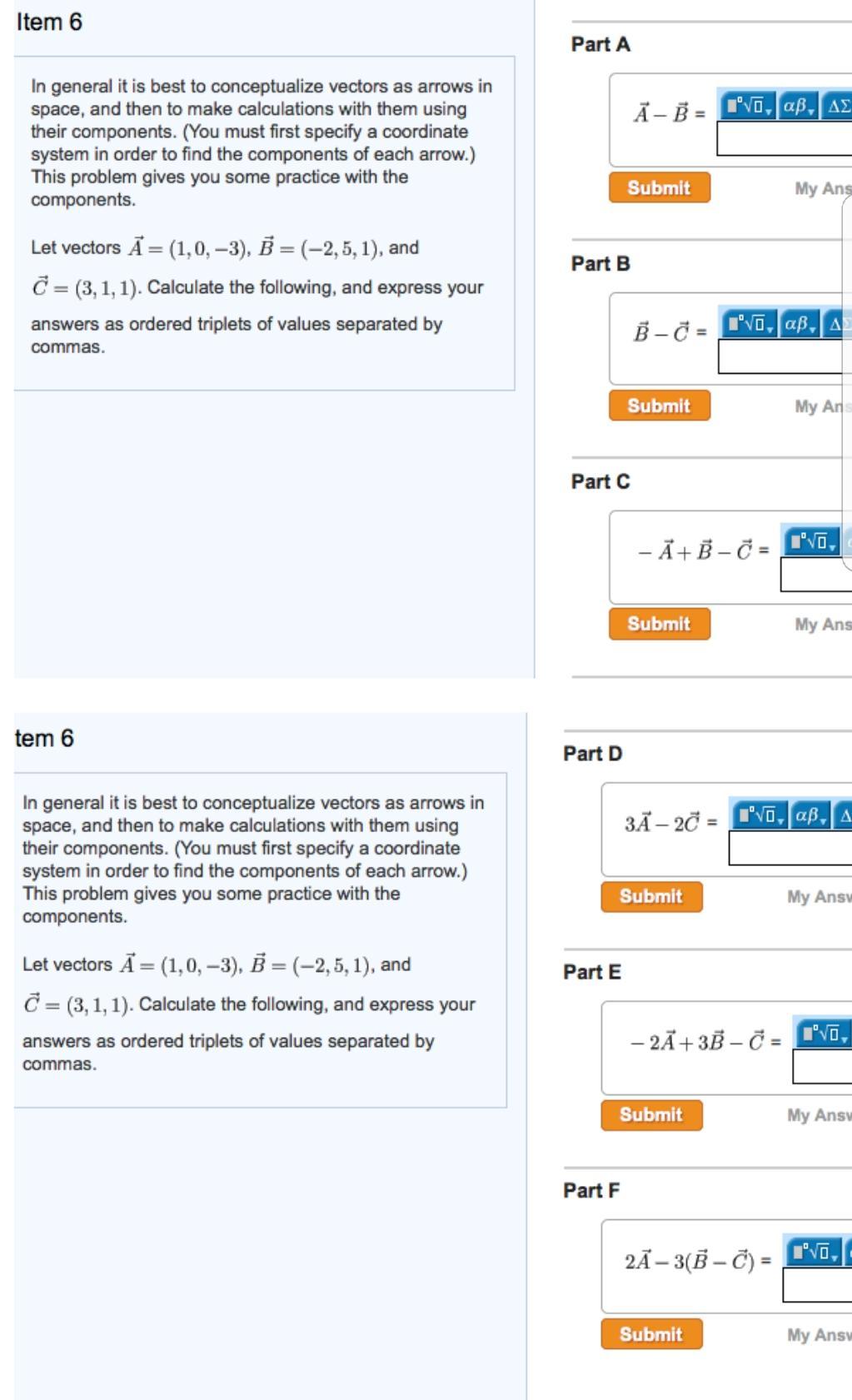
In general it is best to conceptualize vectors as arrows in space, and then to make calculations with them using their component

s. (You must first specify a coordinate system in order to find the components of each arrow.) This problem gives you some practice with the components. Let vectors A⃗ =(1,0,−3), B⃗ =(−2,5,1), and C⃗ =(3,1,1). Calculate and express your answers as ordered triplets of values separated by commas

Physics
1 answer:
Softa [2K]6 days ago
3 0

(1) A - B

(2) B - C

(3) - A + B - C

(4) 3A - 2C

(5) - 2A + 3B - C

(6) 2A - 3 (B - C)

Answer:

(1)  (3,-5,-4)

(2) (-5, 4, 0)

(3) (-6, 4, 3)

(4) (-3, -2, -11)

(5) (-11, 14, 8)

(6) (17, -12, -6)

Explanation:

A⃗ =(1,0,−3)

B⃗ =(−2,5,1)

C⃗ =(3,1,1)

Calculations involving vector addition and subtraction occur on a per-component basis, meaning only the corresponding components can be combined. This applies to components î, j, and k individually.

1) (A - B) = (1,0,−3) - (−2,5,1) = (1-(-2), 0-5, -3-1) = (3,-5,-4)

2)  (B - C) = (−2,5,1) - (3,1,1) = (-2-3, 5-1, 1-1) = (-5, 4, 0)

3) -A + B - C = -(1,0,−3) + (−2,5,1) - (3,1,1) = (-1-2-3, 0+5-1, 3+1-1) = (-6, 4, 3)

4) 3A - 2C = 3(1,0,−3) - 2(3,1,1) = (3,0,-9) - (6,2,2) = (3-6, 0-2, -9-2) = (-3, -2, -11)

5) -2A + 3B - C = -2(1,0,−3) + 3(−2,5,1) - (3,1,1) = (-2,0,6) + (-6,15,3) - (3,1,1) = (-2-6-3, 0+15-1, 6+3-1) = (-11, 14, 8)

6) 2A - 3 (B - C) = 2(1,0,−3) - 3[(−2,5,1) - (3,1,1)] = (2,0,-6) - 3(-5,4,0) = (2+15, 0-12, -6-0) = (17, -12, -6)
You might be interested in
In very cold weather, a significant mechanism for heat loss by the human body is energy expended in warming the air taken into t
ValentinkaMS [2425]
A) B) Explanation: Given: temperature of air, temperature of lungs, specific heat transferred from the lungs, specific heat of air, mass of 1 L air, breath rate. A) Calculate the amount of heat required to raise the air in the lungs to body temperature. B) Determine heat loss per hour.
7 0
8 days ago
Water is made of two hydrogen atoms and one oxygen atom bonded together. Julia is describing how water undergoes a physical chan
kicyunya [2264]
Steam transforms into gas as it escapes into the atmosphere. Even if you manage to capture the steam as it ascends, it can revert to H2O when it cools down. Due to the evaporation process, the final volume of water will differ from the original amount.
8 0
1 month ago
Read 2 more answers
Write a hypothesis about the effect of increasing voltage on the current in the circuit. Use the "if . . . then . . . because .
Yuliya22 [2420]

Hypothesis: An increase in voltage should result in a corresponding rise in current because according to Ohm's Law,

I \propto V

I=\frac{V}{R}

Ohm's Law indicates that current is proportional to voltage when resistance remains constant. Hence, if resistance stays the same, elevating the voltage will lead to an increase in current. Conversely, if voltage remains unchanged and resistance increases, current will decrease.

3 0
24 days ago
Read 2 more answers
A hard rubber rod with an electric potential energy of 5.2 × 10⁻³ J has a charge of 4.0 µC at the tip. What is the electric pote
Keith_Richards [2256]
1) The electric potential energy can be defined as the product of the electric potential and the associated charge:
U=q V
where
q refers to the charge
V denotes the electric potential

In this scenario, the charge on the rod is q=4.0 \mu C = 4.0 \cdot 10^{-6}C, and the potential energy is U=5.2 \cdot 10^{-3} J, thus we may rearrange the earlier formula to find the electric potential at the tip:
V= \frac{U}{q}= \frac{5.2 \cdot 10^{-3}J}{4.0 \cdot 10^{-6} C}=1300 V=1.3 \cdot 10^3 V

2) Using this same formula, if the charge changes to q=2.0 \mu C = 2.0 \cdot 10^{-6} C, the resulting electric potential will be:
V= \frac{U}{q}= \frac{5.2 \cdot 10^{-3} J}{2.0 \cdot 10^{-6}C}=2600 V = 2.6 \cdot 10^{3}V
8 0
10 days ago
Read 2 more answers
A 55-kg pilot flies a jet trainer in a half vertical loop of 1200-m radius so that the speed of the trainer decreases at a const
Keith_Richards [2256]

a) -1.54 m/s^2

b) 803.4 N

Explanation:

a) At point C (top of the loop), the pilot experiences weightlessness, leading to the normal force from the seat being zero:

N = 0

Consequently, the force balance equation at position C becomes:

mg=m\frac{v^2}{r}where the left term signifies the pilot's weight and the right term represents the centripetal force, with:

= acceleration due to gravity

= jet's velocity at the top g=9.8 m/s^2

= loop radius

vBy solving for v,

r=1200 m

Thus, this is the jet's speed at C.

The speed at position A (bottom) can be derived fromv_C=\sqrt{gr}=\sqrt{(9.8)(1200)}=108.4 m/s

The distance traveled by the jet corresponds to half the circumference of the circle with radius r, therefore

v_A=550 km/h =152.8 m/s

Given the plane's deceleration is consistent, we can obtain it using the following equation:

s=\pi r=\pi(1200)=3770 m

b) The pilot experiences a force equal to the normal force from the seat. At point B (half-way through the loop), we find:

v_C^2-v_A^2=2as\\a=\frac{v_C^2-v_A^2}{2s}=\frac{108.4^2-152.8^2}{2(3770)}=-1.54 m/s^2- The normal force from the seat, N, directed towards the center of the loop

- As there are no further forces acting toward the central axis, N must equal the centripetal force:

(1)

where

represents the speed at position B.

To deduce the velocity at B, we note that the distance covered by the jet between positions A and B is a quarter of a circle:

With knowledge of the deceleration, we can implement the equation of motion to find the velocity at the midway point B:N=m\frac{v_B^2}{r}

v_B

Thus, we then apply eq.(1) to determine the normal force acting on the pilot at B:

s=\frac{\pi r}{2}=\frac{\pi(1200)}{2}=1885 m

6 0
6 days ago
Other questions:
  • A roller coaster, traveling with an initial speed of 15 meters per second, decelerates uniformly at â7.0 meters per second2 to a
    11·1 answer
  • A proton starts from rest and gains 8.35 x 10^-14 joule of kinetic energy as it accelerates between points A and B in an electri
    14·2 answers
  • A 7.0-kilogram cart, A, and a 3.0-kilogram cart, B, are initially held together at rest on a horizontal, frictionless surface. W
    7·1 answer
  • A thin electrical heating element provides a uniform heat flux qo" to the outer surface of a duct through which air flows. The d
    7·1 answer
  • A graph of the net force F exerted on an object as a function of x position is shown for the object of mass M as it travels a ho
    8·1 answer
  • A roller coaster moving along its track rolls into a circular loop of radius r. In the loop, it is only affected by its initial
    7·2 answers
  • A beaker contain 200mL of water<br> What is its volume in cm3 and m3
    5·2 answers
  • A 100 W incandescent lightbulb emits about 5 W of visible light. (The other 95 W are emitted as infrared radiation or lost as he
    12·1 answer
  • The speed of sound in air changes with the temperature. When the temperature T is 32 degrees Fahrenheit, the speed S of sound is
    7·1 answer
  • A bobsledder pushes her sled across horizontal snow to get it going, then jumps in. After she jumps in, the sled gradually slows
    5·1 answer
Add answer
Login
Not registered? Fast signup
Signup
Login Signup
Ask question!
