answer.
Ask question
Login Signup
Ask question
All categories
  • English
  • Mathematics
  • Social Studies
  • Business
  • History
  • Health
  • Geography
  • Biology
  • Physics
  • Chemistry
  • Computers and Technology
  • Arts
  • World Languages
  • Spanish
  • French
  • German
  • Advanced Placement (AP)
  • SAT
  • Medicine
  • Law
  • Engineering
fomenos
22 days ago
10

A 5.00 g sample of water vapor, initially at 155°C is cooled at atmospheric pressure, producing ice at –55°C. Calculate the amou

nt of heat energy lost by the water sample in this process, in kJ. Use the following data: specific heat capacity of ice is 2.09 J/g×K; specific heat capacity of liquid water is 4.18 J/g×K; specific heat capacity of water vapor is 1.84 J/g×K; heat of fusion of ice is 336 J/g; heat of vaporization of water is 2260 J/g.
Physics
1 answer:
Ostrovityanka [3.2K]22 days ago
3 0

Answer:

Total energy lost is 16.1 KJ

Explanation:

The heat of vaporization for water is  1.84 J/gK, indicating a loss of energy

The heat loss when cooling from 155 to 100 = 1.84 x 5 x (155 + 273 - 100 + 273) = 506 J

Latent heat of steam = 2260 J/g x 5 g = 11300 J

The heat lost upon cooling from 100 to 0 = 4.18 x 5 x (100 - 0) = 2090 J

The fusion heat is calculated as 336 J/g x 5 g = 1680 J

Heat to cool ice from 0 to -55 =  2.09 J/gK x 5 g x (0 -(-55)) = 574.75 J

Summing all heats gives H of the reaction

506 J + 11300 J + 2090 J + 1680 J + 574.75 J = 16150.75 J = 16.1 KJ

Total energy lost is 16.1 KJ

You might be interested in
At time t=0 a proton is a distance of 0.360 m from a very large insulating sheet of charge and is moving parallel to the sheet w
serg [3582]

Explanation:

The formula for the electric field produced by an infinite sheet of charge is outlined below.

               E = \frac{\sigma}{2 \epsilon_{o}}

where,   \sigma is the surface charge density

Following this, the formula for the electric force acting on a proton is given as:

             F = eE

where,    e is the charge of a proton

According to Newton's second law of motion, the overall force on the proton can be expressed as follows.

                       F = ma

                 a = \frac{eE}{m}

                    = \frac{e(\frac{\sigma}{2 \epsilon_{o}})}{m}

                     = \frac{e \sigma}{2m \epsilon_{o}}

According to kinematic equations, the proton's speed in the perpendicular direction can be described as follows.

              v_{f} = v_{i} + at

                     = (0 m/s) + \frac{e \sigma}{2 m \epsilon_{o}}t

                     = \frac{1.6 \times 10^{-19}C \times 2.34 \times 10^{-9} C/m^{2} \times 5.40 \times 10^{-8}s}{2 \times (1.67 \times 10^{-27} kg)(8.85 \times 10^{-12} C^{2}/Nm^{2}}

                     = 683.974 m/s

Thus, the overall speed of the proton can be calculated as follows.

                v' = \sqrt{(960 m/s)^{2} + (683.974 m/s)^{2}}

                    = \sqrt{921600 + 467820.43}

                    = \sqrt{1389420.43}

                    = 1178.73 m/s

Consequently, we conclude that the proton's speed is 1178.73 m/s.

3 0
17 days ago
-. What is the acceleration of 4 kg trolling bag pulled by a girl with a<br> force of 3 N?
inna [3103]

Answer:

Acceleration(a) = 0.75 m/s²

Explanation:

Given:

Force(F) = 3 N

Mass of object(m) = 4 kg

Find:

Acceleration(a)

Computation:

Force(F) = ma

3 = (4)(a)

Acceleration(a) = 3/4

Acceleration(a) = 0.75 m/s²

3 0
1 month ago
A 55 kg gymnast wedges himself between two closely spaced vertical walls by pressing his hands and feet against the walls. Part
ValentinkaMS [3465]

answer:

Let frictional forces due to both hands and feets be "Ff" each(since its given that they all are equal), acting in upward direction( in opposite direction of supposed motion).\\&#10;Then since there is no motion of gymnast thus net frictional force due to both hands and feets will be exactly balanced by the weight of the gymnast,\\ i.e\\&#10;4f_{f}=weight =mg\\&#10;f_{f}=\frac{55x9.8}{4}\\&#10;=134.75N

5 0
1 month ago
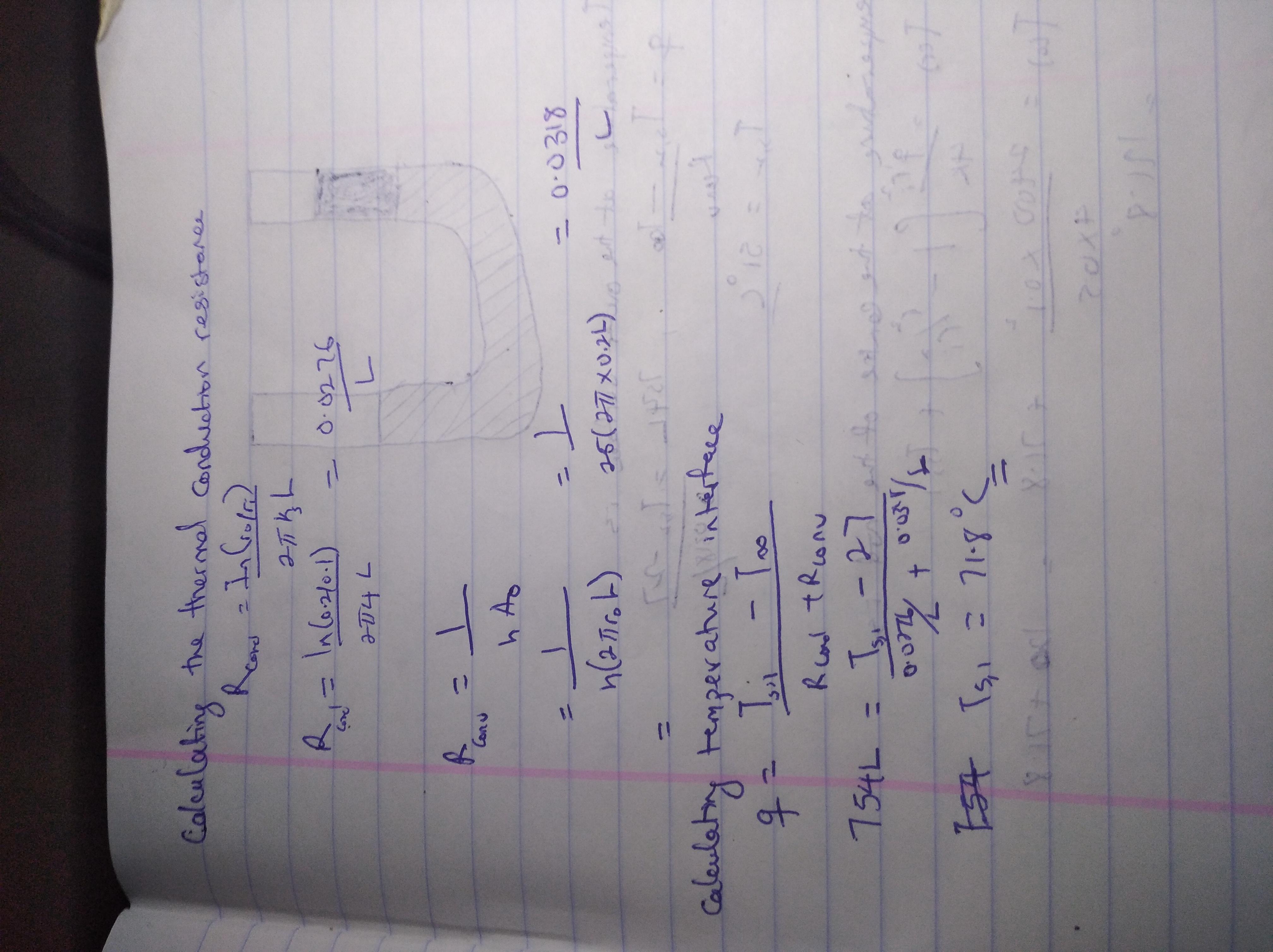
A long cylindrical rod of diameter 200 mm with thermal conductivity of 0.5 W/m⋅K experiences uniform volumetric heat generation
Ostrovityanka [3204]

Answer:

a, 71.8° C, 51° C

b, 191.8° C

Explanation:

Given the data:

D(i) = 200 mm

D(o) = 400 mm

q' = 24000 W/m³

k(r) = 0.5 W/m.K

k(s) = 4 W/m.K

k(h) = 25 W/m².K

The heat generation formula can be articulated as follows:

q = πr²Lq'

q = π. 0.1². L. 24000

q = 754L W/m

Thermal conduction resistance, R(cond) = 0.0276/L

Thermal conduction resistance, R(conv) = 0.0318/L

Applying the energy balance equation,

Energy In = Energy Out

This equates to q, which is 754L

From the initial analysis, the temperature at the interface between the rod and sleeve is found to be 71.8° C

Additionally, the outer surface temperature records as 51° C

Furthermore, based on the second analysis, the calculated temperature at the center of the rod is determined to be 191.8° C

6 0
1 month ago
You throw a baseball at an angle of 30.0∘∘ above the horizontal. It reaches the highest point of its trajectory 1.05 ss later. A
kicyunya [3294]

Answer:

The initial speed at which the baseball is thrown is 20.58 m/s

Explanation:

To determine the time taken to reach the peak height in projectile motion, the formula is:

t = (u sin θ)/g

Where u = initial speed of the baseball =?

θ = angle of launch above the horizontal

g = gravitational acceleration = 9.8 m/s²

1.05 = (u sin 30)/9.8

u can be calculated as (1.05 × 9.8)/0.5

u = 20.58 m/s

7 0
1 month ago
Other questions:
  • a carpenter hits a nail with a hammer. compared to the magnitude of the force the hammer exerts on the nail, the magnitude of th
    8·2 answers
  • Two resistors ( 3 ohms &amp; 6 ohms) in a series circuit with a power supply = 12 volts. The current through resistor 6 ohms is
    15·1 answer
  • HELP ASAP! GIVING BRAINLIEST!
    13·2 answers
  • A rock has mass 1.80 kg. When the rock is suspended from the lower end of a string and totally immersed in water, the tension in
    10·1 answer
  • Use Wien’s Law to calculate the peak wavelength of Betelgeuse, based on the temperature found in Question #8. Note: 1 nanometer
    14·1 answer
  • What will be the final temperature if a 4.00 g silver ring at 41.0◦C if it gives off 18.0 J of heat to the surroundings? The spe
    8·1 answer
  • What’s the force of a pitching machine on a baseball?
    5·2 answers
  • What is the factor involved in increasing an object’s inertia?
    14·1 answer
  • In 2014, about how far in meters would you have to travel on the surface of the Earth from the North Magnetic Pole to the Geogra
    5·1 answer
  • Three point charges are arranged on a line. Charge q3=+5.00x10^-9C and is at the origin. Charge q2=-3.00x10^-9C and is at x=+4.0
    14·2 answers
Add answer
Login
Not registered? Fast signup
Signup
Login Signup
Ask question!