answer.
Ask question
Login Signup
Ask question
All categories
  • English
  • Mathematics
  • Social Studies
  • Business
  • History
  • Health
  • Geography
  • Biology
  • Physics
  • Chemistry
  • Computers and Technology
  • Arts
  • World Languages
  • Spanish
  • French
  • German
  • Advanced Placement (AP)
  • SAT
  • Medicine
  • Law
  • Engineering
Damm
2 months ago
12

In a hexagonal-close-pack (hcp) unit cell, the ratio of lattice points to octahedral holes to tetrahedral holes is 1:1:2. What i

s the general formula for a compound if anions occupy the hcp lattice points and cations occupy half of the tetrahedral holes? AB A3B AB2 A2B What is the general formula for a compound if anions occupy the hcp lattice points and cations occupy all the tetrahedral holes? AB A2B AB2 A3B
Chemistry
1 answer:
VMariaS [2.9K]2 months ago
6 0

Clarification:

Within a hexagonal close-packed (HCP) unit cell, the ratio of lattice points to octahedral and tetrahedral holes is  1: 1: 2.

Defining the:

Number of lattice points = 1x.

Number of octahedral points = 1x

Number of tetrahedral points = 2x

Assuming anions occupy the HCP lattice points and cations fill half of the tetrahedral holes.

The number of anions in the HCP lattice points, A= 1x

The cation count at tetrahedral points, B =  \frac{2x}{2}=x

Thus, the compound's formula will be = A_{1x}B_{1x}=AB

If anions occupy the HCP lattice points and cations take all of the tetrahedral holes, the number of anions remains as A= 1x

The count of cations at tetrahedral points would now be B = 2x

Thus, the formula for the compound will be = A_{1x}B_{2x}=AB_2

You might be interested in
How much CO2 (L) is produced when 2.10 kg of sodium bicarbonate reacts with excess hydrochloric acid at 25.0 °C and 1.23 atm? A)
KiRa [2933]

The equation representing the reaction between sodium bicarbonate and hydrochloric acid is as follows:

NaHCO_3_(_s_) + HCl_(_a_q_) \implies NaCl_(_a_q_) + CO_2_(_g_) + H_2O_(_l_)

The substances NaHCO_3 and HCl combine in a 1:1 ratio. Therefore, we calculate the quantity of sodium bicarbonate and its molar mass to determine the moles formed.

NaHCO_3_M_r = 22.99 + 1.008 + 12.011+ 3 \times 16.0= 84.01 g/mol.

2.1kg\ NaHCO_3 \times \frac{1000g}{kg} \times \frac{mol}{84.01g/mol} = 24.997\ mol.

We also recognize that the stoichiometric proportions are 1:1:1:1:1, which leads to the conclusion that the moles of CO_2 equal 24.977 moles.

Next, we apply the ideal gas equation PV=nRT, where P denotes pressure, V refers to volume, R is the gas constant, and T represents the temperature in kelvins. We rearrange to solve for V

PV= nRT \implies V= \frac{nRT}{P}= \frac{ 24.997\ mol \times 8.2507m^3\ atm \times 298.15K }{mol \times K \times 1.23 atm} = 49967\ m^3

The final answer should be expressed in liters, 1L = 1000\ m^3, hence

49967\ m^3 \times\frac{L}{1000\ m^3} =49.97L\ CO_2\ produced

6 0
3 months ago
Read 2 more answers
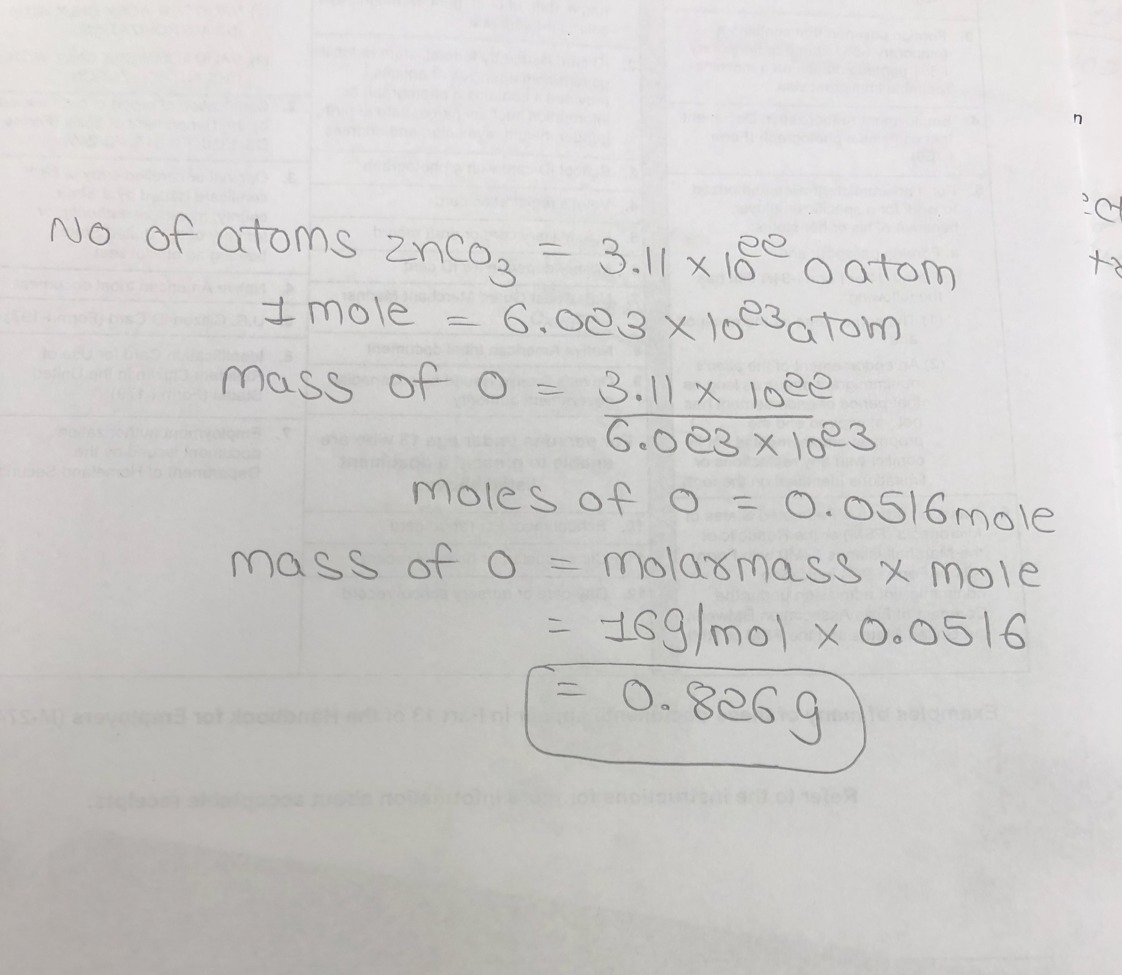
What mass of ZnCO3 contains 3.11×10²² O atoms
KiRa [2933]
Please ask if you have any inquiries.

3 0
3 months ago
Read 2 more answers
An atom's Lewis dot structure has three dots. Which of the following elements could it be, and why? Aluminum, because it is in g
alisha [2963]

Question 1.

The accurate statement is " Aluminium, as it belongs to group 13 and contains three valence electrons. The Lewis dot structure illustrates the number of valence electrons in a single atom. By referencing the periodic table, we identify the element based on its valence electrons. Indeed, aluminium possesses 3 valence electrons and is located in Group 13 of the periodic table.

Question 2.

The correct count is 5. The outer layer of electrons is termed the valence shell, containing what we refer to as valence electrons. Here, the outermost shell corresponds to n=3, meaning all electrons in this layer are classified as valence electrons. While we do have subshells (3s and 3p), they indicate the spatial region where an electron may be located but do not clarify valence.

Question 3.

Chlorine possesses 7 valence electrons, Neon has 8 valence electrons, Phosphorus contains 5 valence electrons, Sulfur has 6 valence electrons. The position of an element in the periodic table aids in determining its electron configuration, and the group number provides insights into the number of valence electrons. By merely checking the periodic table's group number, we can ascertain the valence electrons.

Question 4.

The assertion is True. As atomic orbitals fill, the energy levels extend farther from the nucleus. The outermost orbital capable of being filled with electrons is known as the valence shell, and the electrons within are termed valence electrons. This characteristic defines the reactivity of particular elements.

Question 5.

The atom with the electron configuration 1s^22s^22p^63s^1 contains an unpaired electron in its 3s orbital, rendering it unstable. Meanwhile, the element with 7 valence electrons requires just one additional electron to complete its octet. Therefore, the 1s^22s^22p^63s^1 atom loses an electron to bond with the element holding 7 valence electrons. Consequently, the element 1s^22s^22p^63s^1 acquires a positive charge, while the one with 7 valence electrons becomes negatively charged, leading to the formation of an ionic bond.


5 0
3 months ago
Read 2 more answers
Other questions:
  • In order to use a pipet, place a ____________ at the top of the pipet. Use this object to fill the pipet such that the _________
    9·1 answer
  • Every single-celled organism is able to survive because it carries out *
    5·1 answer
  • Calculate the initial molarity of MCHM in the river, assuming that the first part of the river is 7.60 feet deep, 100.0 yards wi
    10·1 answer
  • The solubility of KCl is 3.7 M at 20 °C. Two beakers each contain 100. mL of saturated KCl solution: 100. mL of 4.0 M HCl is add
    6·2 answers
  • How would a flood be a limitation for synthetic polymers that rely on natural rubber in its production?
    5·2 answers
  • A 7.27-gram sample of a compound is dissolved in 250 grams of benzene. The freezing point of this solution is 1.02°C below that
    7·1 answer
  • Jim, Jill, Robert, and Kim each run paper chromatography on an unknown aqueous mixture. Jim gets a red band and a blue band, Jil
    8·2 answers
  • You’re at the zoo and have a big red 1.80 L helium balloon. The barometric pressure today is 785 mmHg. Then you hear the roar of
    10·2 answers
  • The 1h nmr spectra corresponds to an alcohol with the molecular formula c5h12o. Deduce the structure from the spectra.
    5·1 answer
  • Both black and white road surfaces absorb sunlight. the warmer road surface at the end of a sunny day is the
    12·1 answer
Add answer
Login
Not registered? Fast signup
Signup
Login Signup
Ask question!