answer.
Ask question
Login Signup
Ask question
All categories
  • English
  • Mathematics
  • Social Studies
  • Business
  • History
  • Health
  • Geography
  • Biology
  • Physics
  • Chemistry
  • Computers and Technology
  • Arts
  • World Languages
  • Spanish
  • French
  • German
  • Advanced Placement (AP)
  • SAT
  • Medicine
  • Law
  • Engineering
wel
1 month ago
13

A gold puck has a mass of 12 kg and a velocity of 5i – 4j m/s prior to a collision with a stationary blue puck whose mass is 18

kg. After an elastic collision, the blue puck has a velocity of 2i – 2j m/s. What is the velocity of the gold puck after the collision?
A. 2i –j m/s
B. 3i –j m/s
C. 2i – 2j m/s
D. 3i – 2j m/s
Physics
1 answer:
Maru [3.3K]1 month ago
6 0

Answer:

Explanation:D

You might be interested in
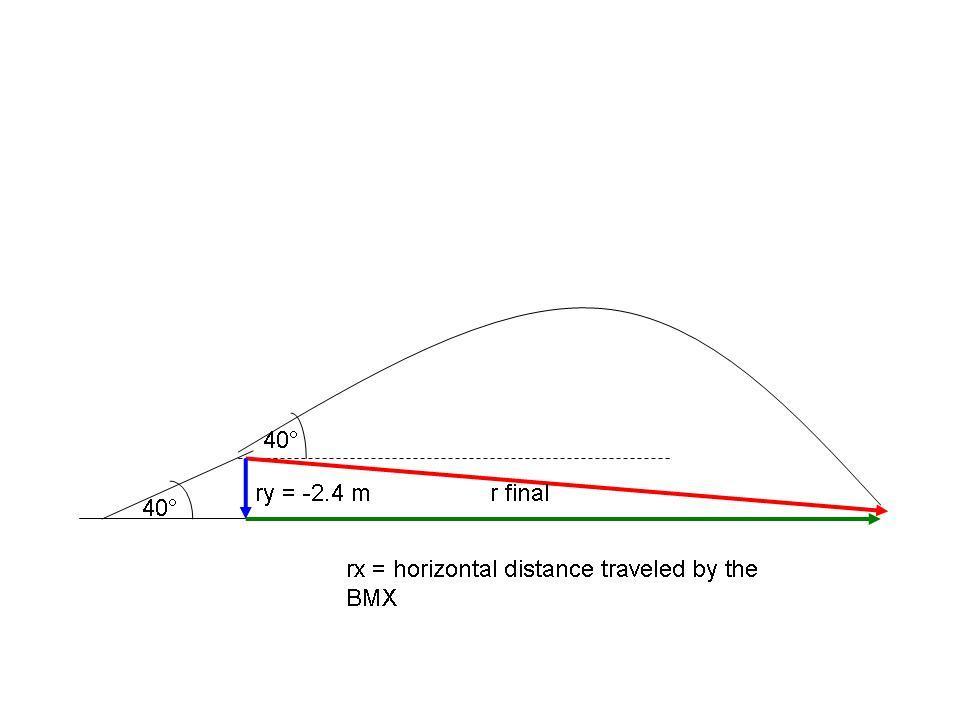
A BMX bicycle rider takes off from a ramp at a point 2.4 m above the ground. The ramp is angled at 40 degrees from the horizonta
Ostrovityanka [3204]

Answer:

The BMX rider lands 5.4 meters horizontally away from the ramp's end.

Explanation:

The BMX position vector is represented as:

r = (x0 + v0 × t × cos α, y0 + v0 × t × sin α + ½ × g × t²)

Where:

r = position at time t

x0 = initial horizontal position

v0 = initial speed

α = angle of jump

y0 = initial vertical height

g = gravitational acceleration (-9.8 m/s², upward positive)

Refer to the diagram for clarity. At the landing time, the vertical coordinate of the position vector is -2.4 m, measured from the ramp's edge as the origin. Using the vertical component equation for y, one can solve for t, then substitute t to find the horizontal distance.

The vertical position equation:

-2.4 m = 0 + 5.9 m/s × t × sin 40° - ½ × 9.8 m/s² × t²

Rearranged:

0 = -4.9 t² + 5.9 t × sin 40° + 2.4

Solving this quadratic yields:

t = 1.2 seconds

Then, calculate horizontal distance:

x = 0 + 5.9 m/s × 1.2 s × cos 40° = 5.4 m

This means the BMX lands 5.4 meters from the ramp's edge.

Have a great day!

8 0
2 months ago
The parasailing system shown uses a winch to pull the rider in towards the boat, which is traveling with a constant velocity. Du
ValentinkaMS [3465]

Answer:

The force magnitude is  F_{net}= 1.837 *10^4N

and it is directed at 57.98° from the horizontal in a counterclockwise manner.

Explanation:

The problem states that

At t = 0, \theta = 20^o

The angular rate of increase is w = 2 \ ^o/s

Converting to revolutions per second gives us  \theta ' = 2 \ ^o/s * \frac{\pi}{180} =0.0349\ rps

The rope length is defined by

                      r = 125- \frac{1}{3}t^{\frac{3}{2} }    

    At \theta =30^o, Tension T of the rope is 18 kN.

     The weight of the para-sailor is M_p = 75kg

In analyzing the question, we observe that the equation for length can be represented as a linear displacement equation.

 The derivative of displacement results in velocity.

Hence,

           r' = -\frac{1}{3} [\frac{3}{2} ] t^{\frac{1}{2} }

signifies the velocity, and further differentiation yields acceleration.

Therefore,

         r'' = -\frac{1}{4} t^{-\frac{1}{2} }

Now considering the moment when the rope forms a 30° angle with the water,

typically angular velocity is expressed as

                      w = \frac{\Delta \theta}{\Delta t}

where \theta represents the angular displacement.

Next, evaluating the interval from 20^o \ to \ 30^o gives us

                 2 = \frac{30 -20 }{t -0}

making t the focal point.

             t = \frac{10}{2}

               = 5s

At this time, the displacement measures

             r = 125- \frac{1}{3}(5)^{\frac{3}{2} }  

                = 121.273 m

The linear velocity computes to

             r' = -\frac{1}{3} [\frac{3}{2} ] (5)^{\frac{1}{2} }

                = -1.118 m/s

Whereas linear acceleration calculates as

          r'' = -\frac{1}{4} (5)^{-\frac{1}{2} }

              = -0.112m/s^2

Generally, radial acceleration is given by

         \alpha _R = r'' -r \theta'^2

              = -0.112 - (121.273)[0.0349]^2

              = 0.271 m/s^2

Simultaneously, angular acceleration can be represented as

                 \alpha_t = r \theta'' + 2 r' \theta '

Then \theta '' = \frac{d (0.0349)}{dt} = 0

Thus,

             \alpha _t = 121.273 * 0 + 2 * (-1.118)(0.0349)

                   = -0.07805 m/s^2

The resultant acceleration is mathematically denoted as

                a = \sqrt{\alpha_R^2 + \alpha_t^2 }

                  = \sqrt{(-0.07805)^2 +(-0.027)^2}

                  = 0.272 m/s^2

Now the acceleration's direction is mathematically expressed as

                  tan \theta_a = \frac{\alpha_R }{\alpha_t }

                       \theta_a = tan^{-1} \frac{-0.271}{-0.07805}

                           = 73.26^o


The y-axis force acting on the para-sailor is mathematically shown as

               F_y = mg + Tsin 30^o + ma sin(90- \theta )

                    = (75 * 9.8) + (18 *10^3) sin 30 + (75 * 0.272)sin(90-73.26)

                    = 9.74*10^3 N

The x-axis force acting on the para-sailor is represented as

              F_x = mg + Tcos 30^o + ma cos(90- \theta )    

             = (75 * 9.8) + (18 *10^3) cos 30 + (75 * 0.272)cos(90-73.26)

             = 1.557 *10^4 N

The overall force is calculated as

                      F_{net} = \sqrt{F_x^2 + F_y^2}

                             =\sqrt{(1.557 *10^4)^2 + (9.74*10^3)^2}

                            F_{net}= 1.837 *10^4N

The directional force is evaluated as

              tan \theta_f = \frac{F_y}{F_x}

                   \theta_f = tan^{-1} [\frac{1.557*10^4}{9.74*10^3} ]

                       = tan^{-1} (1.599)

                       = 57.98^o


7 0
1 month ago
A graph of the net force F exerted on an object as a function of x position is shown for the object of mass M as it travels a ho
Softa [3030]

The alteration in kinetic energy is \Delta K = 3Fd

Clarification:

According to the work-energy principle, the task performed on an object corresponds to the alteration in its kinetic energy. In mathematical terms:

W=K_f -K_i= \Delta K

where:

W signifies the work performed on the object

K_f denotes the kinetic energy at the end

K_i indicates the kinetic energy at the start

Furthermore, when the force is exerted in line with the object’s motion, the work done is expressed as:

W=F\Delta x

Here,

F represents the force’s magnitude

\Delta x denotes the object’s displacement

In this scenario, the force impacting the object is

F

While the distance moved is the horizontal length traveled, hence

\Delta x = 3d

Consequently, the work accomplished is

W=(F)(3d)=3Fd

Thus, the alteration in kinetic energy amounts to

\Delta K = 3Fd

Learn more about work and kinetic energy:

5 0
1 month ago
A plant blossoms with violet-colored flowers. The flowers appear violet because they absorb all light rays except for____ rays.
Ostrovityanka [3204]
~Greetings! ^_^

Your inquiry: A plant produces flowers with a violet hue. The flowers possess a violet appearance due to their ability to absorb all light waves barring____ rays.

Your reply: A plant produces flowers with a violet hue. The flowers possess a violet appearance because they absorb all light rays except for violet rays.


Hope this is beneficial~

5 0
12 days ago
Read 2 more answers
The Hall effect can be used to calculate the charge-carrier number density in a conductor. If a conductor carrying a current of
kicyunya [3294]

Answer:

6.6*10^{27}e/m^3

Explanation:

When calculating Hall voltage, it is crucial to have the current, magnetic field strength, length, area, and number of charge carriers available. The Hall voltage can be expressed using the equation:

V_h = \frac{iB}{neL}

Where:

i= the current

B= the magnetic field strength

L = the length

n = the number of charge carriers

e= charge of an electron

We need to replace values and solve for n:

n= \frac{iB}{V_h e L}

n= \frac{2*1.2}{4.5*10^{-6}*5^10^{-3}*1.6*10^{-19}}

n= 6.6*10^{27}electron.m^{-3}

As a result, the charge carrier density is 6.6*10^{27}e/m^3

5 0
1 month ago
Other questions:
  • Derive an expression for the acceleration of the car. Express your answer in terms of D and vt Determine the time at which the s
    10·1 answer
  • Bonnie and clyde are sliding a 300 kg bank safe across the floor to their getaway car. the safe slides with a constant speed if
    14·1 answer
  • A rock is launched vertically upward by a slingshot. The elastic band of the slingshot accelerates the rock from rest to 40 m/s
    14·1 answer
  • The 20-lb cabinet is subjected to the force F = (3 + 2t) lb, where t is in seconds. If the cabinet is initially moving down the
    12·1 answer
  • Two tiny particles having charges of +5.00 μC and +7.00 μC are placed along the x-axis. The +5.00-µC particle is at x = 0.00 cm,
    7·1 answer
  • What wavelength of light contains enough energy in a single photon to ionize a hydrogen atom?
    5·2 answers
  • Roseanne heated a solution in a beaker as part of a laboratory experiment on energy transfer. After a while, she noticed the liq
    5·1 answer
  • An alert driver can apply the brakes fully in about 0.5 seconds. How far would the car travel if it
    8·1 answer
  • Before leaving her home, Myesha makes sure that every electrical appliance is unplugged and checks that every window and door is
    14·1 answer
  • 1. A2 .7-kg copper block is given an initial speed of 4.0m/s on a rough horizontal surface. Because of friction, the block final
    10·1 answer
Add answer
Login
Not registered? Fast signup
Signup
Login Signup
Ask question!