answer.
Ask question
Login Signup
Ask question
All categories
  • English
  • Mathematics
  • Social Studies
  • Business
  • History
  • Health
  • Geography
  • Biology
  • Physics
  • Chemistry
  • Computers and Technology
  • Arts
  • World Languages
  • Spanish
  • French
  • German
  • Advanced Placement (AP)
  • SAT
  • Medicine
  • Law
  • Engineering
AlexFokin
2 months ago
8

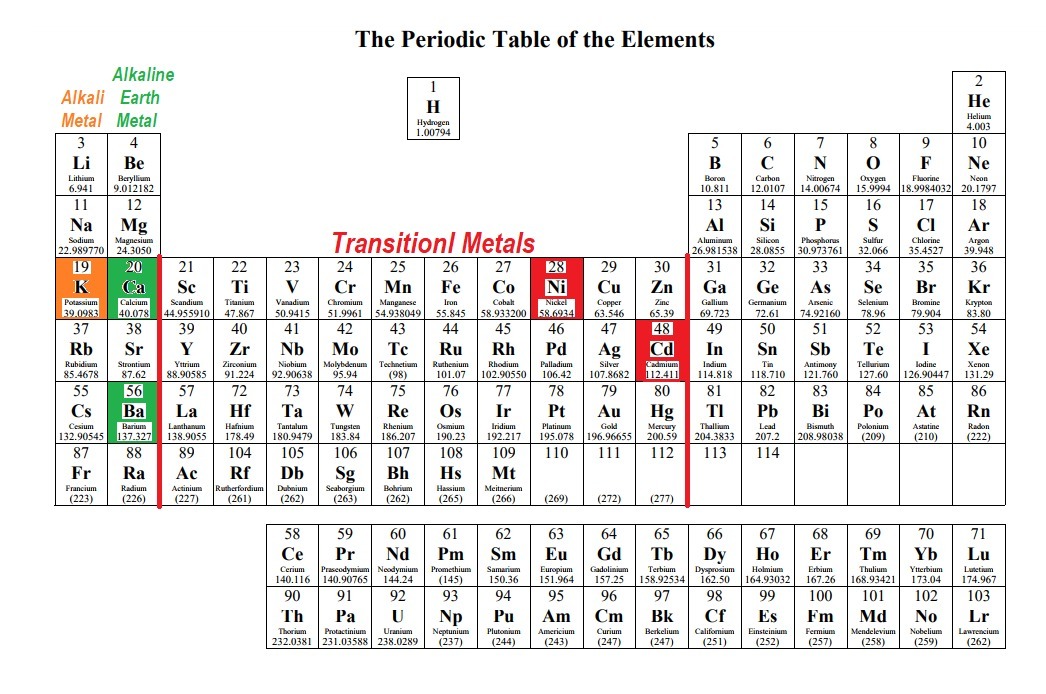
Use the drop-down menus to classify the elements as alkali metals, alkaline earth metals, or transition metals.

Chemistry
2 answers:
lions [2.9K]2 months ago
7 0

Nickel (Ni):  metal from the transition series

Potassium (K): member of the alkali metals

Cadmium (Cd):  metal in the transition group

Calcium (Ca): metal classified as alkaline earth

Barium (Ba): another alkaline earth metal

Tems11 [2.7K]2 months ago
3 0

Here are the element classifications based on the periodic table:

Nickel is a transition metal.
Potassium belongs to the alkali metals.
Cadmium is classified as a transition metal.
Calcium is an alkaline earth metal.
Barium also falls into the alkaline earth metals category.

I have included a color-coded periodic table image to visually support these classifications.

You might be interested in
Which statement is correct? Salts are formed by the reaction of bases with water. Most salts are ionic and are soluble in water.
lorasvet [2795]
<span>Salts result from the reaction between bases and water. - FALSE
</span><span>Most salts are ionic and dissolve in water. - TRUE
</span><span>Most salts are not dissolved in water and do not have electrical charges. - FALSE
</span><span>Solutions containing salt and water are unable to conduct electricity. - FALSE

:)</span>
3 0
2 months ago
Read 2 more answers
Calculate the molarity of 48.0 mL of 6.00 M H2SO4 diluted to 0.250 L
lorasvet [2795]

Answer:

The molality is 1.15 m.

Molality is calculated by dividing the number of moles of solute by the kilograms of solvent, which in this case is water.

Calculate moles of H₂SO₄ from molarity:

C = n/V → n = C × V = 6.00 mol/L × 0.048 L = 0.288 moles

Mass of solvent (water) based on density:

m = ρ × V = 1.00 kg/L × 0.250 L = 0.250 kg

Therefore, molality is:

m = moles/solvent mass = 0.288 moles / 0.250 kg = 1.15 m

4 0
2 months ago
Read 2 more answers
(58 g)/ (4L) reduce units to one
eduard [2782]
The result is 14.5 g L⁻¹. Here, the problem indicates to reduce the units to one. The existing units are g/L. To achieve a singular unit format, we can move L to the numerator, which can be executed as per the exponent laws; specifically, 1 / aˣ = a⁻ˣ. Thus, we can express 1 / L as L⁻¹. Consequently, the simplified unit remains g L⁻¹. However, remember to leave a space between two different units. This ultimately depicts a unit of density.
3 0
1 month ago
Blood is composed of many tiny cells in a liquid called plasma. Blood is actually considered a colloid. The dispersed state of m
VMariaS [2998]

Answer:

In blood: Dispersed phase: blood cells; Dispersed medium: liquid plasma

In fruit jelly: Dispersed phase: fruit juice; Dispersed medium: pectin

Explanation:

The dispersed phase refers to the phase where colloidal particles are dispersed within another phase, known as the dispersion medium.

In blood, the tiny cells act as colloidal particles, forming the dispersed phase within the liquid medium identified as plasma.

Conversely, in fruit jelly, the fruit juice constitutes the dispersed phase while the solid pectin serves as the dispersed medium.

4 0
1 month ago
Read 2 more answers
n the table below, write the density of each object. Then predict whether the object will float or sink in each of the fluids. W
Anarel [2989]

Answer:

0.5 g/mL----- will float

1.0 g/mL---- will float

2.0 g/mL----- will sink

Explanation:

Objects with a density less than or equal to that of water will float due to having a lower mass, while objects with a density exceeding that of water will sink because their mass is greater than that of water. Thus, objects with a density of 0.5 g/mL and 1.0 g/mL will float since they are less dense than water (1 g/mL), whereas an object with a density of 2.0 g/mL will sink.
3 0
2 months ago
Other questions:
  • Enter the chemical equation 2h (aq) s2−(aq)→h2s(g).
    9·1 answer
  • 65g of nitric acid are produced in a reaction. 2.5g of platinum are added to the reaction vessel at the start of the reaction to
    13·1 answer
  • A 1.00 l solution contains 3.50×10⁻⁴ m cu(no3)2 and 1.75×10⁻³ m ethylenediamine (en). the kf for cu(en)22+ is 1.00×10²⁰. what is
    6·1 answer
  • An experimental drug, D, is known to decompose in the blood stream. Tripling the concentration of the drug increases the decompo
    13·1 answer
  • In a voltaic cell made of a Ag strip and an Al strip immersed in 1.0 M aqueous AgNO_3 and Al(NO_3)_3 solutions, respectively, wi
    6·1 answer
  • When the volume of gas is changed from 3.75 to 6.52 L , the temperature will change from 100.0 K to how many k?
    5·1 answer
  • When Z-4,5-dimethyloct-4-ene is treated with hydrogen chloride, HCl, the result is:________.
    7·1 answer
  • Which ph represents a solution that releases 100 times less hydrogen ions than a ph of 9?
    11·2 answers
  • (-)-Cholesterol has a specific rotation of -32o. A mixture of ( )- and (-)-cholesterol was analyzed by polarimetry, and the obse
    10·1 answer
  • The unit cell for cr2o3 has hexagonal symmetry with lattice parameters a = 0.4961 nm and c = 1.360 nm. If the density of this ma
    5·2 answers
Add answer
Login
Not registered? Fast signup
Signup
Login Signup
Ask question!
