answer.
Ask question
Login Signup
Ask question
All categories
  • English
  • Mathematics
  • Social Studies
  • Business
  • History
  • Health
  • Geography
  • Biology
  • Physics
  • Chemistry
  • Computers and Technology
  • Arts
  • World Languages
  • Spanish
  • French
  • German
  • Advanced Placement (AP)
  • SAT
  • Medicine
  • Law
  • Engineering
Artist 52
4 days ago
14

In this problem, you will calculate the location of the center of mass for the Earth-Moon system, and then you will calculate th

e center of mass of the Earth-Moon-Sun system. The mass of the Moon is 7.35×10²² kg , the mass of the Earth is 6.00×1024 kg , and the mass of the sun is 2.00×1030 kg . The distance between the Moon and the Earth is 3.80×10⁵ km . The distance between the Earth and the Sun is 1.50×10⁸ km
A.) Where is the center of mass of the Earth-Moon system? The radius of the Earth is 6378 km and the radius of the Moon is 1737 km. Select one of the answers below:

a. The center of mass is exactly in the center between the Earth and the Moon.
b. The center of mass is nearer to the Moon than the Earth, but outside the radius of the Moon.
c. The center of mass is nearer to the Earth than the Moon, but outside the radius of the Earth.
d. The center of mass is inside the Earth.
e. The center of mass is inside the Moon.
f.) Calculate the location of the center of mass of the Earth-Moon-Sun system during a full Moon. A full Moon occurs when the Earth, Moon, and Sun are lined up as shown in the figure. (Figure 2) Use a coordinate system in which the center of the sun is at x=0 and the Earth and Moon both lie along the positive x direction.
Physics
You might be interested in
A bus is designed to draw its power from a rotating flywheel that is brought up to 3000 rpm by an electric motor. The flywheel i
Yuliya22 [3333]

To tackle this problem, we will use the concept of rotational kinetic energy. After determining this energy, we will find the time based on the power definition, which indicates how energy changes over time. Let's begin with the formula for the kinetic energy of a rotating flywheel:

E_r = \frac{1}{2} I\omega^2

Where

I = moment of inertia

\omega = Angular velocity

In this scenario, we have:

\omega = 3000\frac{rev}{min}(\frac{2\pi rad}{1rev})(\frac{1min}{60s})

\omega = 314.159rad/s

Substituting the moment of inertia values for this object yields:

E_r = \frac{1}{2} (\frac{MR^2}{2})\omega^2

E_r = \frac{1}{2} (\frac{2000(0.5)^2}{2})(314.159)^2

E_r = 1.233698*10^7J

The average power expression is given by:

P = \frac{E_r}{\Delta t}

\Delta t = \frac{E_r}{P}

\Delta t = \frac{1.233698*10^7}{20*10^3}

\Delta t = 616.8s \approx 620s

Hence, the correct conclusion is 620 seconds.

3 0
2 months ago
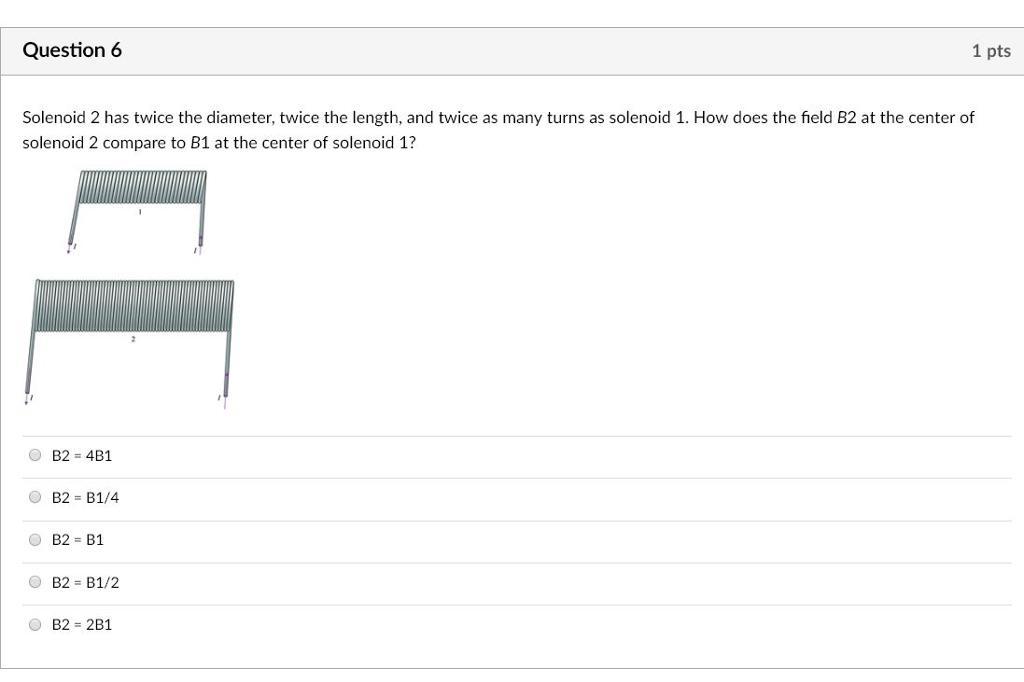
Solenoid 2 has twice the diameter, twice the length, and twice as many turns as solenoid 1. How does the field B2 at the center
Sav [3153]

Complete Question

The entire question is displayed in the first uploaded image

Answer:

The right choice is option  3

Explanation:

The question informs us that

   The diameter of solenoid 1 is  d_1

   The length of solenoid 1 is   L_1

    The  number of turns of solenoid is  N_1

   The diameter of solenoid 2 is  d_2 = 2d_1

   The length of solenoid 2 is   L_2 = 2L_1

    The  number of turns of solenoid  2 is    N_2 = 2 N_1

Typically, the magnetic field in a solenoid can be expressed mathematically as

     B = \frac{\mu_o * N * I }{L}

According to this formula we find that

     B \ \alpha \ \frac{N}{L}

     B = C \frac{N}{L}

Here C denotes constant

=>   C = \frac{B * \frac{L}{N}

=>    \frac{B_1 * \frac{L_1}{N_1} = \frac{B_2 * \frac{L_2}{N_2}

=>  \frac{B_1}{B_2 } = \frac{N_1 L _2}{ N_2L_1}

=>   \frac{B_1}{B_2 } = \frac{N_1 * (2 L_1)}{ (2 N_2)L_1}

=>   \frac{B_1}{B_2 } = 1

=>   B_2 = B_1

4 0
2 months ago
Two resistors ( 3 ohms & 6 ohms) in a series circuit with a power supply = 12 volts. The current through resistor 6 ohms is
Ostrovityanka [3204]

In a series circuit...

-- The overall resistance equals the sum of the individual resistances.

-- The current remains identical throughout the circuit.

The total resistance in this circuit is (3Ω + 6Ω )  =  9Ω

<pThe current at every point measures (V/R) = (12v / 9Ω ) = 1.33 A.

Select choice (a).

6 0
3 months ago
A proton (mass = 1.67 10–27 kg, charge = 1.60 10–19 C) moves from point A to point B under the influence of an electrostatic for
serg [3582]

Answer:

20.353125 V

Explanation:

m = Mass of proton = 1.67\times 10^{-27}\ kg

q = Charge of proton = 1.6\times 10^{-19}\ C

v_A = Velocity of proton at point A = 50 km/s

v_B = Velocity of proton at point B = 80 km/s

The relationship derived from energy conservation is as follows:

\dfrac{1}{2}m(v_B^2-v_A^2)=q(V_B-V_A)\\\Rightarrow V_B-V_A=\dfrac{1}{2q}m(v_B^2-v_A^2)\\\Rightarrow V_B-V_A=\dfrac{1}{2\times 1.6\times 10^{-19}}\times 1.67\times 10^{-27}(80000^2-50000^2)\\\Rightarrow V_B-V_A=20.353125\ V

The determined potential difference is 20.353125 V

3 0
3 months ago
Other questions:
  • Any ferrous metal object within or near the mri magnet has the potential of becoming a projectile. this is commonly referred to
    6·1 answer
  • All students except one are cheating on a test. The one student who is not cheating on the test is exhibiting abnormal behavior.
    5·2 answers
  • A 5.0-g marble is released from rest in the deep end of a swimming pool. An underwater video reveals that its terminal speed in
    11·1 answer
  • A solid cylinder is radiating power. It has a length that is ten times its radius. It is cut into a number of smaller cylinders,
    10·1 answer
  • Look at the diagram of the moon and three different paths that it could take. A planet with a moon in orbit. The moon has arrows
    7·2 answers
  • A wheel completes 5.6 revolutions in 8 seconds.
    6·2 answers
  • Suppose students experiment with the tube and a variety of darts. Some darts have higher masses than others but are the same aer
    8·1 answer
  • If you are swimming upstream (i.e., against the current), at what speed does your friend on the shore see you moving?
    12·1 answer
  • A worker kicks a flat rock lying on a roof. The rock slides up the incline 10.0 m to the apex of the roof, and flies off the roo
    12·1 answer
  • The city is thinking about starting a program to add a new chemical to the public pool. Before they do, they want to find out if
    15·1 answer
Add answer
Login
Not registered? Fast signup
Signup
Login Signup
Ask question!