answer.
Ask question
Login Signup
Ask question
All categories
  • English
  • Mathematics
  • Social Studies
  • Business
  • History
  • Health
  • Geography
  • Biology
  • Physics
  • Chemistry
  • Computers and Technology
  • Arts
  • World Languages
  • Spanish
  • French
  • German
  • Advanced Placement (AP)
  • SAT
  • Medicine
  • Law
  • Engineering
Katyanochek1
4 days ago
5

A plastic film moves over two drums. During a 4-s interval the speed of the tape is increased uniformly from v0 = 2ft/s to v1 =

4ft/s. Knowing that the tape does not slip on the drums, determine (a) the angular acceleration of drum B, and (b) the number of revolutions executed by drum B during the 4-s interval. 5) A rocket weighs 2600 lb, including 2200 lb of fuel, which is consumed at the rate of 25 lb/s and ejected with a relative velocity of 13000 ft/s. Knowing that the rocket is fired vertically from the ground, determine its acceleration (a) as it is fired, and (b) as the last particle of fuel is being consumed.
Physics
You might be interested in
A particle leaves the origin with an initial velocity v⃗ =(2.40 m/s)xˆv→=(2.40 m/s)x^ , and moves with constant acceleration a⃗
Maru [3345]

Answer:

The distance before stopping is 1.52 m,

velocity is 4.0 m/s on the y-axis

Explanation:

The particle’s motion is two-dimensional due to acceleration along both the x and y axes; each axis can be addressed independently for calculations.

a) At the moment the particle starts to reverse, its velocity should be zero (Vfx = 0)

     Vfₓ = V₀ₓ + aₓ t  

     t = -  V₀ₓ/aₓ

     t = - 2.4/(-1.9)

     t=  1.26 s

When the particle stops, we calculate its position

     X1 = V₀ₓ t + ½ aₓ t²

     X1= 2.4 1.26 + ½ (-1.9) 1.26²

     X1= 1.52 m

At this point, the particle begins returning.

b) The velocity comprises both x and y components.

   For the x section, Vₓ = 0 m/s indicates a halt, but the y component retains a velocity

    Vfy= Voy + ay t

    Vfy= 0 + 3.2 1.26

    Vfy = 4.0 m/s

Thus, the velocity reads as

    V = (0 x^ + 4.0 y^) m/s

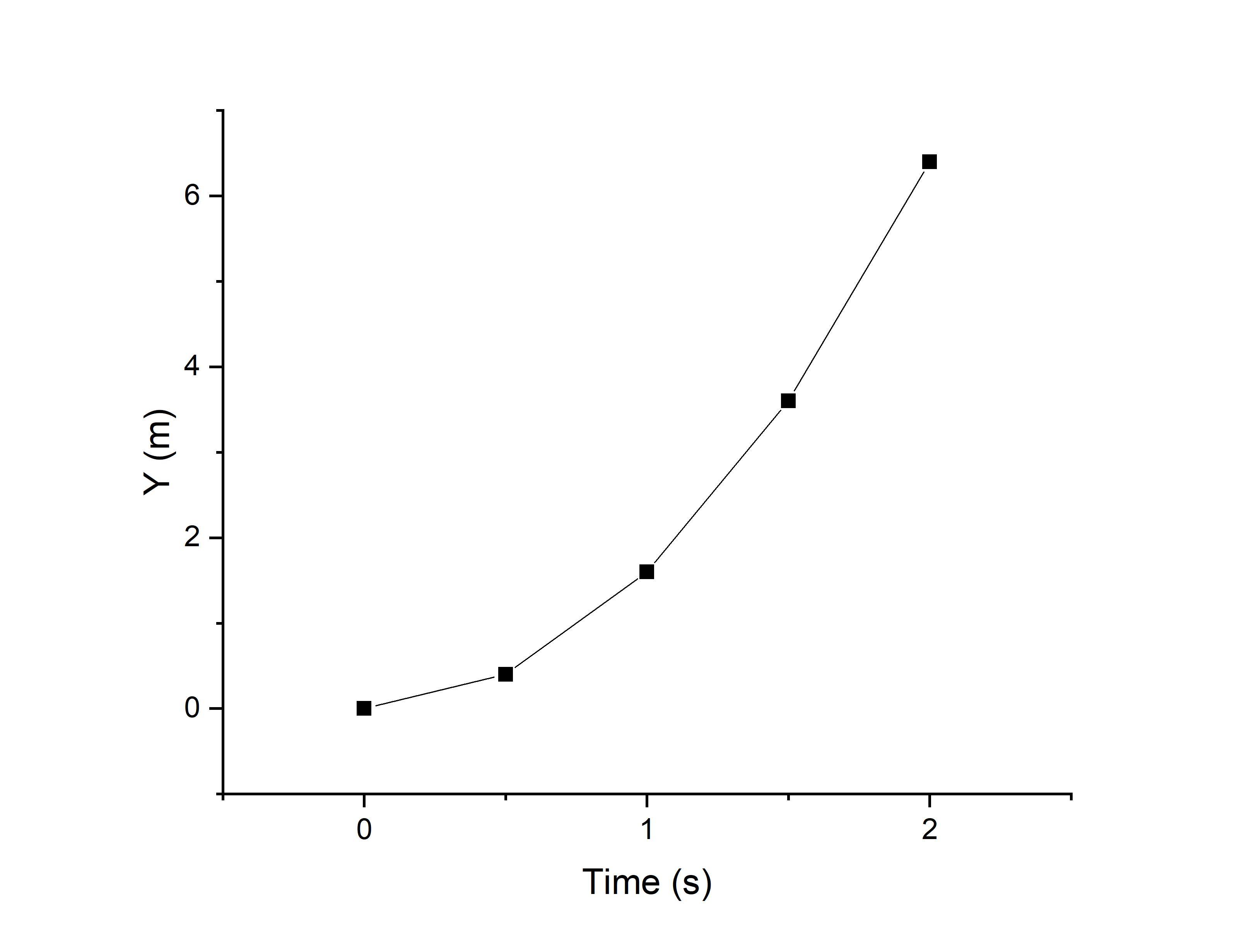
c) To graph the motion, we create a table listing position x and y at given time intervals; let's begin the calculations for equations

      X = V₀ₓ t+ ½  aₓ t²

      Y = Voy t + ½  ay t²

      X= 2.4 t + ½ (-1.9) t²

      Y= 0 + ½ 3.2 t²

      X= 2.4 t – 0.95 t²

      Y=   1.6 t²

With these equations, we construct two graphs for position against time, one for the x-axis and another for the y-axis

                       Chart for graphing

              Time (s)     x(m)            y(m)

                 0                0               0

                 0.5             0.960       0.4

          1       1.45          1.6

                 1.50      1.46      3.6

                2.00      1.00      6.4

7 0
2 months ago
You decide it is time to clean your pool since summer is quickly approaching. Your pool maintenance guide specifies that the chl
Yuliya22 [3333]

Answer:

Cl2 concentration: 1,048 ppm

Explanation:

Molarity (M) is a unit that indicates how many moles of a substance are in one liter of solution, while ppm is similar to mg/L, representing the mass of the substance per liter. To convert M to ppm, we need to consider both mass and volume. The volume remains in liters in both cases, so no adjustments are needed there. The challenge arises when converting moles from molarity to milligrams for the mg/L conversion to find ppm.

First, we must recognize that the substance in question is Cl2, prompting the need to connect mole quantity to its mass. Referring to the periodic table, we find the atomic weight of Cl is 35.4 g/mole. This relationship allows us to establish moles' mass, as shown in the following equation:

mass=mole*atomic mass

We already know the moles of Cl2 in the solution is (moles=2.96x10^-5). Substituting this value, we can calculate:

m=2,96x10^-5 moles*35,4 g/mole\\ m=1,048x10^-3 g

Keep in mind that we're discussing the mass found per liter of solution, which gives us 1.048x10^-3 g/L. We previously established that ppm equals mg/L, so we need to convert grams to milligrams:

1 g = 1000 mg

Now multiplying both sides by 1.048x10^-3:

1 * 1.048x10^-3 g = 1000 * 1.048x10^-3 mg

Thus, 1,048x10^-3 g translates to 1,048 mg.

This amount of mass detected in one liter indicates that the concentration of the substance in the solution is:

1,048 mg/L

Since we know that mg/L=ppm, the conclusion is:

1,048 ppm

4 0
3 months ago
The 1.5-in.-diameter shaft AB is made of a grade of steel with a 42-ksi tensile yield stress. Using the maximum-shearing-stress
Keith_Richards [3271]

Answer:T = 0.03 Nm.

Explanation:

d = 1.5 in = 0.04 m

r = d/2 = 0.02 m

P = 56 kips = 56 x 6.89 = 386.11 MPa

σ = 42 ksi = 42 x 6.89 = 289.58 MPa

To find Torque = T =?

Solution:σ = (P x r) / T

Thus, T = (P x r) / σ

Calculating T = (386.11 x 0.02) / 289.58

results in T = 0.03 Nm.

7 0
2 months ago
Two parallel plates of area 2.34*10-3 M2 have 7.07*10-7C of charge placed on them. A6.62*10-5C charge q1 is placed between the p
kicyunya [3294]

Response:

The force acting on the q_1 is F = 2.25*10^{3} \ N

Clarification:

According to the problem statement,

The area is A = 2.34*10^{-3} \ m^2

The amount of charge placed on them is q = 7.07 * 10^{-7} C

The charge located between the plates is q_1 = 6.62 *10^{-5} C

The electric field surrounding the plate is mathematically expressed as

E = \frac{q}{A \epsilon_o}

Substituting in the values

E = \frac{7.07*10^{-7}}{2.34*10^{-3} * 8.85 *10^{-12}}

E = 34*10^{6} \ V/m

The force on the charge q_1 is mathematically described as

F = q_1 * E

Replacing values

F = 6.62 *10^{-5} * 34*10^{6}

F = 2.25*10^{3} \ N

8 0
2 months ago
A motorcycle is following a car that is traveling at constant speed on a straight highway. Initially, the car and the motorcycle
Softa [3030]

Answer:

a) \Delta{t} = 5.39s

b) the distance the motorcycle covers is 155 m

Explanation:

Let t_2-t_1 = \Delta{t} denote the variables. Next, we analyze the motion equation for the accelerating motorcycle alongside the constant speed of the car:

v_{m2}=v_0+a\Delta{t}\\x+d=(\frac{v_0+v_{m2}}{2} )\Delta{t}\\v_c = v_0 = \frac{x}{\Delta{t}}

where:

v_{m2} represents the motorcycle's speed at time 2

v_{c} is the steady velocity of the car

v_{0} indicates the initial speeds of both vehicle types at time 1

d signifies the distance separating the car and motorcycle at the initial moment

x is the distance the car travels from time 1 to time 2

Solving the equations provides:

\left[\begin{array}{cc}car&motorcycle\\x=v_0\Delta{t}&x+d=(\frac{v_0+v_{m2}}{2}}) \Delta{t}\end{array}\right]

v_0\Delta{t}=\frac{v_0+v_{m2}}{2}\Delta{t}-d \\\frac{v_0+v_{m2}}{2}\Delta{t}-v_0\Delta{t}=d\\(v_0+v_{m2})\Delta{t}-2v_0\Delta{t}=2d\\(v_0+v_0+a\Delta{t})\Delta{t}-2v_0\Delta{t}=2d\\(2v_0+a\Delta{t})\Delta{t}-2v_0\Delta{t}=2d\\a\Delta{t}^2=2d\\\Delta{t}=\sqrt{\frac{2d}{a}}=\sqrt{\frac{2*58}{4}}=\sqrt{29}=5.385s

For the second query, we determine x+d by applying the car’s motion equation to compute x:

x = v_0\Delta{t}= 18\sqrt{29}=96.933m\\then:\\x+d = 154.933

3 0
3 months ago
Other questions:
  • A mouse runs along a baseboard in your house. The mouse's position as a function of time is given by x(t)=pt2+qt, with p = 0.36
    9·1 answer
  • A ladybug sits at the outer edge of a turntable, and a gentleman bug sits halfway between her and the axis of rotation. The turn
    7·2 answers
  • You throw a baseball at an angle of 30.0∘∘ above the horizontal. It reaches the highest point of its trajectory 1.05 ss later. A
    13·1 answer
  • Ellen does an experiment by releasing a ball from a height of 1 m above each floor in a tall building. She records the time it t
    8·2 answers
  • A friend climbs an apple tree and drops a 0.22-kg apple from rest to you, standing 3.5 m below. When you catch the apple, you br
    11·1 answer
  • Why is the more cumbersome Two's complement representation preferred instead of the more intuitive sign bit magnitude approach?
    14·1 answer
  • Consider an electron with charge −e and mass m orbiting in a circle around a hydrogen nucleus (a single proton) with charge +e.
    14·1 answer
  • Sketch a position-time graph for a bear starting
    10·1 answer
  • To understand the forces between a bar magnet and 1. a stationary charge, 2. a moving charge, and 3. a ferromagnetic object. A b
    7·1 answer
  • 3-m-high large tank is initially filled with water. The tank water surface is open to the atmosphere, and a sharp-edged 10-cm-di
    8·1 answer
Add answer
Login
Not registered? Fast signup
Signup
Login Signup
Ask question!