answer.
Ask question
Login Signup
Ask question
All categories
  • English
  • Mathematics
  • Social Studies
  • Business
  • History
  • Health
  • Geography
  • Biology
  • Physics
  • Chemistry
  • Computers and Technology
  • Arts
  • World Languages
  • Spanish
  • French
  • German
  • Advanced Placement (AP)
  • SAT
  • Medicine
  • Law
  • Engineering
RideAnS
2 months ago
6

If a swimming pool contains 2,850 kiloliters (kL) of water, how many gallons (gal) of water does it contain? (1 gal = 3.785 L)

Chemistry
2 answers:
VMariaS [2.9K]2 months ago
6 0

We have

a swimming pool that holds 2,850 kiloliters (kL) of water

2,850 kiloliters (kL) equals 2,850,000 liters (L)

We understand that

1gal=3.785L

3.785L=1gal

First, we will calculate for 1L

1L=\frac{1}{3.785}gal

Now, both sides will be multiplied by 2,850,000

2850000*1L=2850000*\frac{1}{3.785}gal

2850000L=2850000*\frac{1}{3.785}gal

2850000L=752972.25892gal

Consequently,

the swimming pool's water volume is 752972.25892 gallons..........Answer


Anarel [2.9K]2 months ago
5 0

The resulting amount is 753,000 gallons of water.

You might be interested in
If you weigh 100 kg, how much would you weigh if all the water were removed from your body? A65 kg B45 kg C50 kg D35 kg
castortr0y [3046]
The answer is B. 45k. Human bodies contain approximately 60 to 70% water.
5 0
2 months ago
In an experiment, hydrochloric acid reacted with different volumes of sodium thiosulfate in water. A yellow precipitate was form
KiRa [2933]

I predict that there will be an increase in the seconds recorded in the time column. This is because, as more water is mixed with sodium thiosulfate, its concentration diminishes in each flask. Additionally, a lower concentration results in a slower reaction rate since fewer molecules of sodium thiosulfate means there are less frequent collisions with sulfuric acid. With fewer collisions occurring in the reaction, it takes a longer time for the reaction to complete, leading to increased time when sodium thiosulfate is diluted.

Explanation:

I can confirm that this explanation is accurate.

6 0
3 months ago
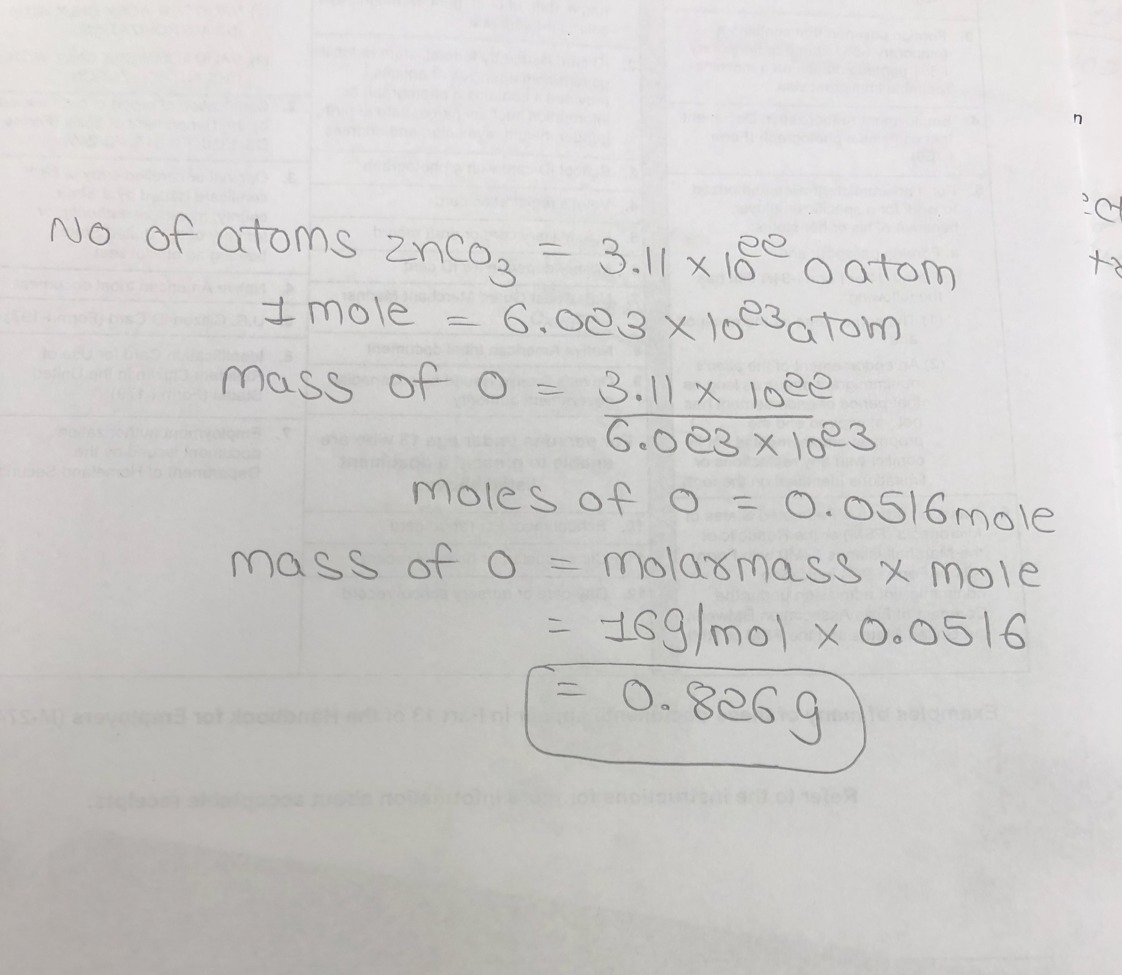
What mass of ZnCO3 contains 3.11×10²² O atoms
KiRa [2933]
Please ask if you have any inquiries.

3 0
2 months ago
Read 2 more answers
An alkene with the molecular formula C8H16 undergoes ozonolysis to yield a mixture of (CH3)2C=O and (CH3)3CCHO. The alkene is:
eduard [2782]
The ozonolysis of 2,4,4-trimethyl-2-pentene produces a combination of (CH_{3})_{2}C=O and (CH_{3})_{3}CHO

Explanation: In ozonolysis (where a reducing agent like Zn is involved during hydrolysis), a pi bond cleaves to generate ketones or aldehydes.

Ketones arise from the double bond's disubstituted side, whereas aldehydes come from the monosubstituted side of the same bond.

Notably, ozonolysis comprises two steps: (1) the formation of an ozonide, followed by (2) the hydrolysis of the ozonide.

Hydrolysis can transpire with or without a reducing agent. When it occurs without a reducing agent, carboxylic acid, carbon dioxide, or ketones can be produced.

In this case, 2,4,4-trimethyl-2-pentene yields a mixture of (CH_{3})_{2}C=O and (CH_{3})_{3}CHO

The reaction process is illustrated below.

8 0
2 months ago
Ibuprofen, a headache remedy, contains 75.69% C, 8.80% H, and 15.51% O by mass and has a molar mass of 206 g/mol. Express your a
castortr0y [3046]

Answer:

A) The molecular formula for ibuprofen isC_{13}H_{18}O_2

B) The molecular formula for Cadaverine is C_{5}H_{14}N_2

C) The molecular formula for Epinephrine is C_9H_{13}O_3N_1

Explanation:

Element percentage in a compound:

\frac{\text{Number of atoms of element}\times \text{Atomic mass of element}}{\text{molecular mass of element}}\times 100

A) The composition of ibuprofen, used for headaches, consists of 75.69% carbon, 8.80% hydrogen, and 15.51% oxygen by weight.

Ibuprofen has a molar mass of 206 g/mol.

The proposed molecular formula for ibuprofen is =C_xH_yO_z

Count of carbon atoms in one ibuprofen molecule;

75.69\%=\frac{x\times 12 g/mol}{206 g/mol}\times 100

x=\frac{75.69\times 206 g/mol}{100\times 12 g/mol}=12.99\approx 13

Count of hydrogen atoms in one ibuprofen molecule;

8.80\%=\frac{y\times 1 g/mol}{206 g/mol}\times 100

y=\frac{8.80\times 206 g/mol}{100\times 1 g/mol}=18.12\approx 18

Count of oxygen atoms in one ibuprofen molecule;

15.51\%=\frac{z\times 16 g/mol}{206 g/mol}\times 100

z=\frac{15.51\times 206 g/mol}{100\times 16 g/mol}=1.99\approx 2

Molecular formula for ibuprofen:

= C_xH_yO_z= C_{13}H_{18}O_2

B) Cadaverine consists of 58.55% carbon, 13.81% hydrogen, and 27.40% nitrogen by weight

Cadaverine has a molar mass of 102.2 g/mol.

The proposed molecular formula for Cadaverine is =C_xH_yN_z

Count of carbon atoms in one Cadaverine molecule;

58.55\%=\frac{x\times 12 g/mol}{102.2 g/mol}\times 100

x=\frac{58.55\times 102.2 g/mol}{100\times 12 g/mol}=4.98\approx 5

Count of hydrogen atoms in one Cadaverine molecule;

13.81\%=\frac{y\times 1 g/mol}{102.2 g/mol}\times 100

y=\frac{13.81\times 102.2 g/mol}{100\times 1 g/mol}=14.11\approx 14

Count of nitrogen atoms in one Cadaverine molecule;

27.40\%=\frac{z\times 14 g/mol}{102.2 g/mol}\times 100

z=\frac{27.40\times 102.2 g/mol}{100\times 14 g/mol}=2.00\approx 2

Molecular formula for Cadaverine:

= C_xH_yN_z= C_{5}H_{14}N_2

C) Epinephrine includes 59.0% carbon, 7.1% hydrogen, 26.2% oxygen, and 7.7% nitrogen by weight

Epinephrine has a molar mass of 180 g/mol.

The proposed molecular formula for Epinephrine is =C_xH_yO_zN_w

Count of carbon atoms in one Epinephrine molecule;

59.0\%=\frac{x\times 12 g/mol}{180 g/mol}\times 100

x=\frac{59.0\times 180 g/mol}{100\times 12 g/mol}=8.85\approx 9

Count of hydrogen atoms in one Epinephrine molecule;

7.1\%=\frac{y\times 1 g/mol}{180 g/mol}\times 100

y=\frac{7.1\times 180 g/mol}{100\times 1 g/mol}=12.78\approx 13

Count of oxygen atoms in one Epinephrine molecule;

26.2\%=\frac{z\times 16 g/mol}{180 g/mol}\times 100

z=\frac{26.2\times 180 g/mol}{100\times 16 g/mol}=2.94\approx 3

Count of nitrogen atoms in one Epinephrine molecule;

7.7\%=\frac{w\times 14 g/mol}{180 g/mol}\times 100

w=\frac{7.7\times 180 g/mol}{100\times 14 g/mol}=0.99\approx 1

Molecular formula for Epinephrine:

= C_xH_yO_zN_w= C_9H_{13}O_3N_1

7 0
3 months ago
Other questions:
  • The secondary structure of a protein results from _____. the secondary structure of a protein results from _____. bonds between
    9·1 answer
  • PLEASE HELP!!! The image represents the reaction between a certain number of molecules of N2 and H2.
    14·2 answers
  • Classify these compounds as acid, base, salt, or other.? 1. ch3oh 3. hno3 5. nabr
    8·2 answers
  • If the standard solutions had unknowingly been made up to be 0.0024 m agno3 and 0.0040 m k2cro4, would this have affected your r
    6·2 answers
  • When balanced, which equation would have the coefficient 3 in front of any of the reactants? Zn + HCl ZnCl2 + H2 H2SO4 + B(OH)3
    11·2 answers
  • What functional feature(s) does the phosphate group contribute to the structure of a phospholipid? select all that apply. select
    13·1 answer
  • A researcher wants to show the effects of slight changes in pH on the reproductive rates of fish in a lake. Why would a table be
    12·2 answers
  • What is the oxidation state of selenium in SeO3?​
    7·1 answer
  • HELP PLZ!!! A sample contains only the compound CaCl2 and water. When it is dried, its weight decreases from 5.00g to 4.24g. Wha
    7·2 answers
  • Based on a kc value of 0.200 and the given data table, what are the equilibrium concentrations of xy, x, and y, respectively? ex
    5·1 answer
Add answer
Login
Not registered? Fast signup
Signup
Login Signup
Ask question!