answer.
Ask question
Login Signup
Ask question
All categories
  • English
  • Mathematics
  • Social Studies
  • Business
  • History
  • Health
  • Geography
  • Biology
  • Physics
  • Chemistry
  • Computers and Technology
  • Arts
  • World Languages
  • Spanish
  • French
  • German
  • Advanced Placement (AP)
  • SAT
  • Medicine
  • Law
  • Engineering
NISA
2 months ago
12

1.562 g sample of the alcohol CH3CHOHCH2CH3 is burned in an excess of oxygen. What masses of H2O and CO2 should be obtained

Chemistry
1 answer:
eduard [2.7K]2 months ago
7 0

Answer:

m_{CO_2}=3.709gCO_2 \\\\m_{H_2O}=1.898gH_2O

Explanation:

Hello.

In this scenario, as the molecular formula for the specified alcohol is C₄H₁₀O (with a molar mass of 74.14 g/mol), its combustion reaction can be represented as follows:

C_4H_1_0O+6O_2\rightarrow 4CO_2+5H_2O

This implies a mole ratio of 1:4 with carbon dioxide (molar mass = 44.01 g/mol) and a mole ratio of 1:5 with water (molar mass = 18.02 g/mol), allowing us to determine the resultant masses as follows:

m_{CO_2}=1.562gC_4H_1_0O*\frac{1mol}{74.14gC_4H_1_0O} *\frac{4molCO_2}{1molC_4H_1_0O} *\frac{44.01gCO_2}{1molCO_2}=3.709gCO_2 \\\\m_{H_2O}=1.562gC_4H_1_0O*\frac{1mol}{74.14gC_4H_1_0O} *\frac{5molH_2O}{1molC_4H_1_0O} *\frac{18.02gH_2O}{1molH_2O}=1.898gH_2O

Best regards!

You might be interested in
No amino acid molecule by itself can speed up or catalyze reactions between other molecules; however, when amino acids are joine
Anarel [2989]

Answer:

This indicates that the enzyme is a type of protein.

Explanation:

It is important to remember that proteins are composed of vast numbers of amino acids. Because these amino acids are tiny units, they cannot function as a catalyst on their own.

However, when they form a polymer, the protein enzyme will possess varying shapes, sizes, and both physical and chemical attributes differing from a single monomer.

Additionally, for proteins to function actively, a specific number of amino acids must combine to create a distinct shape suited to interact with another molecule, thus accelerating the chemical reaction and functioning as an enzyme.

8 0
2 months ago
Read 2 more answers
The final overall chemical equation is Upper Ca upper O (s) plus upper C upper O subscript 2 (g) right arrow upper C a upper C u
lions [2927]

Answer:

The enthalpy of the second intermediate equation is altered by halving its value and changing the sign.

Explanation:

Let's examine both the first and second intermediate reactions alongside the overall equation concerning the examined process;

First reaction;

Ca (s) + CO₂ (g) + ½O₂ (g) → CaCO₃ (s) ΔH₁ = -812.8 kJ

Second reaction;

2Ca (s) + O₂ (g) → 2CaO (s) ΔH₂ = -1269 kJ

Thus, the overall reaction becomes;

CaO (s) + CO₂ (g) → CaCO₃ (s) ΔH =?

According to Hess's law, which states that the total heat change in a reaction is equal to the sum of the heat changes for each step, we cannot simply sum the enthalpies for this overall reaction. Instead, we obtain the overall enthalpy by halving the second intermediate reaction's enthalpy and changing its sign before adding, as illustrated below;

Enthalpy of Intermediate reaction 1 + ½(-Enthalpy of Intermediate reaction 2) = Enthalpy of Overall reaction

7 0
2 months ago
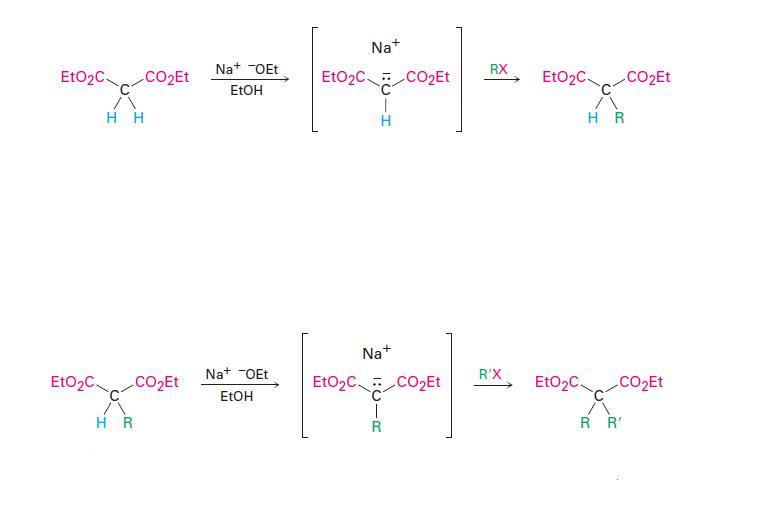
Barbiturates, including "truth serums" seen in movies like Meet the Fockers and sedatives that may have led to the untimely deat
Alekssandra [3086]

Answer:

Explanation:

Diethyl malonate possesses greater acidity compared to monocarbonyl substances (pKa=13) because its alpha hydrogens are linked to two carbonyl groups. Consequently, the malonic ester can be readily changed into its enolate ion by reacting it with sodium ethoxide in ethanol. When the malonic ester undergoes alkylation, a hydrogen atom in the alpha position becomes acidic, permitting another round of alkylation to yield a dialkylated malonic ester.

In this scenario, when diethyl malonate interacts with urea in the presence of sodium ethoxide base, the second alkylation step occurs within the molecule, producing a cyclic compound known as barbituric acid.

8 0
2 months ago
As a final problem for the week Snape thinks we should incorporate something from a previous week, hydrates perhaps. Suppose we
lorasvet [2795]
The formula is =
5 0
1 month ago
n the table below, write the density of each object. Then predict whether the object will float or sink in each of the fluids. W
Anarel [2989]

Answer:

0.5 g/mL----- will float

1.0 g/mL---- will float

2.0 g/mL----- will sink

Explanation:

Objects with a density less than or equal to that of water will float due to having a lower mass, while objects with a density exceeding that of water will sink because their mass is greater than that of water. Thus, objects with a density of 0.5 g/mL and 1.0 g/mL will float since they are less dense than water (1 g/mL), whereas an object with a density of 2.0 g/mL will sink.


3 0
3 months ago
Other questions:
  • Consider a general reaction A ( aq ) enzyme ⇌ B ( aq ) A(aq)⇌enzymeB(aq) The Δ G ° ′ ΔG°′ of the reaction is − 5.980 kJ ⋅ mol −
    15·1 answer
  • Miniature golf is a game in which players hit a golf ball with a club, which causes the ball to roll along the flat ground. Thre
    15·1 answer
  • A) How many moles of CO2 and H2O are formed from 3.85 mole of propane C3H8 (This calculation needs to be done twice-once fro CO2
    9·1 answer
  • Compound X contains only carbon, hydrogen, nitrogen, and chlorine. When 1.00 g of X is dissolved in water and allowed to react w
    14·1 answer
  • If the volume occupied by the gas molecules shown below were doubled, what would happen to the pressure they exert? (Assume cons
    13·1 answer
  • How should students prepare to use chemicals in the lab? Select one or more: Sort the lab chemicals in alphabetical order for qu
    13·1 answer
  • A recipe for chocolate cake calls for 236.6 mL of buttermilk.
    5·1 answer
  • Name the following molecule: W(H3AlO4)3
    12·1 answer
  • Which equation is derived from the combined gas law? StartFraction V subscript 1 over T subscript 1 EndFraction equals StartFrac
    13·2 answers
  • In terms of molecular structure, what additional information does the vsepr theory give you beyond electron dot structures?
    13·1 answer
Add answer
Login
Not registered? Fast signup
Signup
Login Signup
Ask question!