answer.
Ask question
Login Signup
Ask question
All categories
  • English
  • Mathematics
  • Social Studies
  • Business
  • History
  • Health
  • Geography
  • Biology
  • Physics
  • Chemistry
  • Computers and Technology
  • Arts
  • World Languages
  • Spanish
  • French
  • German
  • Advanced Placement (AP)
  • SAT
  • Medicine
  • Law
  • Engineering
madreJ
2 months ago
3

The position of a 2.75×10⁵n training helicopter under test is given by r⃗ =(0.020m/s3)t3i^+(2.2m/s)tj^−(0.060m/s2)t2k^. part a f

ind the net force on the helicopter at t=5.0s.

Physics
2 answers:
Sav [3.1K]2 months ago
5 0

At the moment t = 5.0\,{\text{s}}, the helicopter experiences a net force of \fbox{\begin\\\left( {1.68 \times {{10}^4}\,\hat i - 3.36 \times {{10}^3}\,\hat j} \right)\,{\text{N}}\end{minispace}}.

Detailed Explanation:

The helicopter's motion results from a force that alters its position over time, governed by the equation below.

\vec{r}=(0.020\text{ m}/\text{s}^3)\text{ t}^3\hat{i}+(2.2\text{ m}/\text{s})\text{ t}^3\hat{j}-(0.060\text{ m}/\text{s}^2)\text{ t}^2\hat{k}

The force applied to the helicopter at any given time is expressed as:

\fbox{\begin\\F= m\cdot{a}\end{minispace}}

Where m denotes the helicopter's mass and a indicates its acceleration.

The helicopter's weight is 2.75 \times {10^5}\,{\text{N}}, which can be used to calculate its mass.

The weight equation for the helicopter is:

\fbox{\begin\\W=m \cdot g\end{minispace}}

Rearranging the formula allows simplification to obtain the helicopter's mass:

\begin{aligned}m&=\frac{W}{g}\\&=\frac{{2.75\times{{10}^5}}}{{9.8}}\,{\text{kg}}\\&=2.{\text{80}}\times{\text{1}}{{\text{0}}^4}\,{\text{kg}}\\\end{aligned}

The helicopter's velocity is found by differentiating its position vector with respect to time.

\begin{aligned}\vec{v}&=\dfrac{{d\vec{r}}}{{dt}}\\&=\dfrac{d}{{dt}}\ [(0.020\text{ m}/\text{s}^3)\text{ t}^3\hat{i}+(2.2\text{ m}/\text{s})\text{ t}^3\hat{j}-(0.060\text{ m}/\text{s}^2)\text{ t}^2\hat{k}]\\&=0.060{t^2}\hat{i}+2.2\hat{j}-0.12t\hat{k}\end{aligned}

The acceleration corresponds to the time derivative of the velocity.

\begin{aligned}\vec a&=\frac{{d\vec v}}{{dt}}\\&=\frac{d}{{dt}}\left({0.060{t^2}\hat i+2.2\hat j-0.12t\hat k}\right)\\&=0.12t\hat i-0.12\hat k\\\end{aligned}

By substituting t = 5.0\,{\text{s}} into the acceleration formula, we get:

\begin{aligned}a&=0.12\left({5.0}\right)\hat i-0.12\hat k\\&=0.6\hat i-0.12\hat k\\\end{aligned}

Replacing both the acceleration and mass values into the force equation yields:

\begin{aligned}F&=\left( {2.80\times{{10}^4}\,{\text{kg}}}\right)\left({0.6\hat i-0.12\hat k}\right) \\&=\left({1.68\times{{10}^4}\,\hat i-3.36\times{{10}^3}\,\hat j}\right)\,{\text{N}}\\\end{aligned}

Therefore, the net force impacting the helicopter at t = 5\,{\text{s}} is \fbox{\begin\\\left( {1.68 \times {{10}^4}\,\hat i - 3.36 \times {{10}^3}\,\hat j} \right)\,{\text{N}}\end{minispace}}.

serg [3.5K]2 months ago
3 0

The helicopter's net force at t = 5.0 seconds is F = 1.65 × 10⁴ i - 3.3 × 10³ k

Additional explanation

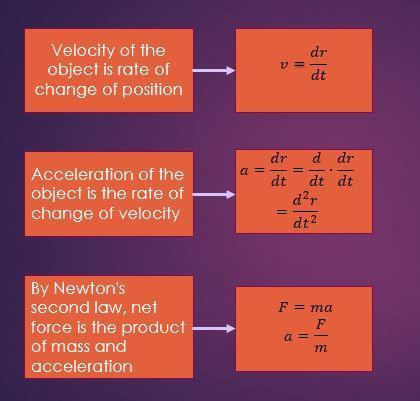
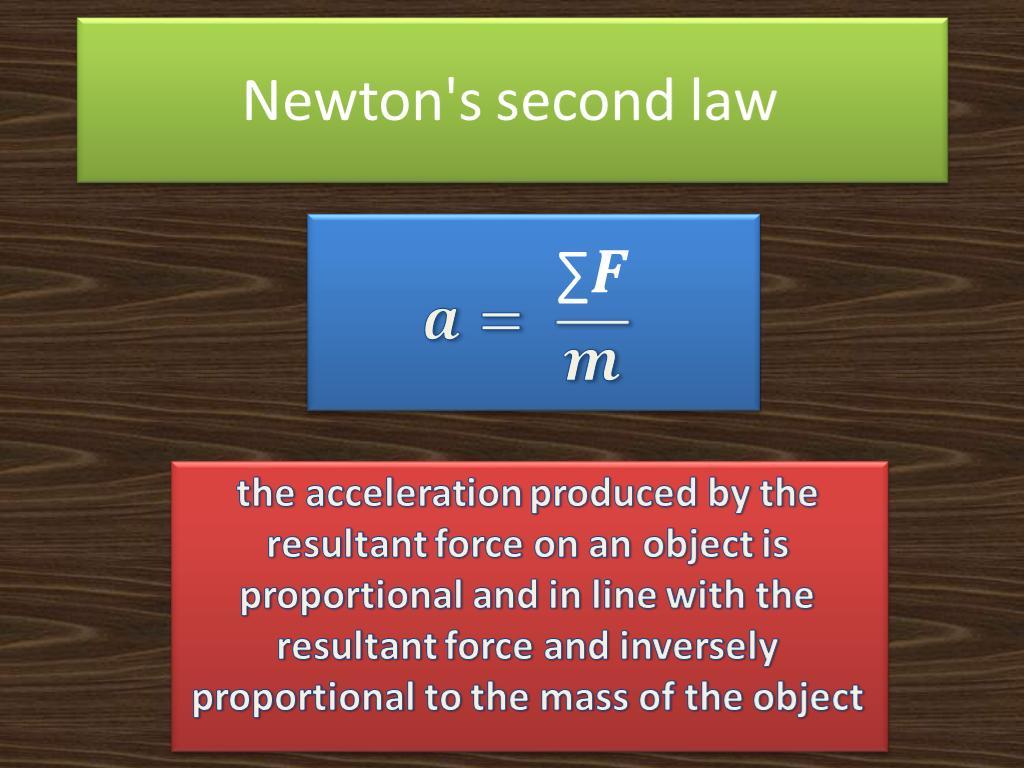
Newton's second law states that the acceleration caused by the net force acting on an object is directly proportional to that force and inversely proportional to the object's mass.

\large{\boxed{\bold{a~=~\frac{F}{m} }}}

The sum of forces equals mass times acceleration (∑F = m·a).

Where F represents force (in Newtons), m is mass (in kilograms), and a is acceleration (in meters per second squared).

Velocity is the first derivative of position with respect to time:

\large{\boxed{\bold{V~=~\frac{dr}{dt} }}}

Acceleration is the derivative of velocity with respect to time:

\large{\boxed{\bold{a~=~\frac{dv}{dt} }}}

The position vector is given as r = 0.020 t³ i + 2.2 t j − 0.06 t² k.

Velocity (v) then is

v~=~\frac{dr}{dt}

v = 0.06 t² i + 2.2 j − 0.12 t k.

Acceleration (a) is

a~=~\frac{dv}{dt}

a = 0.12 t i − 0.12 k.

Also, weight (W) equals mass times gravity: W = m·g

m~=~\frac{W}{g}

The given force magnitude is 2.75 × 10⁵ N divided by g = 10 m/s², yielding

mass m = 2.75 × 10⁴ kg.

Therefore, net force is:

F = m × a = 2.75 × 10⁴ × (0.12 t i − 0.12 k)

At t = 5 s:

F = 2.75 × 10⁴ × (0.12 × 5 i − 0.12 k) = 2.75 × 10⁴ × (0.6 i − 0.12 k)

F = 1.65 × 10⁴ i − 3.3 × 10³ k
You might be interested in
Lucy took 3 hours to cover 2/3 of a journey. She covered the remaining 60 miles in 2 hours. What was the average speed for the w
serg [3582]

The accurate answer is 36 miles per hour

Explanation:

To calculate the average speed, start by determining the total distance and total time Lucy traveled, as average speed is the total distance divided by the total time.

Total Distance

Lucy is known to have covered 2/3 of the total distance initially, later finishing the journey with 60 miles. Therefore, the last segment of 60 miles corresponds to 1/3 of the total distance.

\frac{2}{3} + \frac{1}{3} = \frac{3}{3} (Total distance)

Consequently, since 60 miles equals one-third, multiplying this by 3 gives the total distance: 180 miles.

This indicates the total distance traversed is 180 miles

Total Time

Lucy took 3 hours for the first part of her journey and 2 hours for the second, leading to a total time of 5 hours (3 + 2 = 5)

Determining Average Speed

Average speed =\frac{Distance}{time}

Average speed = \frac{180 m}{5 h}

Average speed = 36m/h

5 0
1 month ago
A circuit contains a 6.0-v battery, a 4.0-w resistor, a 0.60-µf capacitor, an ammeter, and a switch all in series. what will be
Softa [3030]
<span>You are presented with a circuit that includes a 6.0-v battery, a 4.0-ohm resistor, a 0.60 microfarad capacitor, an ammeter, and a switch all connected in series. Your task is to determine the current reading once the switch is closed. Ohm's law should be used, which states V = IR where V signifies voltage, I indicates current, and R represents resistance.</span>

V = IR
I = V/R
I = 6 volts / 4 ohms
I = 1.5A

Upon closing the switch, the cathode side plate starts accumulating electrons if it was previously empty. As this process continues, the current diminishes. Eventually, when the capacitor reaches its maximum electron retention, the current will cease. An increased capacitance means a greater capacity for electron storage.
4 0
28 days ago
Read 2 more answers
A student with a mass of 66.0 kg climbs a staircase in 44.0 s. If the distance between the base and the top of the staircase is
serg [3582]

power = 205.8 \: watt \\ solution \\ mass = 66 \: kg \\ time = 44 \: sec \\ distance = 14 \\ now \\ power = \frac{w}{t} \\ \: \: \: \: \: \: \: \: = \frac{f \times d}{t} \\ \: \: \: \: \: = \frac{m \times g \times d}{t} \\ \: \: \: \: \: \: = \frac{66 \times 9.8 \times 14}{44} \\ \: \: \: \: = \frac{9055.2}{44} \\ \: \: \: \: \: = 205.8 \: watt \\ hope \: it \: helps

4 0
1 month ago
Water is made of two hydrogen atoms and one oxygen atom bonded together. Julia is describing how water undergoes a physical chan
kicyunya [3294]
Steam transforms into gas as it escapes into the atmosphere. Even if you manage to capture the steam as it ascends, it can revert to H2O when it cools down. Due to the evaporation process, the final volume of water will differ from the original amount.
8 0
2 months ago
Read 2 more answers
A center lane with solid and broken yellow lines that is used by vehicles making left turns in both directions is called a:
Sav [3153]
A left turn lane is designated for vehicles making left turns. Vehicles must completely enter this lane and wait for a clear path before proceeding with the turn. It is not permissible for a vehicle to be partially in and out of the lane, as this obstructs traffic and creates hazardous conditions.
7 0
16 days ago
Other questions:
  • Two students walk in the same direction along a straight path, at a constant speed one at 0.90 m/s and the other at 1.90 m/s. a.
    12·1 answer
  • Kayla, a fitness trainer, develops an exercise that involves pulling a heavy crate across a rough surface. The exercise involves
    6·1 answer
  • The summer camps had a field trip from the campus to the fragrance Hill they traveled at an average speed of 65 km an hour and t
    6·1 answer
  • If a beaker of water is placed under a broiler so that the heating coil is above the beaker. It is observed that only the surfac
    7·1 answer
  • A person holds a 4.0 kg block at position A shown above on the left, in contact with an uncompressed vertical spring with a spri
    9·1 answer
  • A coil of 1000 turns of wire has a radius of 12 cm and carries a counterclockwise current of 15A. If it is lying flat on the gro
    7·1 answer
  • A pulley in the shape of a solid cylinder of mass 1.50 kg and radius 0.240 m is free to rotate around a horizontal shaft along t
    10·1 answer
  • A strip 1.2 mm wide is moving at a speed of 25 cm/s through a uniform magnetic field of 5.6 t. what is the maximum hall voltage
    11·1 answer
  • As part of a carnival game, a 5.00 kg target is freely hanging from a very long and very light wire. Contestants can use one of
    14·1 answer
  • A hockey stick of mass ms and length L is at rest on the ice (which is assumed to be frictionless). A puck with mass mp hits the
    12·1 answer
Add answer
Login
Not registered? Fast signup
Signup
Login Signup
Ask question!