answer.
Ask question
Login Signup
Ask question
All categories
  • English
  • Mathematics
  • Social Studies
  • Business
  • History
  • Health
  • Geography
  • Biology
  • Physics
  • Chemistry
  • Computers and Technology
  • Arts
  • World Languages
  • Spanish
  • French
  • German
  • Advanced Placement (AP)
  • SAT
  • Medicine
  • Law
  • Engineering
stellarik
1 month ago
14

A firecracker breaks up into several pieces, one of which has a mass of 200 g and flies off along the x-axis with a speed of 82.

0 m/s. A second piece has a mass of 300 g and flies off along the y-axis with a speed of 45.0 m/s. What are the magnitude and direction of the total momentum of these two pieces?A firecracker breaks up into several pieces, one of which has a mass of 200 g and flies off along the -axis with a speed of 82.0 m/s. A second piece has a mass of 300 g and flies off along the -axis with a speed of 45.0 m/s. What are the magnitude and direction of the total momentum of these two pieces?361 kg·m/s at 0.983° from the x-axis361 kg·m/s at 56.3° from the x-axis93.5 kg·m/s at 28.8° from the x-axis21.2 kg·m/s at 39.5° from the x-axis21.2 kg·m/s at 56.3° from the x-axis
Physics
1 answer:
Maru [3.3K]1 month ago
6 0

Answer:

La magnitud del momento total es de 21.2 kg m/s y su dirección es de 39.5° respecto al eje x.

Explanation:

¡Hola!

El momento total se calcula como la suma de los momentos de las piezas.

El momento de cada pieza se calcula de la siguiente manera:

p = m · v

Donde:

p = momento.

m = masa.

v = velocidad.

El momento es un vector. La pieza de 200 g se mueve a lo largo del eje x, por lo que su momento será:

p = (m · v, 0)

p = (0.200 kg · 82.0 m/s, 0)

p = (16.4 kg m/s, 0)

La pieza de 300 g se mueve a lo largo del eje y. Su vector momento será:

p =(0, m · v)

p = (0, 0.300 kg · 45.0 m/s)

p = (0, 13.5 kg m/s)

El momento total es la suma de cada momento:

Momento total = (16.4 kg m/s, 0) + (0, 13.5 kg m/s)

Momento total = (16.4 kg m/s + 0, 0 + 13.5 kg m/s)

Momento total = (16.4 kg m/s, 13.5 kg m/s)

La magnitud del momento total se calcula de la siguiente manera:

|p| = \sqrt{(16.4 kgm/s)^2+(13.5 kg m/s)^2}= 21.2 kg m/s

La dirección del vector de momento se calcula utilizando trigonometría:

cos θ = px/p

Donde px es el componente horizontal del momento total y p es la magnitud del momento total.

cos θ = 16.4 kg m/s / 21.2 kg m/s

θ = 39.3 (39.5° si no redondeamos la magnitud del momento total)

<pFinalmente, la magnitud del momento total es 21.2 kg m/s y su dirección es 39.5° respecto al eje x.


You might be interested in
When a submarine dives to a depth of 5.0 × 10² m, how much pressure, in pa, must its hull be able to withstand? how many times l
ValentinkaMS [3465]
Depth = 5.0 × 10^2 m
Density of seawater = 1.025 x 10^3
Pd = Po + pgh
Standard atmospheric pressure is Patm = 1.01325 x 10^5 Pa
Since the pressure inside the hull is normal, we can disregard Po.
Thus, Pd = pgh = 1.025 x 10^3 x 9.8 x 5.0 x 10^2 = 50.225 x 10^5
Now calculating Pd / Patm gives us 50.225 x 10^5 / 1.01325 x 10^5 = 49.56
This indicates the pressure is 49.56 times greater.
5 0
1 month ago
Read 2 more answers
An airplane pilot wishes to fly directly westward. According to the weather bureau, a wind of 75.0 km/hour is blowing southward.
Softa [3030]

Answer:

The plane's speed in relation to the ground is 300.79 km/h.

Explanation:

Provided details include:

Wind speed = 75.0 km/hr

Plane's airspeed = 310 km/hr

Next, we must find the ground speed of the plane

Calculating the angle

Using the angle formula

\sin\theta=\dfrac{v'}{v}

Where v' represents the wind speed

v represents the plane's speed

We will substitute the values into the formula

\sin\theta=\dfrac{75}{310}

\theta=\sin^{-1}(\dfrac{75}{310})

\theta=14.0^{\circ}

Now, we must find the resultant speed

Using the resultant speed formula

\cos\theta=\dfrac{v''}{v}

Insert the values into the formula

\cos14=\dfrac{v''}{310}

v''=\cos14\times310

v''=300.79\ km/h

Consequently, the plane's speed in relation to the ground equals 300.79 km/h.

6 0
1 month ago
A 250 GeV beam of protons is fired over a distance of 1 km. If the initial size of the wave packet is 1 mm, find its final size
Maru [3345]

Answer:

The final size is nearly the same as the initial size because the increase in size1.055\times 10^{- 7} is remarkably small

Solution:

According to the problem:

The proton beam energy is E = 250 GeV =250\times 10^{9}\times 1.6\times 10^{- 19} = 4\times 10^{- 8} J

Distance traveled by the photon, d = 1 km = 1000 m

Proton mass, m_{p} = 1.67\times 10^{- 27} kg

Initial size of the wave packet, \Delta t_{o} = 1 mm = 1\times 10^{- 3} m

Now,

This operates under relativistic principles

The rest mass energy for the proton is expressed as:

E = m_{p}c^{2}

E = 1.67\times 10^{- 27}\times (3\times 10^{8})^{2} = 1.503\times 10^{- 10} J

This proton energy is \simeq 250 GeV

Thus, the speed of the proton, v\simeq c

The time to cover 1 km = 1000 m of distance is calculated as:

T = \frac{1000}{v}

T = \frac{1000}{c} = \frac{1000}{3\times 10^{8}} = 3.34\times 10^{- 6} s

According to the dispersion factor;

\frac{\delta t_{o}}{\Delta t_{o}} = \frac{ht_{o}}{2\pi m_{p}\Delta t_{o}^{2}}

\frac{\delta t_{o}}{\Delta t_{o}} = \frac{6.626\times 10^{- 34}\times 3.34\times 10^{- 6}}{2\pi 1.67\times 10^{- 27}\times (10^{- 3})^{2} = 1.055\times 10^{- 7}

Thus, the widening of the wave packet is relatively minor.

Hence, we can conclude that:

\Delta t_{o} = \Delta t

where

\Delta t = final width

3 0
1 month ago
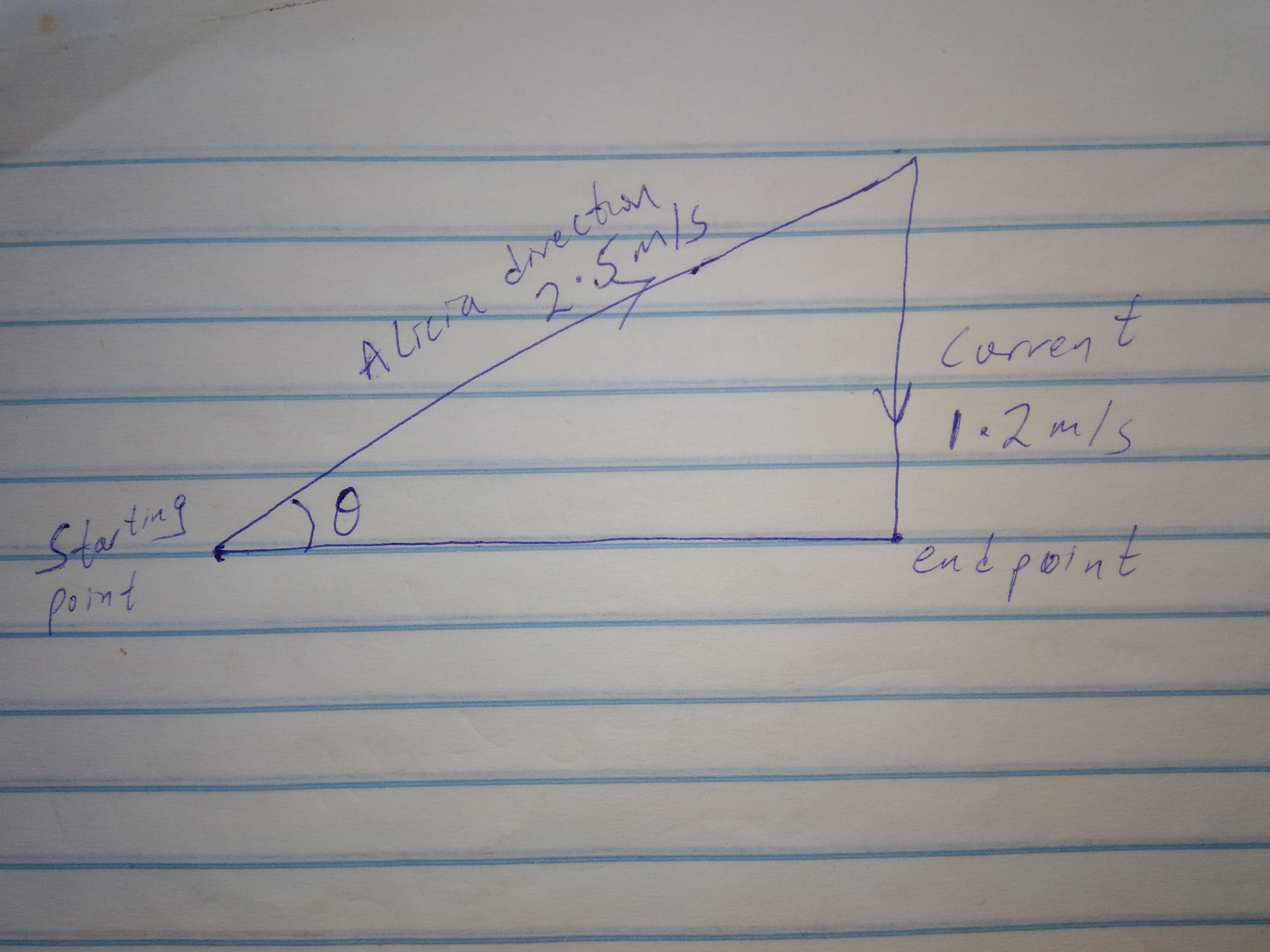
Alicia intends to swim to a point straight across a 100 m wide river with a current that flows at 1.2 m/s. She can swim 2.5 m/s
Sav [3153]

Answer:

θ = 61.3°

Alicia must swim at an angle of 61.3°

Explanation:

Parameters given include:

Width of the river = 100 m

Alicia's speed in still water = 2.5 m/s

Speed of river's current = 1.2 m/s

The angle she needs to swim can be determined by combining the velocities, taking into account the current's influence.

Her swimming speed aimed against the current must offset the current's velocity;

2.5cosθ - 1.2 = 0

2.5cosθ = 1.2

cosθ = 1.2/2.5

θ = cosinverse(1.2/2.5)

θ = 61.3°

4 0
1 month ago
James Cameron piloted a submersible craft to the bottom of the Challenger Deep, the deepest point on the ocean's floor, 11,000 m
serg [3582]

Answer:

4.1\cdot 10^8 N

Explanation:

To begin with, we must determine the pressure acting on the sphere, which is calculated using:

p=p_0 + \rho g h

where

p_0 =1.01\cdot 10^5 Pa denotes the atmospheric pressure

\rho = 1000 kg/m^3 represents the density of the water

g=9.8 m/s^2 signifies the acceleration due to gravity

h=11,000 m indicates the depth

By substituting these values,

p=1.01\cdot 10^5 Pa + (1000 kg/m^3)(9.8 m/s^2)(11,000 m)=1.08\cdot 10^8 Pa

The sphere's radius is calculated as r = d/2 = 1.1 m/2 = 0.55 m

Thus, the sphere's total surface area can be expressed as

A=4 \pi r^2 = 4 \pi (0.55 m)^2=3.8 m^2

Consequently, the inward force acting on the sphere equals

F=pA=(1.08\cdot 10^8 Pa)(3.8 m^2)=4.1\cdot 10^8 N

8 0
28 days ago
Read 2 more answers
Other questions:
  • A sheet of gold leaf has a thickness of 0.125 micrometer. A gold atom has a radius of 174pm. Approximately how many layers of at
    11·1 answer
  • A 620-g object traveling at 2.1 m/s collides head-on with a 320-g object traveling in the opposite direction at 3.8 m/s. If the
    8·2 answers
  • Pure sodium metal placed in water will spark and ignite, as well as form bubbles and gas. What are the signs that this is a chem
    15·2 answers
  • A convex mirror with a focal length of 0.25 m forms a 0.080 m tall image of an automobile at a distance of 0.24 m behind the mir
    7·2 answers
  • A projectile is launched from the ground with an initial velocity of 12ms at an angle of 30° above the horizontal. The projectil
    15·2 answers
  • A baseball player throws a ball straight up and catches it 3.0 s later. If the ball accelerates at 9.85 m/s2 down, at what veloc
    13·1 answer
  • The light waves have that particular interference from question #1 because they are emitted _____.
    9·2 answers
  • A 72.0-kg person pushes on a small doorknob with a force of 5.00 N perpendicular to the surface of the door. The doorknob is loc
    15·1 answer
  • An object with charge 4.3x10⁻⁵ C pushes another object 0.31 micrometers away with a force of 7 N. What is the total charge of th
    11·1 answer
  • A plane has an average air speed (this is the speed the plane moves through air) of 750 mph. The plane flies a route of 5000 mil
    14·1 answer
Add answer
Login
Not registered? Fast signup
Signup
Login Signup
Ask question!