answer.
Ask question
Login Signup
Ask question
All categories
  • English
  • Mathematics
  • Social Studies
  • Business
  • History
  • Health
  • Geography
  • Biology
  • Physics
  • Chemistry
  • Computers and Technology
  • Arts
  • World Languages
  • Spanish
  • French
  • German
  • Advanced Placement (AP)
  • SAT
  • Medicine
  • Law
  • Engineering
dusya
2 months ago
3

During an all-night cram session, a student heats up a one-half liter (0.50 x 10- 3 m3) glass (Pyrex) beaker of cold coffee. Ini

tially, the temperature is 18 °C, and the beaker is filled to the brim. A short time later when the student returns, the temperature has risen to 92 °C. The coefficient of volume expansion of coffee is the same as that of water. How much coffee (in cubic meters) has spilled out of the beak?
Physics
1 answer:
serg [3.5K]2 months ago
8 0

Answer:

ΔV_{c} = 7.415 10⁻⁶ m³   (7.415 10⁻³ L)

Explanation:

This problem seeks to calculate the change in volume of coffee and pyrex with the expression

                 ΔV = V₀ β ΔT

The coefficients for expansion are

Water Volumetry        β = 207 10⁻⁶ C⁻¹

Pyrex Linear                α = 3.2 10⁻⁶ C⁻¹

In general, for solids, the linear expansion coefficients are cited, but the volumetric coefficient is linked to

                  β = 3 α

Now, let’s compute the volume change for pyrex glass

                ΔV_{p} = V₀ 3α ΔT

                 ΔV_{p}= 0.50 10⁻³ 3 3.2 10⁻⁶ (92-18)

                ΔV_{p} = 3.552 10⁻⁷ m³

For the change in volume of coffee, which is equivalent to that of water

                ΔV_{w} = 0.50 10⁻³ 210 10⁻⁶ (92-18)

                ΔV_{w} = 7.77 10⁻⁶ m³

The spilled coffee amount represents the difference in the respective volumes

              ΔV_{c} =  ΔV_{w} -  ΔV_{p}

             ΔV_{c} = 7.77 10⁻⁶ - 3.552 10⁻⁷

              ΔV_{c} = 7.415 10⁻⁶ m³

To convert to liters

            ΔV_{c} = 7.415 10⁻⁶ m³ (1000 L / 1 m³)

             ΔV_{c} = 7.415 10⁻³ L

You might be interested in
If a 50.0-kg mass weighs 554 n on the planet saturn, calculate saturn’s radius
ValentinkaMS [3465]

Answer:

17.35 × 10^(-6) m

Explanation:

Mass; m = 50 kg

Weight; W = 554 N

From the formula:

W = mg

This simplifies to; 554 = 50g

g = 554/50

g = 11.08 m/s²

Also, using the formula;

mg = GMm/r²

hence; g = GM/r²

Rearranging gives;

r = √(GM/g)

With G as a known constant of 6.67 × 10^(-11) Nm²/kg²

r = √(6.67 × 10^(-11) × 50/11.08)

r = 17.35 × 10^(-6) m

8 0
1 month ago
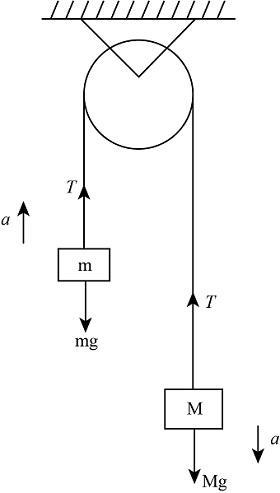
Two blocks are attached to opposite ends of a massless rope that goes over a massless, frictionless, stationary pulley. One of t
Softa [3030]

Answer:

1/7 kg

Explanation:

Refer to the attached diagram for enhanced clarity regarding the question.

One of the blocks weighs 1.0 kg and accelerates downward at 3/4g.

g denotes the acceleration due to gravity.

Let M represent the block with known mass, while 'm' signifies the mass of the other block and 'a' refers to the acceleration of body M.

Given M = 1.0 kg and a = 3/4g.

By applying Newton's second law; \sum fy = ma_y

For the body with mass m;

T - mg = ma... (1)

For the body with mass M;

Mg - T = Ma... (2)

Combining equations 1 and 2 gives;

+Mg -mg = ma + Ma

Ma-Mg = -mg-ma

M(a-g) = -m(a+g)

Substituting M = 1.0 kg and a = 3/4g into this equation leads to;

3/4 g-g = -m(3/4 g+g)

3/4 g-g = -m(7/4 g)

-g/4 = -m(7/4 g)

1/4 = 7m/4

Multiplying gives: 28m = 4

m = 1/7 kg

Hence, the mass of the other box is 1/7 kg

3 0
2 months ago
Calculate the critical angle between glass (n = 1.90) and ice (n = 1.31)? 43° 52° 60° 75°
Maru [3345]
According to Snell’s Law: Where: is the index of refraction of the first medium (glass), and is the index of refraction of the second medium (ice). The angle of incidence and the angle of refraction are represented by and. The refractive index quantifies the speed of light in a medium. The critical angle is identified as the angle at which total internal reflection occurs, meaning no light passes through into another medium. This phenomenon happens only when the light is transitioning from a medium with a higher index of refraction to one with a lower index of refraction.
4 0
1 month ago
Albert presses a book against a wall with his hand. As Albert gets tired, he exerts less force, but the book remains in the same
Maru [3345]

Answer:

the maximum static friction force of the wall acting on the book (Increasing)

the normal force of the wall acting on the book (Decreasing)

the weight of the book (Constant)

Explanation:

According to Newton's third law of motion:

"Every action has an equal and opposite reaction"

In the scenario provided, Albert is pressing the book against the wall and subsequently decreases the force applied against the wall.

Let's evaluate all forces influencing the book in this situation.

1. Weight of the book acting downwards (y-axis)

2. Friction from the book against the wall acting upwards (y-axis)

3. Albert’s force exerted on the book against the wall (x-axis)

4. Normal force of the wall reacting to Albert’s applied force (x-axis)

As Albert eases off his force, the new scenario reads:

1. The weight remains constant as represented by W = mg

Since neither mass nor gravitational acceleration has changed, the weight exerted on the book remains the same.

2. As Albert reduces his force, the wall’s normal reaction force decreases correspondingly, following Newton's third law of motion.

3. Friction operates in response to the force applied to it. With a box resting on the floor, no friction acts upon it until it is dragged, at which point friction begins to manifest and rise until it reaches its maximum. Therefore, when Albert diminishes his force, the weight's pull will influence the book and the maximum static friction will rise to resist the book’s downward movement.

It should be noted that the maximum static friction is working to prevent movement of the book. With Albert's force reduced, but the weight of the book unchanged, maximum static friction increases to prevent downward movement.

7 0
2 months ago
A (1.25+A) kg bowling ball is hung on a (2.50+B) m long rope. It is then pulled back until the rope makes an angle of (12.0+C)o
Ostrovityanka [3204]

Answer:

F = 0.535 N

Explanation:

We will apply energy concepts, considering both the peak and the bottom of the path.

Top

   Em₀ = U = mg y

Bottom

    Em_{f} = K = ½ m v²

    Emo =Em_{f}

    mg y = ½ m v²

    v = √ (2gy)

   y = L - L cos θ

  v = √ (2g L (1 - cos θ))

Next, we will employ Newton's second law at the lowest point where the acceleration is centripetal.

     F = ma

     a = v² / r

For the turning radius, the cable length is r = L.

    F = m 2g (1 - cos θ)

Now, let's find the result.

    F = 2  1.25  9.8 (1 - cos 12)

    F = 0.535 N


7 0
1 month ago
Other questions:
  • A hydraulic lift raises a 2000 kg automobile when a 500 N force is applied to the smaller piston. If the smaller piston has an a
    8·1 answer
  • Six pendulums of mass m and length L as shown are released from rest at the same angle (theta) from vertical. Rank the pendulums
    5·2 answers
  • During a snowball fight two balls with masses of 0.4 and 0.6 kg, respectively, are thrown in such a manner that they meet head-o
    7·1 answer
  • A student must design an experiment to determine the relationship between the mass of an object and the resulting acceleration w
    8·1 answer
  • The nardo ring is a circular test track for cars. it has a circumference of 12.5 km. cars travel around the track at a constant
    7·2 answers
  • No official standard exists for extinguisher-cylinder colors. that said, a red cylinder is typically associated with which type
    6·1 answer
  • Using evidence from the article, defend the concept that Earth’s magnetic poles have swapped places over time.
    10·1 answer
  • An end of a light wire rod is bent into a hoop of radius r. The straight part of the rod has length l; a ball of mass M is attac
    10·1 answer
  • A roller coaster of mass 2000 kg is rolling down a track with an instantaneous speed 10m/s what is kinetic energy in Joules
    6·1 answer
  • A thin insulating rod is bent into a semicircular arc of radius a, and a total electric charge Q is distributed uniformly along
    6·1 answer
Add answer
Login
Not registered? Fast signup
Signup
Login Signup
Ask question!