answer.
Ask question
Login Signup
Ask question
All categories
  • English
  • Mathematics
  • Social Studies
  • Business
  • History
  • Health
  • Geography
  • Biology
  • Physics
  • Chemistry
  • Computers and Technology
  • Arts
  • World Languages
  • Spanish
  • French
  • German
  • Advanced Placement (AP)
  • SAT
  • Medicine
  • Law
  • Engineering
victus00
9 days ago
8

A clever inventor has created a device that can launch water balloons with an initial speed of 85.0 m/s. Her goal is to pass a b

alloon through a small hoop mounted on the observation platform at the top of the Eiffel Tower, 276 m above the ground. If the balloon is to pass through the hoop at the peak of its flight, at what angle above horizontal should she launch the balloon? Please explain step by step

Physics
1 answer:
serg [1.1K]9 days ago
6 0

Answer:

She must launch the balloon at a 59.9° angle above the horizontal plane.

Explanation:

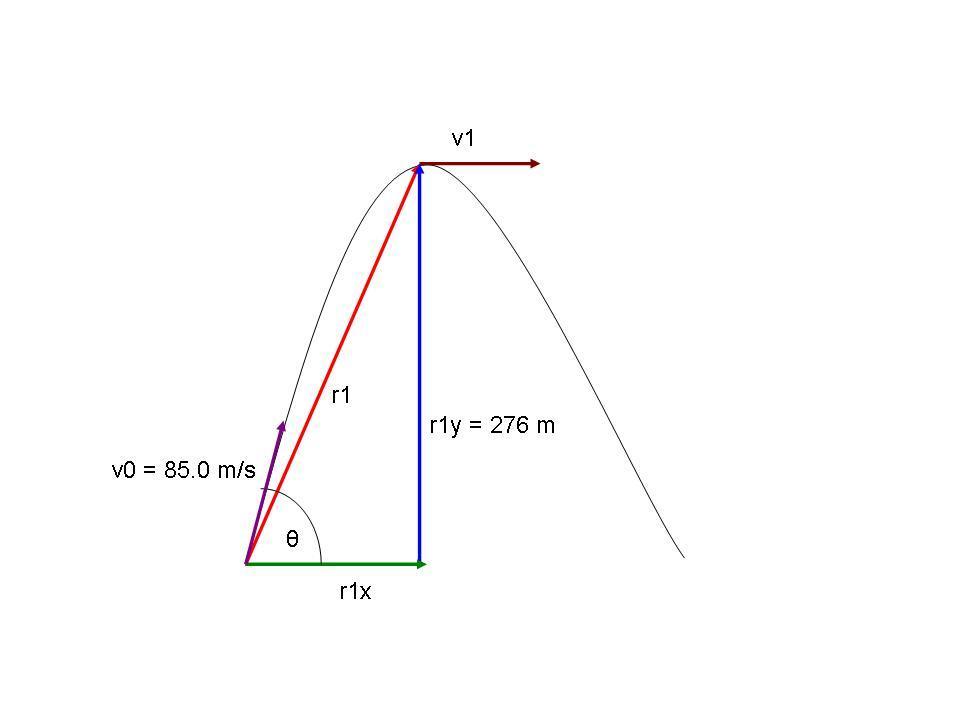
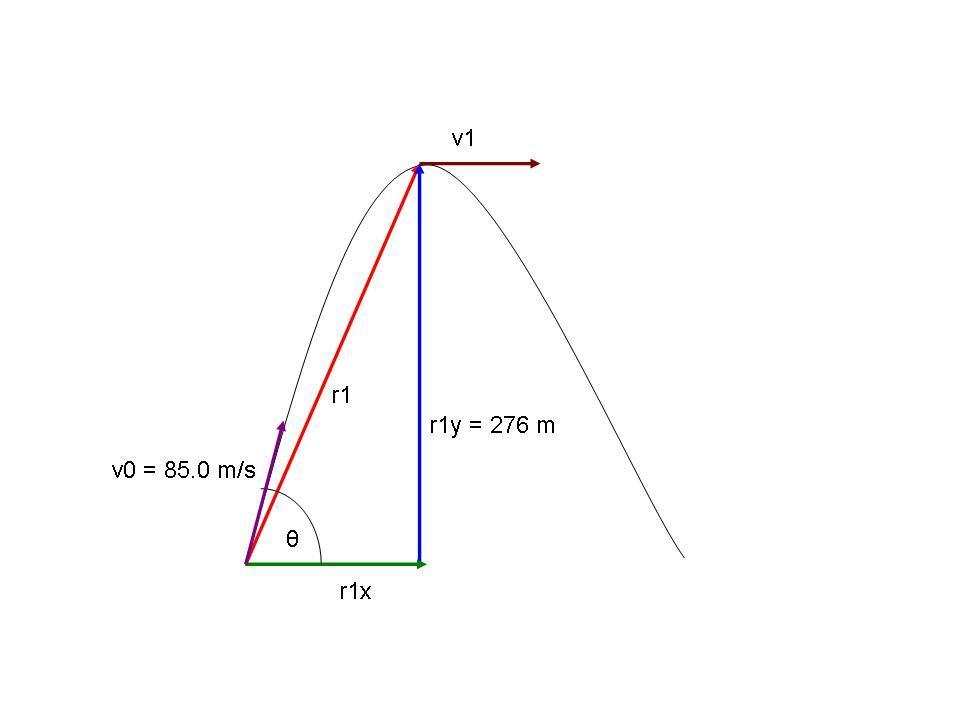
Refer to the accompanying diagram for a visual explanation of the scenario.

The position and velocity vectors of the balloon at time "t" can be computed using these formulas:

r = (x0 + v0 · t · cos θ, y0 + v0 · t · sin θ + 1/2 · g · t²)

v = (v0 · cos θ, v0 · sin θ + g · t)

Where:

r = position vector at time "t".

x0 = initial horizontal position.

v0 = initial velocity.

t = time.

θ = launch angle.

y0 = initial vertical position.

g = acceleration due to gravity (-9.81 m/s² if upward is treated as positive).

v = velocity vector at time "t".

We can establish the origin of the reference frame at the launch point, making x0 and y0 = 0.

At the maximum altitude (276 m), the balloon's velocity vector is horizontal (refer to v1 in the diagram). Thus, the y-component of the velocity vector is zero. We can express this using the velocity vector's y-component equation:

At maximum altitude:

vy = v0 · sin θ + g · t

0 = v0 · sin θ + g · t

Also, at maximum height, the y-component of the position vector is 276 m (see r1y in the diagram). Therefore:

At peak height:

y = y0 + v0 · t · sin θ + 1/2 · g · t²  

276 m = y0 + v0 · t · sin θ + 1/2 · g · t²

We have two equations involving two unknowns (θ and t):

276 m = y0 + v0 · t · sin θ + 1/2 · g · t²

0 = v0 · sin θ + g · t

To solve for the variables, we can rearrange the velocity equation for sin θ and substitute it back into the position equation to find t and eventually θ:

0 = v0 · sin θ + g · t

0 = 85.0 m/s · sin θ - 9.81 m/s² · t

9.81 m/s² · t / 85.0 m/s = sin θ

Now, substituting sin θ in the position equation:

276 m = y0 + v0 · t · sin θ + 1/2 · g · t²    (y0 = 0)

276 m = 85.0 m/s · t · (9.81 m/s² · t /85.0 m/s) - 1/2 · 9.81 m/s² · t²

276 m = 9.81 m/s² · t² - 1/2 · 9.81 m/s² · t²

276 m = 1/2 · 9.81 m/s² · t²

276 m / (1/2 · 9.81 m/s²) = t²

t = 7.50 s

With t known, we can find the angle θ using the previously derived formula:

9.81 m/s² · t / 85.0 m/s = sin θ

9.81 m/s² · 7.50 s / 85.0 m/s = sin θ

θ = 59.9°

She should launch the balloon at a 59.9° angle above the horizontal.
You might be interested in
Multiply the number 4.48E-8 by 5.2E-4 using Google. What is the correct answer in scientific notation?
Ostrovityanka [942]

Answer:

2.32\times 10^{-11}

Explanation:

The first number is 4.48\times 10^{-8}.

The second number is 5.2\times 10^{-4}.

We must multiply these two numbers together.

4.48\times 10^{-8}\times 5.2\times 10^{-4}=(4.48\times 5.2)\times 10^{(-8-4)}\\\\=23.296\times 10^{-12}

In scientific notation: 2.32\times 10^{-11}

Therefore, this is the solution you are looking for.

8 0
13 days ago
A delivery man starts at the post office, drives 40 km north, then 20 km west, then 60 km northeast, and finally 50 km north to
Yuliya22 [1153]


assuming north-south is along the Y-axis and east-west along the X-axis

X = total X-displacement

from the graph, total displacement in the X-direction is computed as

X = 0 - 20 + 60 Cos45 + 0

X = 42.42 - 20

X = 22.42 m


Y = total Y-displacement

from the graph, total displacement in the Y-direction is computed as

Y = 40 + 0 + 60 Sin45 + 50

Y = 90 + 42.42

Y = 132.42 m

To calculate the magnitude of the net displacement vector, we apply the Pythagorean theorem, yielding

magnitude: Sqrt(X² + Y²) = Sqrt(22.42² + 132.42²) = 134.31 m

Direction: tan⁻¹(Y/X) = tan⁻¹(132.42/22.42) = 80.4 deg north of east


4 0
6 days ago
A 75.0-kg person climbs stairs, gaining 2.50 meters in height. Find the work done to accomplish this task. 1.84 x 10³ J
Yuliya22 [1153]
<span>The work done corresponds to the potential energy that the person acquires while ascending the stairs.
work = potential energy acquired = mgh
W = 75kg * 9.8m/s² * 2.50m = 1837.5 J</span>
4 0
6 days ago
A crate with a mass of m = 450 kg rests on the horizontal deck of a ship. The coefficient of static friction between the crate a
Sav [1095]

Answer:F_{v} =\mu_{k} mg

The force required has a magnitude of 2601.9 N

Explanation:

m = 450 kg

Static friction coefficient μs = 0.73

Kinetic friction coefficient μk = 0.59

The force necessary to initiate movement of the crate is F_{s} =\mu_{s} mg.

Once the crate begins to move, the frictional force decreases to F_{v} =\mu_{k} mg.

To maintain the motion of the crate at a steady velocity, we must lower the pushing force to F_{v} =\mu_{k} mg.

Subsequently, the pushing force aligns with the frictional force stemming from kinetic friction, enabling balanced forces and consistent velocity.

<pMagnitude of the force

F_{v} =\mu_{k} mg\\F_{v} =0.59 \times 450 \times 9.8\\F_{v} =2601.9 N

4 0
6 days ago
Two charges of 15 pC and −40 pC are inside a cube with sides that are of 0.40-m length. Determine the net electric flux through
Keith_Richards [1021]

To address this issue, we will utilize the principles related to Gauss' law, which states that the electric flux across a surface corresponds to the object's charge divided by the permittivity of vacuum. In mathematical terms, this can be expressed as

\phi = \frac{Q_{net}}{\epsilon_0}

It's crucial to remember that the net charge equals the difference between the two specified charges, so upon substitution,

\phi = \frac{(15-40)*10^{-12}C}{8.85*10^{-12}C^2/Nm^2}

\phi = 2.82WB

The negative sign indicates that the flux is directed into the surface

4 0
5 days ago
Other questions:
  • An object is released from rest near and above Earth’s surface from a distance of 10m. After applying the appropriate kinematic
    8·1 answer
  • The spring in a retractable ballpoint pen is 1.8 cm long, with a 300 N/m spring constant. When the pen is retracted, the spring
    6·2 answers
  • A semi is traveling down the highway at a velocity of v = 26 m/s. The driver observes a wreck ahead, locks his brakes, and begin
    15·1 answer
  • In this problem you are to consider an adiabaticexpansion of an ideal diatomic gas, which means that the gas expands with no add
    6·1 answer
  • When a mass of 25 g is attached to a certain spring, it makes 20 complete vibrations in 4.0 s. what is the spring constant of th
    14·2 answers
  • A steel casting weighing 2 kg has an initial temperature of 500°c; 25 kg of water initially at 25°c is contained in a perfectly
    12·2 answers
  • Jack pulls a sled across a level field by exerting a force of 110 n at an angle of 30 with the ground. what are the parallel and
    7·2 answers
  • Over a period of more than 30 years, albert klein of california drove 2.5 × 10⁶ km in one automobile. consider two charges, q1 =
    5·1 answer
  • Two balls of unequal mass are hung from two springs that are not identical. The springs stretch the same distance as the two sys
    12·1 answer
  • Suppose you analyze standardized test results for a country and discover almost identical distributions of physics scores for fe
    6·1 answer
Add answer
Login
Not registered? Fast signup
Signup
Login Signup
Ask question!