answer.
Ask question
Login Signup
Ask question
All categories
  • English
  • Mathematics
  • Social Studies
  • Business
  • History
  • Health
  • Geography
  • Biology
  • Physics
  • Chemistry
  • Computers and Technology
  • Arts
  • World Languages
  • Spanish
  • French
  • German
  • Advanced Placement (AP)
  • SAT
  • Medicine
  • Law
  • Engineering
lana66690
3 months ago
5

A rocket in deep space has an exhaust-gas speed of 2000 m/s. When the rocket is fully loaded, the mass of the fuel is five times

the mass of the empty rocket. Part A What is the rocket's speed when half the fuel has been burned?
Physics
1 answer:
Sav [3.1K]3 months ago
3 0

Answer:

 v_{f} = 1,386 m / s

Explanation:

The mechanism behind rocket propulsion is defined by the formula

       v_{f} - v₀ =  v_{r} ln (M₀ / Mf)

Here, v refers to the initial, final, and relative velocities, while M indicates the masses

The provided values include the relative velocity (see = 2000 m / s) and the initial mass, where the mass of the rocket when loaded is represented as (M₀ = 5Mf)

For our analysis, we assume the rocket begins at rest (v₀ = 0)

Once half of the fuel has burnt, the mass ratio indicates that the current mass is    

       M = 2.5 Mf

       v_{f} - 0 = 2000 ln (5Mf / 2.5 Mf) = 2000 ln 2

       v_{f} = 1,386 m / s

You might be interested in
A farmer is using a rope and pulley to lift a bucket of water from the bottom of a well. the farmer uses a force f1=57.5 n to pu
inna [3103]
The initial problem cannot be resolved due to the absence of the distance or the length of the rope since work is defined as distance multiplied by force. I can only address the second problem. As the bucket ascends, the gravitational force acts downward, leading to the net force being:
Fnet = F1 - Fg
Here Fg = mg
g is the acceleration due to gravity ( 9.81 m/s^2)
Fnet = 57.5 N - (3.9 kg)(9.81) N
Fnet = 19.24 N
4 0
3 months ago
The drawing shows the top view of a door that is 1.68 m wide. two forces are applied to the door as indicated. what is the magni
ValentinkaMS [3465]
Initially, torque is defined as the product of force and distance. For the first force applied, the torque becomes zero since it acts at the hinge. Hence, the net torque is given by:
t = ( 12 N ) ( 0 m ) ( cos 30 ) + ( 12 N ) ( 1.68 m ) cos 45
t = 14.26 Nm represents the torque concerning the hinge
8 0
3 months ago
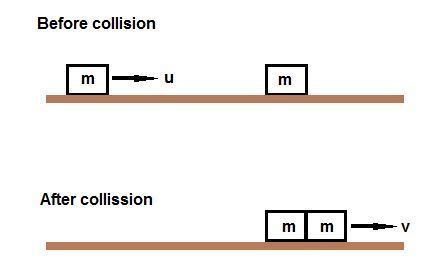
An air-track glider undergoes a perfectly inelastic collision with an identical glider that is initially at rest. what fraction
Yuliya22 [3333]
Please consult the diagram below.

Initially, the system's kinetic energy (KE) is
KE₁ = (1/2)mu²

After the inelastic collision, both masses merge together.
Momentum conservation states that
m*u = 2m*v
Thus,
v = u/2

The final KE is
KE₂ = (1/2)(2m)v²
= m(u/2)²
= (1/4)mu²
= (1/2) KE₁

The reduction in KE is
KE₁ - KE₂ = (1/2) KE₁.

Energy conservation implies that the reduction in KE must be considered as thermal energy.

Result: 1/2

5 0
3 months ago
Read 2 more answers
In March 2006, two small satellites were discovered orbiting Pluto, one at a distance of 48,000 km and the other at 64,000 km. P
inna [3103]

Answer:

The period for the first satellites is 24.46 days, while the second satellites have a period of 37.67 days

Explanation:

Provided:

Distance of the first satellites r_{sat1} = 48000 \times 10^{3} m

Distance of the second satellites r _{sat2} = 64000 \times 10^{3} m

Distance of Charon r_{c} = 19600 \times 10^{3} m

Orbit period of Charon T_{c} = 6.39 days

According to Kepler's third law,

the square of the orbital period correlates to the cube of the semi-major axis.

T^{2} = r^{3}

\frac{T}{r^{\frac{3}{2} } } = constant

For the first satellites,

\frac{T_{c} }{r_{c} ^{\frac{3}{2} } } = \frac{T_{sat1} }{r_{sat1} ^{\frac{3}{2} } }

{T_{sat1} } = 6.39 \times \frac{(48000 \times 10^{3} )^{\frac{3}{2} } }{(19600\times 10^{3} )^{\frac{3}{2} }}

T_{sat1} = 24.46 days

For the second satellites,

\frac{T_{c} }{r_{c} ^{\frac{3}{2} } } = \frac{T_{sat2} }{r_{sat2} ^{\frac{3}{2} } }

{T_{sat2} } = 6.39 \times \frac{(64000 \times 10^{3} )^{\frac{3}{2} } }{(19600\times 10^{3} )^{\frac{3}{2} }}

T_{sat2} = 37.67 days

Thus, the orbital period for the first satellites is 24.46 days and for the second satellites, it is 37.67 days


8 0
2 months ago
Other questions:
  • Two charges of 15 pC and −40 pC are inside a cube with sides that are of 0.40-m length. Determine the net electric flux through
    12·1 answer
  • A clock has an hour hand of length 2.4 cm and a minute hand of length 3.8 cm. (a) Calculate the position and velocity of the hou
    15·1 answer
  • (a) A 15.0 kg block is released from rest at point A in the figure below. The track is frictionless except for the portion betwe
    12·1 answer
  • Mickey, a daredevil mouse of mass m , m, is attempting to become the world's first "mouse cannonball." He is loaded into a sprin
    7·2 answers
  • Priscilla is driving her car on a busy street and Harvey passes her on his motorcycle. What will happen to the sound from his mo
    8·2 answers
  • Caroline, a piano tuner, suspects that a piano's B4 key is out of tune. Normally, she would play the key along with her B4 tunin
    7·1 answer
  • Write a hypothesis for Part II of the lab, which is about the relationship described by F = ma. In the lab, you will use a toy c
    14·2 answers
  • 78. A particle moves along the x- axis. The velocity of the particle at time tis given by 4vt()=3 t +1 . If the position of the
    7·1 answer
  • While riding a multispeed bicycle, the rider can select the radius of the rear sprocket that is fixed to the rear axle. The fron
    7·1 answer
  • A typical cell phone charger is rated to transfer a maximum of 1.0 Coulomb of charge per second. Calculate the maximum number of
    11·1 answer
Add answer
Login
Not registered? Fast signup
Signup
Login Signup
Ask question!