answer.
Ask question
Login Signup
Ask question
All categories
  • English
  • Mathematics
  • Social Studies
  • Business
  • History
  • Health
  • Geography
  • Biology
  • Physics
  • Chemistry
  • Computers and Technology
  • Arts
  • World Languages
  • Spanish
  • French
  • German
  • Advanced Placement (AP)
  • SAT
  • Medicine
  • Law
  • Engineering
Stells
1 month ago
13

Yesinia read that certain perfume ingredients, called esters, would agitate bees. Because perfume formulas are secret, she decid

ed to determine whether the unknown Ester X was present in four different perfumes by observing the bees’ behavior. She placed a saucer containing 10 mL of the first perfume 3 meters from the beehive. She recorded the time required for the bees to emerge and made observations on their behavior. After a 30-minute recover period, she tested the second, third and four perfumes. All experiments were conducted on the same day when the weather conditions were similar, that is, air temperature and wind. What was the hypothesis? What would be the control group? What is the experimental group? What was deliberately changed? What responded to the change?
Chemistry
1 answer:
castortr0y [3K]1 month ago
6 0

Answer:

Hypothesis: IF the perfumes include Ester "X", THEN the bees would react aggressively

Control group: This group consists of bees that were not subjected to any perfume application

Experimental group: Bees that were subjected to various perfumes

Independent variable: The kinds of perfumes used

Dependent variable: the bees' behavior

Explanation:

A hypothesis acts as a testable proposition or proposed answer to an issue, which can be validated or refuted through experimentation. The hypothesis for this study is: IF the perfumes include Ester "X", THEN the bees would react aggressively

The control group in an experiment is the segment that does not undergo the experimental treatment or within which the independent variable remains unchanged. Here, although not explicitly stated, the control group could be the BEES THAT WEREN'T EXPOSED TO ANY PERFUME.

On the other hand, the experimental group receives experimental treatment. In this instance, it includes the bees that were exposed to the various types of perfumes.

The independent variable is intentionally modified by the experimenter. In this context, it refers to the TYPE OF PERFUME administered to the bees.

The dependent variable represents what changes in response to the independent variable. The behavior of the bees serves as this measured variable.

You might be interested in
An -ateor -iteat the end of a compound name usually indicates that the compound contains _____.
Tems11 [2777]
A compound signifies a substance comprised of two or more elements that have undergone a chemical combination. A polyatomic ion, often referred to as a molecular ion, represents a charged particle formed from two or more atoms. An example would be the nitrate ion (NO3-), which consists of one nitrogen atom and three oxygen atoms covalently bonded, acting as a single charged entity. Thus, the apt term would be a polyatomic ion or a molecular ion.
8 0
2 months ago
Read 2 more answers
An infant acetaminophen suspension contains 80 mg/0.80 mL suspension. The recommended dose is 15 mg/kg body weight.
KiRa [2933]

Response:

0.8853 mL

Clarification:

Initially, we convert 13 lb to kg, remembering that 1 lb = 0.454 kg:

  • 13 lb * \frac{0.454kg}{1lb} = 5.902 kg

Next, we determine the required mg of acetaminophen to administer, applying the recommended dosage and infant's weight:

  • 15 mg/kg * 5.902 kg = 88.53 mg

Finally, we compute the necessary mL of suspension, utilizing its concentration:

  • 88.53 mg ÷ (80 mg/0.80 mL) = 0.8853 mL
8 0
2 months ago
Barbiturates, including "truth serums" seen in movies like Meet the Fockers and sedatives that may have led to the untimely deat
Alekssandra [3086]

Answer:

Explanation:

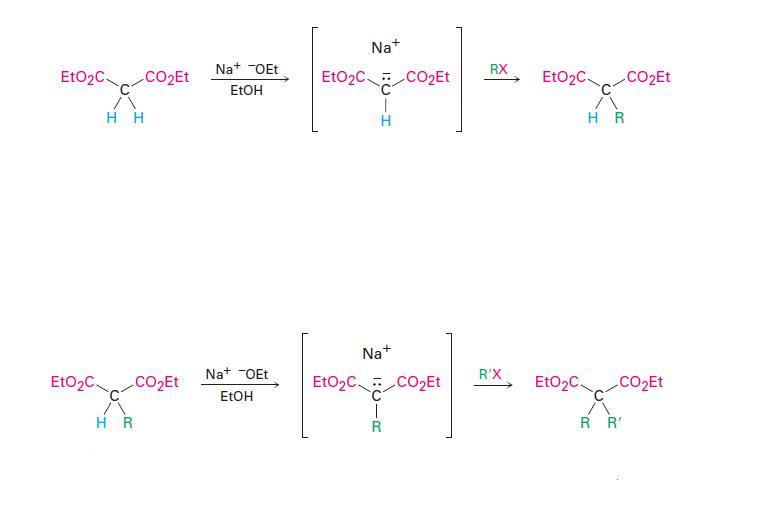
Diethyl malonate possesses greater acidity compared to monocarbonyl substances (pKa=13) because its alpha hydrogens are linked to two carbonyl groups. Consequently, the malonic ester can be readily changed into its enolate ion by reacting it with sodium ethoxide in ethanol. When the malonic ester undergoes alkylation, a hydrogen atom in the alpha position becomes acidic, permitting another round of alkylation to yield a dialkylated malonic ester.

In this scenario, when diethyl malonate interacts with urea in the presence of sodium ethoxide base, the second alkylation step occurs within the molecule, producing a cyclic compound known as barbituric acid.

8 0
2 months ago
Freon-11, CCl3F has been commonly used in air conditioners. It has a molar mass of 137.35 g/mol and its enthalpy of vaporization
alisha [2963]

Answer:

180.56 kilojoules of heat energy is extracted when 1.00 kg of freon-11 evaporates.

Explanation:

The molar mass of freon-11 is 137.35 g/mol

The enthalpy of vaporization for freon-11 is 24.8 kJ/mol at its normal boiling point of 24°C. Given that,\Delta H_{vap}=24.8 kJ/mol

Mass of freon-11 evaporated = 1.00 kg = 1000 g

Moles of freon-11 evaporated can be calculated as

\frac{1000 g}{137.35 g/mol}=7.2807 mol

The energy removed in the form of heat when 1.00 kg of freon-11 vaporizes is:

7.28067 mol\times \Delta H_{vap}=7.2807 mol\times 24.8 kJ/mol

=180.56 kJ

0 0
1 month ago
he population of the Earth is roughly eight billion people. If all free electrons contained in this extension cord are evenly sp
eduard [2782]

1) Drift velocity: 3.32\cdot 10^{-4}m/s

2. 5.6\cdot 10^{13} electrons per individual

Explanation:

1)

In a conducting material with an electric current, the drift velocity of electrons can be calculated using this equation:

v_d=\frac{I}{neA}

where

I stands for current

n represents the density of free electrons

e=1.6\cdot 10^{-19}C indicates the charge of an electron

A signifies the wire's cross-sectional area

The wire's cross-sectional area can be determined as

A=\pi r^2

where r denotes the wire's radius. Thus, the equation transforms to

v_d=\frac{I}{ne\pi r^2}

In this scenario, we have:

I = 8.0 A as the current

8.5\cdot 10^{28} m^{-3} indicates the free electron concentration

d = 1.5 mm is the diameter, making the radius

r = 1.5/2 = 0.75 mm = 0.75\cdot 10^{-3}m

So, the resulting drift velocity is:

v_d=\frac{8.0}{(8.5\cdot 10^{28})(1.6\cdot 10^{-19})\pi(0.75\cdot 10^{-3})^2}=3.32\cdot 10^{-4}m/s

2)

The entire length of the cord is

L = 3.00 m

And the cross-sectional area is

A=\pi r^2=\pi (0.75\cdot 10^{-3})^2=1.77\cdot 10^{-6} m^2

Consequently, the volume of the cord is

V=AL (1)

The number of electrons per unit volume is n, thus the total electrons in this cord would be

N=nV=nAL=(8.5\cdot 10^{28})(1.77\cdot 10^{-6})(3.0)=4.5\cdot 10^{23}

Overall, the Earth's population rounds to 8 billion individuals, equating to

N'=8\cdot 10^9

Hence, the number of electrons distributed to each person is:

N_e = \frac{N}{N'}=\frac{4.5\cdot 10^{23}}{8\cdot 10^9}=5.6\cdot 10^{13}

7 0
2 months ago
Other questions:
  • Leonard adds 5 grams of sugar to 1 liter of water to make one sugar solution. Then he adds 10 grams of sugar to 1 liter of water
    9·1 answer
  • A student places a small amount of water in a glass dish and then carefully places a small paperclip on the surface of the water
    8·2 answers
  • Exactly 500 grams of ice are melted at a temperature of 32°f. (lice = 333 j/g.) calculate the change in entropy (in j/k). (give
    5·1 answer
  • Arbon dioxide is dissolved in blood (ph 7.5) to form a mixture of carbonic acid and bicarbonate. Part a neglecting free co2, wha
    9·2 answers
  • Using this information together with the standard enthalpies of formation of O2(g), CO2(g), and H2O(l) from Appendix C, calculat
    12·1 answer
  • Which are chemical processes? (1 rusting of a nail, 2 freezing of water, 3 decomposition of water into hydrogen and oxygen gases
    11·1 answer
  • (1.) 163.26 g/mol, C11H17N
    11·1 answer
  • Limes have a [H3O+] of 1.3 x 10⁻² mol/L. Their pOH is​
    12·1 answer
  • How much water must be added to 36.0 g of srcl2 to produce a solution that is 35.0 wt% srcl2? how much water must be added to 36
    14·1 answer
  • A gas of 190 mL at a pressure of 74 atm can be expected to change its pressure when its volume changes to 30.0 mL. Express its n
    15·2 answers
Add answer
Login
Not registered? Fast signup
Signup
Login Signup
Ask question!